Wedding Events
Wedding Processional Songs: How the Cue, Length and Arrangement Work Live
Dylan Galvin is a live events performer who has performed across the United States since 2009, now based in the DMV (Washington DC, Maryland, and Virginia), more than 1,500 events. Mentored by music legends John Mayer, Paul Simon and Livingston Taylor.
At the weddings I have played, the song chosen for the bride's walk has never once been played to the end. A full-length song would keep her at the aisle for about three minutes, and a bride's walk comes nowhere near that. That makes the song's length the wrong thing to shop for. The part the aisle uses is what to choose.
This page is for the person choosing the ceremony music, whether a couple or a planner doing it for them. Planning guides use "processional" for the whole aisle sequence, so "wedding processional songs" can mean the music for any of it. A ceremony plan splits it into three moments: the wedding party's walk, the bride's walk and the exit (the recessional).
The song and the walk run on different clocks, and three decisions settle most of it: which part of the song the room will hear, how that part is arranged, and who gives the cue. The mechanics below come from my own ceremonies as a solo guitarist. Other instruments solve the same problems differently, and the questions near the end work for any act. The order of who walks varies by tradition and ceremony, and wedding guides such as Junebug Weddings and Minted cover the common versions.
Choose Three Songs for Three Moments
A ceremony needs a song for each of three moments: the wedding party's walk, the bride's walk and the exit. I always plan three separate songs with every couple and treat it as non-negotiable, because a specific song has to be chosen for each one.
A wedding day has four sections: pre-ceremony, ceremony, cocktail hour and reception. The sections are fairly standard from one wedding to the next, and the timing inside them changes every time. The wedding music page covers the other parts of the day, the guide to choosing a ceremony musician lists the ceremony moments from the pre-ceremony music to the recessional, and the wedding ceremony order of events with the music cues shows where each song falls and who cues it.
At least one planning call asked for one song for the wedding party, one for the bride and one for the recessional.
Expect the Walk to End Before the Song Does
The song for the bride's walk can be any length, because the aisle uses only the first part of it. The useful question is which part of the song the room will hear.
By my estimate, the bride's walk takes 20 seconds to a minute and almost never longer, and a wedding party's walk usually takes 20 to 50 seconds. In my last 10 ceremonies the shortest was 20 seconds, with one bridesmaid, and the longest was about two and a half minutes, with about eight people walking slowly through a very long area. For the bride's walk, usually only the intro and the first verse get played, sometimes the chorus.
Several things set the length. A bride's walk depends on how far the walkway runs and how nervous or energetic she is, and often someone walks beside her, holding her dress or guiding her so she stays on pace. A wedding party's walk depends on how many people are in it, how slowly they walk and the distance from the start to the altar. People tend to walk faster when they are nervous. Some planners coach a party to walk very slowly to offset that, and a party can overdo it.

For a couple choosing music, the choice follows from this. Pick the song for its opening and first verse. If one part of a song matters to you, tell the musician which part, since the aisle will use only a small section of it.
What I Do When the Walk Doesn't Match the Song
At one ceremony, the wedding party's walk ran about two and a half minutes. The party walked on the slower side, and the path from the entrance to the altar was exceptionally long. I arranged the piece in real time to cover the extra time, and no one in the room could tell. A musician who can only play the rehearsed version of a song would have run out of music partway through, and the ceremony would have had silence in the middle of it.
The method behind that is to treat a song as sections and know how to extend each one in the smallest increments that make musical sense. The tempo holds. What changes is how much of the song gets played, so a section ends when the walk does. A musician used to playing a song as written will struggle here. Starting the next section with only five seconds left chops the song off in the middle, and the music then arrives late for the next moment. Ending early leaves silence. Ceremony timing has no fixed formula, because nobody can know how long a walk will take until it happens.
The same skill covers a late bride. When she is not at the door as the music should start, I note the key of the song planned for the walk. I then make up a chord progression that sounds similar to it, and repeat and build on that progression as an ambient intro until she appears.
I rehearse a song by cutting it into sections and rearranging them at random in real time: the verse twice, the chorus twice, the chorus first and then the verse, the intro after the verse. That way any change on the day is covered, and the rendition is ready for whatever happens. A song rehearsed only from start to finish tends to throw the performer off when something changes.
The Cue and the Handoff From the Wedding Party's Song to the Bride's
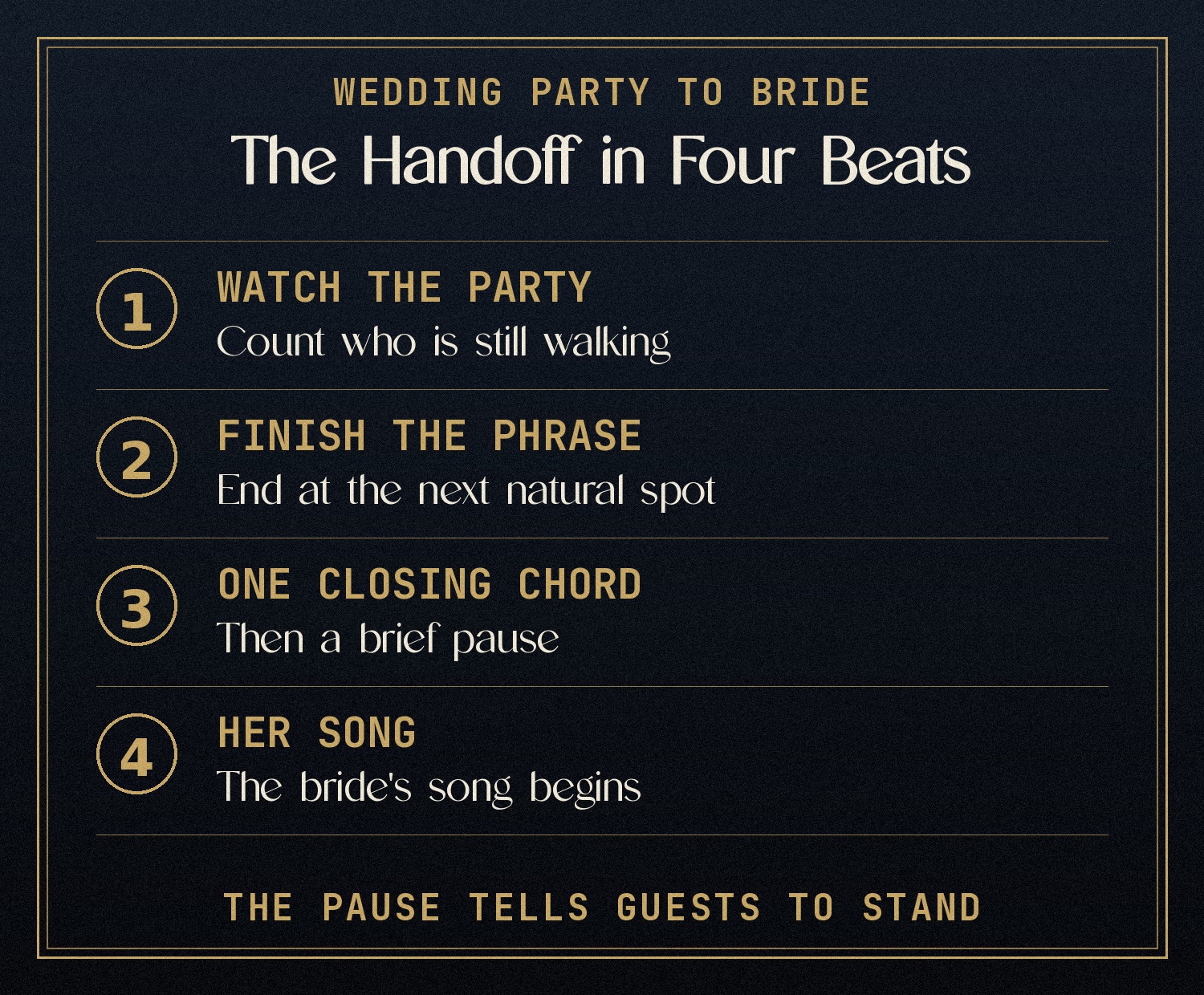
When the bride reaches the door or the spot for the cue, I look at the wedding party and count how many people are still walking. The arrangement then ends at the next natural spot in the song, without chopping it up. If the wedding party's song is two-thirds of the way through the chorus when she arrives, I finish the chorus and play one chord to show the song is over. A brief pause follows, so everyone knows a change is coming. Then the bride's song begins.
The pause doubles as the signal for guests to stand. Sometimes the officiant notices first and tells the guests to stand. Usually I notice the bride first.
The first thing I watch for is the signal from the coordinator. The cue usually comes from the day-of coordinator or the coordinator's assistant. It does not come from the couple, because that burden does not belong to them. The officiant rarely gives the cue. A coordinator standing behind a corner, with no line of sight to the musician, sometimes signals through an assistant with a walkie-talkie, or tells the officiant when to look at me.
Pick a coordinator who is intuitive and socially aware, one who will not confuse a look with the cue. Clear communication between the planner and the musician before the wedding is probably the most important part of the whole arrangement.
What a Pop Song Becomes at the Aisle
The usual advice for a walk-in song is to pick something that is not too fast or too slow, followed by a few examples. That advice holds up. What it leaves out is that almost any song can be arranged to fit. An up-tempo song does not have to be passed over, because a slow, romantic version of it can have a beautiful effect. An acoustic rendition of "Mr. Brightside" by The Killers, arranged slow, can fit a wedding ceremony.
So the filter belongs on the arrangement. A fast arrangement encourages people to walk faster than they should, which can throw off the timing of the wedding party. A slow to medium tempo helps the bride and the party hold the right pace, so nobody scampers to the altar. High energy is usually out of place at this point of the day, though it works at other points. An acoustic instrumental arrangement also keeps the performance from pulling attention away from the walk.
Instrumental is the default for the bride's walk. The song is usually a custom arrangement worked out for that bride. Live vocals pull attention toward the performer, and attention belongs on the bride during her walk. A little more than half of the brides I work with already want an instrumental version, and I explain the effect of live vocals to the rest.
The instrument shapes what can change on the day. A string quartet is several players who usually read sheet music, and rearranging a song in real time takes a band director or some signal between the players. A pianist or harpist can change an arrangement on the day too, but sits in one place. A wireless guitar can step aside when the photographer needs the space.
Songs I name for the aisle are not counted and not a ranking. They include "Can't Help Falling in Love" by Elvis Presley (in my experience the most common choice for the bride's walk) and "A Thousand Years" by Christina Perri (popular with brides for how emotionally weighty it sounds). Pachelbel's "Canon" and "For the Longest Time" by Billy Joel also work. Acoustic arrangements of Taylor Swift songs come up too, and the specific song changes from bride to bride. "Here Comes the Sun" by The Beatles shows up more often as an exit song, and it has also worked for me as a welcome song into the reception and as a walk. A longer list of acoustic guitar songs for a wedding ceremony is sorted by moment.
Live or Recording for the Aisle: One Rule
The choice between a live performance and a recording depends first on the taste of the couple. After taste, two situations favor a recording.
The first is a walker who is extra nervous and wants the exact version of the song they know. A nervous walker can latch onto a perfectly familiar recording, with no live element depending on them, and familiar things tend to be more comfortable than new ones. Most walkers are not that nervous, so this fits a minority.
The second is a wedding only days away. A new song cannot be learned and rehearsed in that time, and a strong, comfortable performance beats a shaky, unprepared one.
Live is the better call when the length of the walk is unpredictable. A recording has a fixed length. When the walk and the recording do not match, a fade is the practical adjustment, because stretching a recording far enough to cover a long walk changes how it sounds, and the room hears it. A live musician can extend a section to fit.
Venue and Vendor Rules That Change the Plan
One large botanical garden where I performed had extremely strict noise rules. A manager came out with a decibel meter to check that none of the music went over a set volume. At the garden, the rules changed the volume and left the song selection alone. I set the speaker volume very carefully and did not raise it at all during the ceremony.
Very few venues tell you what songs you can and cannot play, and songs with vulgarity or profanity are generally not accepted. Some old traditional churches may require instrumental hymns or organ music, and those restrictions are usually set before the musician is involved. A noise ordinance can set the volume limit before the venue does, and live wedding music in Old Town Alexandria covers one. Sound, power and AV for live music covers the equipment side.
Vendor insurance can stop a performance outright. Make sure each vendor has a copy of its insurance, and ask whether it can name the venue as additional insured, a question the ceremony musician guide lists. Some venues require it, you may not find out until the day of, and a vendor without it cannot perform, whatever music was chosen.
Three questions to put to the venue first, drawn from those three cases:
- Is there a volume limit, and will anyone measure it?
- Does the venue or the officiant limit the type of music, such as hymns or organ?
- Do vendors need to show proof of insurance, and by when?
What to Send the Musician and What to Ask
Send the musician:
- One song for each of the three moments, and the part of each song that matters to you, if one does.
- The song, the version and the artist, because different songs share the same title. Nothing is worse than getting ready to walk down the aisle and hearing a song that is not the one you discussed.
- The name of the person who gives the cue.
Ask the musician:
- Whether you can hear a short clip of the arrangement.
- How the act prepares for a walk that runs short or long, and how it ends a song on cue. The guide to choosing a ceremony musician already asks about pacing for a processional that runs long or short, so add how the act ends the song.
- How many weeks the act needs for a song it must learn.
FAQ: Wedding Processional Songs
What if there is no coordinator to give the cue?
I follow the wedding party and the bride. Some weddings have started with the party and the bride moving before anyone signaled, and some wedding parties are less organized than others. When the group stops following the cue, I follow the group, use best judgment as the walk begins, and keep the music going without a seam.
Can the bride walk to a song with lyrics?
Yes. A bride who loves the recorded version of a song can have that recording, and I play it for her walk. When I play her walk live, it is an instrumental arrangement.
How early does the processional song have to be chosen?
For me, a new song takes a few weeks to learn, arrange for fingerstyle guitar and rehearse until it is polished. The wedding song requests guide covers how many new songs a performer will learn and the short-notice floor.
Choose the Section of the Song the Walk Will Use
For the walk down the aisle, keep the music instrumental and slow to medium in pace, whatever song you pick. Then ask the musician which part of the song the bride's walk will use.
Quick Recap
- Choose three songs, one each for the wedding party, the bride and the exit. Most songs run past the bride's walk, so the opening and first verse are what the room hears.
- A musician who can rearrange sections on the spot covers a long walk, and an ambient intro covers a late bride.
- One chord and a pause tell the guests to stand. One named person should give the cue.
- Almost any song can become a slow to mid-tempo instrumental arrangement.
- Taste decides live or recorded first. A recording suits a nervous walker or a wedding only days away, and live suits a walk of unpredictable length.
- Check the venue's rules on volume, music and insurance before the day, and name the exact version and artist for each song you send.
Questions about music for your own event? The contact page is here.
Latest Blogs