Wedding Events
Wedding Song Requests With Live Music: Who Decides What Gets Played
Dylan Galvin is a live events performer who has played across the United States since 2009 and is now based in the DMV (Washington DC, Maryland, and Virginia), with more than 1,500 events performed. Mentored by music legends John Mayer, Paul Simon and Livingston Taylor.
At one Pennsylvania wedding, the songs that cleared the dance floor came from the bride's own list. I let it go, because it was her wedding.
If you are getting married, or you are a guest hoping to hear a particular song, wedding song requests come down to three questions for the musician or DJ: who has the final say, what the performer is able to play, and what gets sent ahead of time. I play live and I also offer some light DJ services, and the answers here come from both. Where another act or a DJ works differently, ask. For the engagement-party version of this topic, see the guide to engagement party songs.
Ask What Happens to a Song the Performer Doesn't Know
Before you book any musician or DJ, ask what happens when a guest requests a song they do not play. The answer depends on the format.
A DJ can reach nearly any song on the internet, so the limits on a request are time and the couple's wishes: is there room in the night for it, and did the couple ask not to hear it. A live musician has a third limit, which is repertoire. A live performer can only play what is already in it. I play live and also offer some light DJ services, and a live act fields fewer requests than a DJ for that reason. If you are choosing between the two, the live versus DJ comparison covers the wider differences, and the wedding music page describes the formats.
When a guest asks me for a song I do not know, I work through three steps in order. Ask your act for its own order.
- I play another song by the same artist.
- If that does not fit, I name a few similar songs and let the guest choose one.
- If neither works, I put the song on the playlist that plays during my break and play it from there.
At a micro wedding in Yosemite, the mother of the bride asked for a James Taylor ballad. I did not have one, so I played a few slow acoustic instrumentals to match the mood.

Plan for Wedding Song Requests at the Reception, Fewer at Cocktail Hour
Plan your request rules for the reception, because that is when guests ask. In my experience, a guest asks for a song during roughly 4 in 10 cocktail hours and roughly 9 in 10 receptions.
Ceremony music is chosen in advance, so requests do not come up there, and the ceremony songs are yours to send ahead. The cocktail hour makes a request possible but unlikely, because most guests are busy catching up with each other. The reception is when guests are ready to party, and requests pick up once the dancing starts.

People booking raise requests before the event, too. In a set of 126 recorded planning calls with prospective clients, 14 (11.1%, about one in nine) included a question about requests, meaning whether the performer takes requests or learns a song of the client's choosing, including songs sent ahead. Six of the 14 were weddings. The other eight were two engagement parties, a hotel patio event, two corporate events, a graduation and two birthdays.
The engagement party songs guide cites 9 of the same 126 calls, a narrower count of the calls that asked about requests by name. The 14 here also counts calls that asked the performer to learn a song or play one that is not in the set list. The 4-in-10 and 9-in-10 figures describe how often guests ask on the night. The 14 of 126 describes how often the people booking ask before the event.
Name Your Music Contact and Tell the Performer
Tell the performer in advance who the music contact is on the day: you, your partner or your planner. The couple's wishes outrank a guest's, so the performer needs to know who speaks for them.
Here is how I handle it:
- If the couple hired me directly, I go to the couple for music choices on the day.
- If a planner brought me on and wants to be the liaison between the couple and all of the vendors, I go to the planner.
- I take most other day-of issues to the planner or day-of coordinator.
Requests themselves usually come straight to me, from the couple and from guests. Sending a music request through a planner adds one more person to pass the message along, because the planner would have to ask the couple anyway.
If you are a guest, go to the performer directly with your request. Expect a different answer if the song is on the couple's do-not-play list: I go to the couple directly unless they are busy, and if they are busy, you wait.
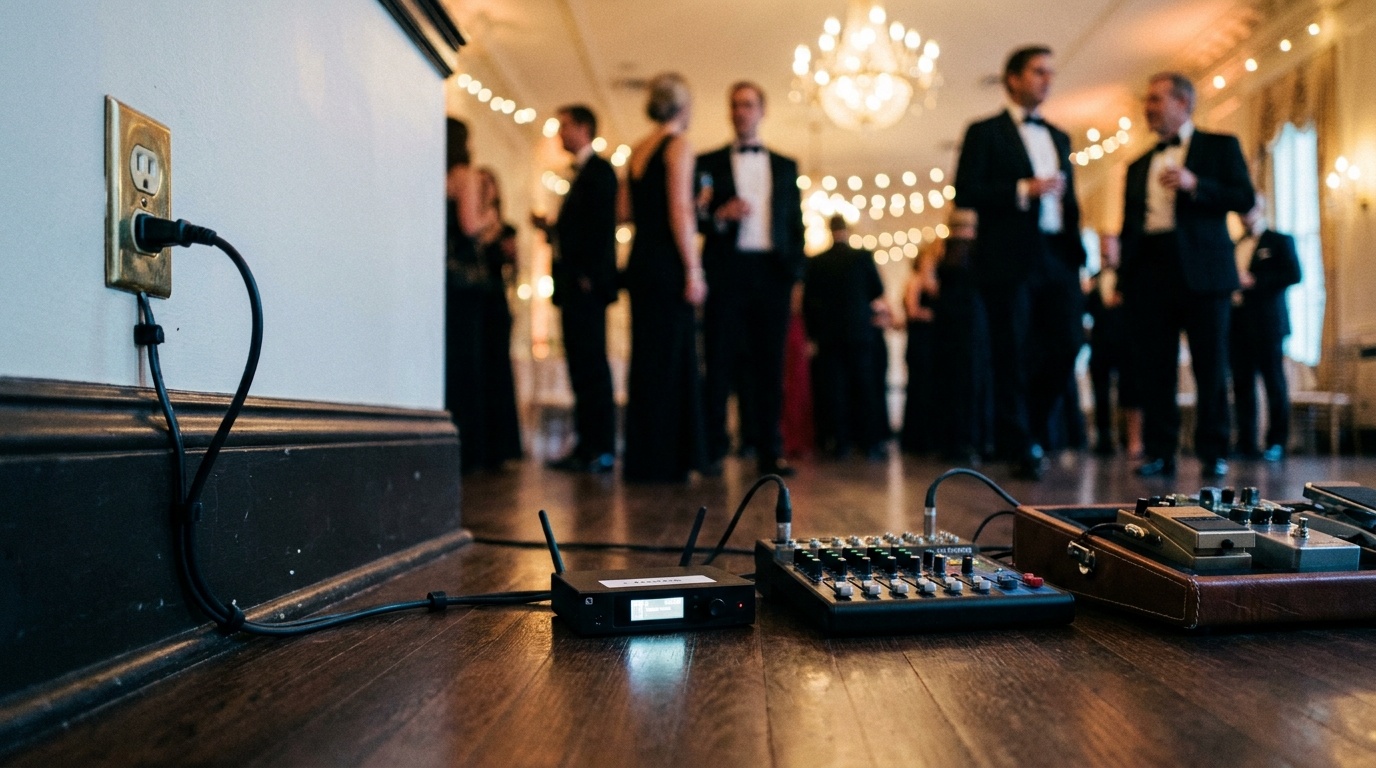
With a wireless setup, I can keep playing, walk over to the couple, say who asked and check that it is fine. If the couple says no, you do not hear it. With a playlist running, I walk over and talk to the couple while a song plays. How an act reaches the couple mid-performance depends on its setup, so if you are the couple, ask. I also agree a backup plan with the couple on a discovery call before the wedding. Ask your act whether it does the same.
Couples often relax about the list. By the reception, many care much less about what is on it, and when they see that a guest wants a song and the room is having a good time, they often say yes. That is how it went at a wedding at Cross Keys Vineyard in Virginia. An older relative kept asking for ABBA. I took the request to the bride, who approved it. Once the song started, people danced.
At that Pennsylvania wedding, the bride's own list was heavy early-2000s alternative emo rock. I tried to blend her picks with songs the rest of the guests would know, until she wanted her own songs played as they were. When those songs came up, the floor cleared to her and a few friends. Many of the older relatives did not connect with the music. She had a great time, and the guests had plenty of time to dance beforehand. In a moment like that there is little to do, since it was her wedding. I have noticed that when a bride is very picky about exact songs, the overall feel of the wedding can suffer, because every song follows one person's preferences.
Decide How Your Performer Says No
Ask your performer when they turn a guest request down, and decide how you want it handled. I turn a guest request down in three cases:
- The request is something the couple said they did not want to hear.
- It is early in the reception and the couple's own picks have not been played yet.
- It is late in the night and the queue is already full for the rest of the evening.
I do not like to subtract from the couple's list for guest requests until the couple has heard a good share of the songs they wanted.
A sample line for a full queue: "The bride and groom already have about 10 songs coming up in the queue for the playlist. If there's enough time to put yours in, I will, but it's looking like they've already filled up the rest of the evening with their choices."
For a request on the do-not-play list, I tell the guest the song was on the couple's do-not-play list, so they will need to ask the couple and come back with the go-ahead. There is a second approach. A good DJ tries to avoid telling the guest the couple banned the song unless it is absolutely necessary, so the couple does not look like the bad guy. The exception is a guest who is extra pushy. Then it may be necessary to say the couple did not want to hear the song, so the requests stop.
There is no formula for any of this. I read the room and make the call in the moment. Ask the performer in advance which approach they use, and decide whether you want the couple named to guests at all.
Send Your Songs Ahead, and Ask What Gets Learned
Ask the act for its repertoire first. Songs the performer already plays can be picked from it. Songs the performer does not know have to be learned, and that carries a lead time and a limit.
Here is how I handle a couple who sends a list of 25 songs. The first step is to sort them by the part of the wedding where each belongs. For the ceremony songs, I listen to each one, transcribe it for guitar and memorize it. The rest I split into low-to-mid energy songs for the cocktail hour and higher-energy songs for dancing. Each group becomes its own playlist, built out to fill that part of the evening. When I play live, those playlists are my break music.
I keep more music on hand than a segment needs. If a cocktail hour break is only 20 minutes, I want an hour of music, which leaves room to pivot if a song is not landing. If the 25 songs come from my own repertoire, they go on my setlist, though I pull songs from it one at a time to keep the energy moving. If I do not know them, I learn a few for the couple and put the rest on a playlist.
How many songs get learned varies by act. I am usually willing to learn two or three for a wedding, most often for the ceremony, since song choice carries the most weight there. Learning a song means listening to it, memorizing it, working it out on the guitar, rehearsing it and polishing it, and it takes longer when the couple wants vocals. That workload is why a cap and a cutoff exist. Some acts do not learn songs at all, so it has to be raised before booking.
Ask the act for the number of learned songs and the cutoff date. Several months ahead is ideal. In an emergency I have learned songs a couple of weeks out, and I avoid anything under two weeks, because too little time makes for a shaky performance. The ceremony musician guide lists the numbers: roughly 20% of couples ask for a newly learned song, and under 5% send a list of 30 or more must-play and 20 or more do-not-play songs. The 10 questions to ask before booking wedding entertainment covers the short version of this topic.

A ceremony song adds a timing problem. Only a segment of the song gets played, almost always, and it has to end at a good spot, timed to the walk so that no one stands at the altar waiting. That can mean reworking the arrangement in real time to match the walking pace.
Keep Your Do-Not-Play List Short
Write down the artists and the song titles you do not want played, and keep the list short. A wedding planner writing in Inside Weddings recommends giving the band or DJ both a "do not play" list and a "must play" list, and a list is useful. My argument is for keeping the do-not-play list short.
Hearing familiar songs is half the fun of entertainment at a wedding. Interacting with the band, musician or DJ is the other half. A long list closes off the second half. Think of meeting your favorite celebrity. You ask them to do your favorite line from their movie, and they do it, and you feel great. Ask again, and they say "no, not today, sorry." A long do-not-play list makes the musician give that second answer to guest after guest. Your wedding night is not the time to be a music snob.
I understand two kinds of song on the list: songs that are inappropriate, and songs tied to a hard time, such as one that reminds you of someone who has died. The first dance guide also advises a short do-not-play list.
Songs I sense are risky I avoid anyway, unless someone asks for them on the dance floor that night. One do-not-play guide notes that it is easier to block a whole genre than to list fifty individual songs.
Songs in a gray area can work if they come late. Earlier in the evening, selections need to be specific, and as the night goes on they can loosen. I think of the energy of a wedding as a boulder on a flat surface. Getting it moving takes a great deal of energy, and once it rolls, it is easy to keep going. The momentum from the earlier songs carries the energy later.
At a New Hampshire reception where I also handled the DJ duties, the couple's long list held many atypical wedding picks. Reading the floor, I leaned into more typical wedding songs, and the couple still had a great time. Whitney Houston's "I Want to Dance with Somebody" is often played early because so many people know it and it gets them up. Because this couple's list was full of non-typical songs, I held it until they were all excited about hearing their songs, and it became the climax of the night. They loved it, and everybody else did too. I think it would not have worked earlier in the night, because it is too typical a dance song for that list.

Decide on Request Lines, QR Codes and Guest Votes
Before you add a request line to the RSVP card, a QR request page or a guest vote, ask your performer how it would work with their setup. Each one changes something different for a live act.
A request line on the RSVP card. I have never had a couple put one on an RSVP card, but I am open to it. My reasoning is that guests have eclectic taste, and many pick a song because they personally find it cool and have never heard it at a wedding. As a hypothetical, take Uncle Frederick, who wants to hear a Radiohead B-side and also loves Justin Timberlake. He will be happy with either. The rest of the wedding party wants only the Justin Timberlake song.
Each guest might love one song that nobody else knows, and the playlist ends up without cohesion. The goal at a wedding is a dance party, so the aim is songs that give the most enjoyment to the most people. Odd picks probably will not get a spot in the playlist, because requests have to be filtered through the professional judgment of the DJ or musician. One couple posting in a wedding forum said the request line on their RSVP card mostly brought back sentimental love songs.
A QR request page. A QR code for song requests does work for a live musician, particularly at cocktail hour. It makes guests feel part of the performance and creates a live jukebox effect. It works less well at the reception. Letting guests set the order makes them the DJ, and a guest picks the song they want next without asking what fits after the last one. At cocktail hour, song order carries far less weight.
A guest vote. This is the version I prefer over individual requests. The couple builds the playlist they want to hear, guests submit a pool of possible songs and vote on the ones they most want, and the DJ or musician looks through the submissions and adds the most fitting ones to the playlist for the night.
If Your Event Is a Birthday or a Company Party
Tell the performer what kind of event it is, because requests follow the event. In my experience, weddings produce the most requests, birthdays come second and corporate events produce few. Weddings and birthdays give a performer the most freedom on genre and artist, because the guests are family and friends at a private event. Corporate events tend to carry more restrictions. There is usually a brand to keep in mind, and the guests are co-workers with professional relationships. When children are present at a wedding or a birthday, the DJ or musician has to watch song choices.
If you want the room to sing "Happy Birthday" with the performer, ask for it. The tricky part is the key. Whatever key I pick on my instrument, the guests sing in another. So I wait for the first word, hear the key, then adjust and play the chords to match for the rest of the song.
At a corporate event, requests are rare, and I ask for them anyway. I go to the client, some of the staff working the event or the co-workers and ask what they want to hear. The answers have ranged from Johnny Cash to "something we can dance to."
For a non-wedding event, the private and corporate events page covers that side of the work.
Questions to Ask Any Act Before You Book
Send these six questions to every musician or DJ you are considering:
- Can you take requests?
- Can we see your live song repertoire, all the songs that you play?
- If something is not on your set list, can you DJ it and take requests on the night of the event?
- How many new songs will you learn, and by what date do you need them?
- Can you learn a ceremony song, end it on cue and attend the rehearsal? If several musicians play, how do they follow the pacing and flow of the ceremony together in real time?
- Do you play from memory, or read from an iPad or sheet music?
Memory versus a screen is a trade-off. Playing from memory means fewer songs, but the connection with the room is better. I play from memory. Acts vary, so ask.
An act that says yes to all of this without qualification is being vague. I do not think any musician can play any song on the spot live, since nobody can memorize every song in existence, and the only other option is reading the songs from a screen. A specific answer, with a number of songs and a cutoff date, is more useful than an easy yes.
A bonus is an act that can play live and DJ songs, including playing live while DJing. The hybrid live and DJ handoff guide explains how that works.
FAQ: Wedding Song Requests
Can songs that are not in the performer's live set be played from a playlist?
Yes, with some acts. At the reception, I either mix live performing with DJing or let a playlist run for much of the night, and I build a larger playlist around the couple's songs, because the reception lends itself to dancing more than to a live set.
A guest says the couple approved a request. Does the performer take their word for it?
A guest sometimes carries a message from the couple to me, and I decide in the moment whether to believe it. The question in my mind is whether the guest is just saying the couple approved it because they want to hear the song. The simpler setup is for the couple to talk to me directly.
Does the planner or day-of coordinator need a copy of the do-not-play list?
No. Only whoever plays the music needs it, because no one else chooses the songs. Give it directly to the performer.
Can we ask for clean versions of songs?
Yes. I tend to play clean versions of songs at weddings and corporate events alike, and a couple who wants a clean wedding can ask for that.
Settle Who Says Yes Before the First Request
Settle two things with whichever act you hire, ahead of the night: who may say yes to a guest, and who the performer asks when a request touches the couple's list.
Quick Recap
- Ask every act what happens to a song it does not play. I try another song by the artist, then a few similar songs, then the break playlist.
- Expect guests to ask mostly at the reception. Choose your ceremony songs in advance, since requests do not come up there.
- Tell the performer who your music contact is. As a guest, ask the performer directly.
- Decide how you want a guest turned down.
- Send learned songs by the cutoff date. Ask the act for its song count and date.
- Keep the do-not-play list short and leave gray-area songs for later in the night.
- Ask a performer how a QR page, an RSVP line or a guest vote would work with their setup.
- Send every act the six questions, and treat an easy yes to all of them as a warning sign.
Questions about music for your own event? The contact page is here.
Blog Categories
Latest Blogs