
Wedding Events
Wedding Dinner Music: How Loud, How Long and What Happens During the Toasts
Dylan Galvin is a live events performer who has performed across the United States since 2009, now based in the DMV (Washington DC, Maryland, and Virginia), more than 1,500 events. Mentored by music legends John Mayer, Paul Simon and Livingston Taylor.
A wedding dinner has no arc, so the music should not build toward one. This page is for the couple or planner booking wedding dinner music.
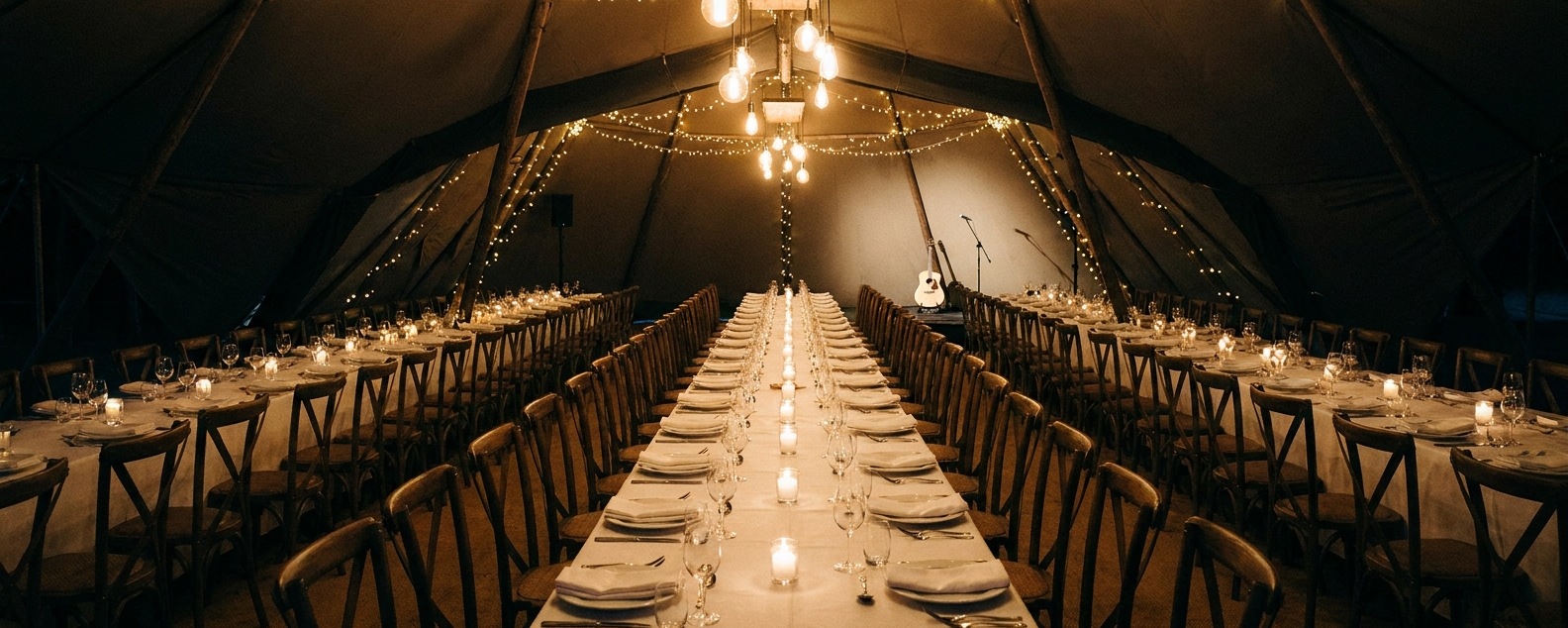
At one tented dinner for about 150 guests, the guests' energy ran a little higher at the start than in the middle and was highest at the end, when people were getting ready to dance. The energy of the music did not change at any point. The plan for a dinner is a low to medium backdrop held steady, a live set of about 45 to 60 minutes, a plan for the speeches, and a playlist that leads into the reception.
A Wedding Dinner Has No Arc
Nothing changed as that dinner went on. You do not want anything to change. The dinner is a low to medium energy part of the night, and you want to keep it exactly as it is and gently lead people through that stretch of the evening to the reception when they are ready to party.
The guests are eating and talking, and the music is definitely not the feature of this part of the evening.
The dinner in that tent ran about 45 minutes to an hour, and the energy was laid back and somewhat restrained. In the first 10 minutes people were still moving from cocktail hour, standing in lines for food and then going down to sit, so the room was a little more heightened than it was in the middle. The last 10 minutes were the highest of the dinner, as people finished their plates and got ready to dance, and the transition to dance music was close.
Several speeches happened during that dinner. Dinner is a great time for speeches, because everyone is already sitting down and little of the flow of the evening gets interrupted.
Dinner usually follows cocktail hour and is the last thing before the dance floor opens, so it works as a transition into the reception. Joy's sample reception timeline lays out the order of the evening the same way, with cocktail hour first and dinner after. Cocktail hour is its own set, and the cocktail hour music guide covers it.
Volume: Dinner Should Sit Around a 3 out of 10
On a scale of 1 to 10, a dinner should sit around a 3. Guests at a dinner almost never want the music turned up, and the ones who care about the level lean toward quieter.
A low level matters most for guests sitting close to a speaker and for older guests, who want more room to talk. For a guest without great hearing, the music makes conversation difficult.
The room also changes the volume after the sound check. A large crowd absorbs more sound than an empty venue, and the ambient chatter adds to it, so music that was easy to hear during the check becomes a little harder to hear once dinner starts. The level always needs adjusting, and it usually has to happen in real time.
Guests at dinner are talking and eating, so it is very easy for the music to be obnoxious. A lower level, from a performer or from DJ music, is very important here. For a seated corporate dinner, the holiday party entertainment guide covers volume and energy at a seated meal.
The Dinner Set: About 45 to 60 Minutes Live, Then a Playlist Into the Reception
A live set for a dinner usually runs about 45 minutes to an hour. After it the performer usually takes a break and switches to DJ music. That works out well because the reception usually comes soon after, and the break can serve as the final reprieve before the nonstop dancing begins.
Breaks are not tied to the courses, and they get worked into transitions. Long speeches and toasts can disrupt a pre-written set, so the plan has to be ready to adjust on the fly for everyone who is talking.
A live musician can offer different options for a dinner, sometimes instrumental music only, or a soft DJ playlist built around the client's preferences. What gets played first changes at every wedding. Usually it fits the taste of the couple and stays low-key in energy.
The mechanics of the swap are in the live-to-DJ handoff guide.

When the Speeches Start: What Happens to the Music
How speeches are handled depends on how many people get up and how much of the set is left when they finish. A lot of the time, some of the speeches are not worked into the itinerary at all. Whenever the next person wants to speak, they walk up.
When the performer is not the MC
A performer who is not hired as the MC stands by. Usually the performer is playing live when the speeches start. When the coordinator comes over, the performer brings the current song to a natural ending and hands the first speaker a wireless mic that is already set up, such as a Shure SLXD24+ handheld with a Beta 58A capsule. Then the performer runs sound live for that speaker and for everyone else who gets up.
Guests have different voices. Some talk loud, some talk quietly, some hold the mic very close to their mouth, and some hold it very far away. The mic volume has to be adjusted constantly to compensate. A mic with nobody running the sound works badly, and people either cannot hear the speaker or get their ears blown out. The gear and the live-mixing side are covered in wireless mics for toasts and live sound.
When there are lots of toasts and speeches
If a dinner has lots of toasts and speeches, the performer usually DJs the music. It is cumbersome to perform live when another person walks up, say, every five to ten minutes. A playlist running underneath, with the music faded in and out, works better. Ending many songs abruptly in the middle for speeches makes no sense.
At one dinner with well over 100 guests at an East Coast venue, there were probably seven or eight speeches. They destroyed the setlist I had planned. I worked as the sound man for that whole section, played a shortened set afterward, and switched to DJing shortly after.
A band definitely cannot begin and end a large number of songs around speeches. Several people playing together cannot improvise their way into and out of songs the way a solo performer can. A band with no sound person won't be able to run a mic for a line of speakers either. DJs are usually ready for this and have a much easier time fading in and out.
After the speeches
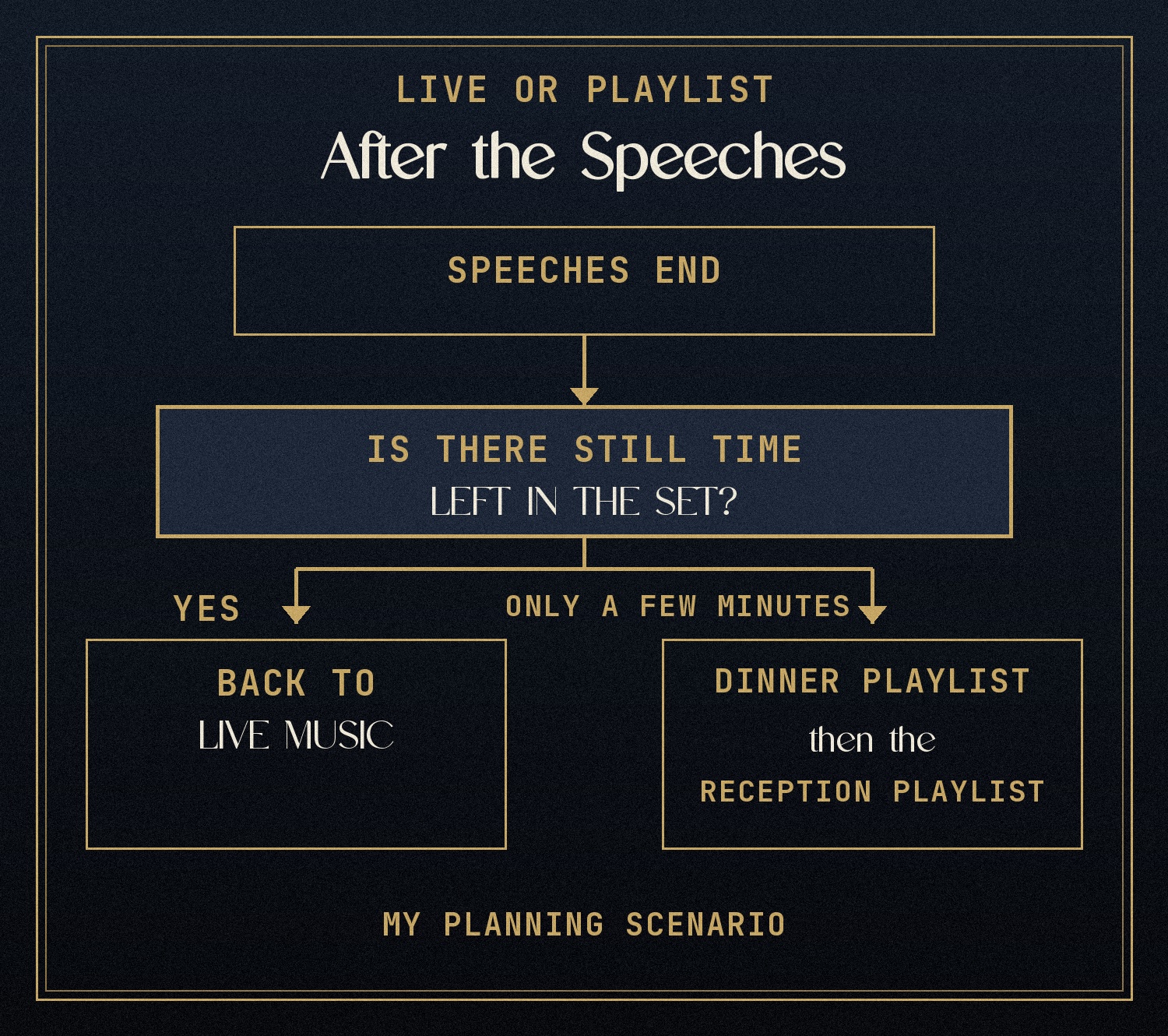
The time left in the set decides. Take a planned set of 45 to 60 minutes with between 5 and 30 minutes of it taken by speeches. When the speeches end and the set has real time left, the performer goes back into the set and plays live. When the speeches ate up the majority and only a few minutes remain, the performer will probably not play live for such a short stretch. A dinner playlist goes on instead, a few transition songs that capture the feeling of the dinner, ready to switch to the reception playlist when the reception starts shortly after.
A performer rarely has to tell the couple anything to keep the music and the speeches from colliding. If a couple wants to give a lot of speeches, making everything run smoothly on the day is up to the performer, more than anything the couple prepares ahead.
Which Acts Fit Wedding Dinner Music, and Why the Song List Matters Less
What is played
The genre can be whatever you want, and so can the decade. It can be instrumental or have vocals. Classical, pop, electronic, house, film scores and Disney songs all work. Keep it at a medium to lower volume, stay away from super high energy songs, and you are good. Vibe, energy level and volume, kept low and relaxed, count for more than which songs you pick. People are sitting and eating, and most of them are not listening closely to the music. They do not usually care which specific songs are played.
A list of dinner songs boxes you in to the taste of the person who made the list. Pick whatever you want.
Who plays it
Not every live instrument is the right fit for a dinner. A harp player, a keyboard player, a guitarist, or a solo musician playing and singing ambient background music all fit the vibe. A sax player or a percussion player is a spectacle. You can design that as a moment, when the energy is low and the room is quiet and attention is easy to get, but it does not match the vibe of the dinner itself. Certain instruments run way more high energy than others.
A DJ can work well, as long as the DJ understands the vibe of the dinner. Musician or DJ is a matter of preference.
A full band usually does not fit. Full bands are designed for maximum attention and energy, which is the opposite of what a dinner needs, and a full band playing during dinner can ruin everyone's conversation. A band could do a song or two as a special moment.

Vocals at dinner
Vocals can work during dinner, absolutely. The overall volume of the performer needs to go down, because a performance that grabs too much attention interrupts guests who are focused on one another and on friends and family they have not seen in years. You want to complement that.
Live, a DJ or a Playlist for Dinner: How to Decide
At least half of the last ten weddings a performer played included a dinner performance. At the others the performer usually was not hired for that section of the evening.
- If you have no live musician at any other point of the day, hiring one just for the dinner is not advised.
- If you have a musician for cocktail hour, it is not a bad idea to extend that through the dinner portion of the evening.
- If you have a live band for the reception, see whether one or two of the musicians can do a roaming performance for dinner, or an acoustic or stripped down set for the dinner hour.
- If you want a wow, have someone come out for a couple of songs as an unexpected and creative reveal. Keep it short, because your guests still want to eat their dinner.
- A full band for the whole dinner usually does not fit, and a long run of speeches points to a DJ or a playlist with fades.
The rest of the wedding-day music decisions are on the wedding music page.
What to Hand the Performer for Dinner (Almost Nothing)
Roughly nine in ten couples who book dinner music say nothing about the dinner. At most they give the performer a mood, or just mention that there is a dinner and leave it to the performer.
When couples have specific songs, they want them played at some point in the night. They never ask for specific songs during dinner. When the music is supposed to be ambient, the ceremony and the reception are the moments that get the specific song choices.
So for dinner, send a mood and an energy level, and ask for a medium to lower volume. For the songs that do matter to you, who says yes to a song request has its own guide.
Two Questions to Ask Any Act About Dinner, and the Answer That Is a Warning
The first question is "Are you able to create the vibe we're looking for during the dinner portion of the evening?" A good answer is a yes that offers to go step by step, as specific or as general as you want, and keeps dinner distinct from the rest of the evening. A warning answer is "Well, the dinner is basically the reception, so I don't see why you need something that's different."
The second question is "Do you have wireless mics ready if we want to give some speeches or toasts?" A good answer is specific. It names the make and model of the mic, says how far a speaker can walk with it, and says who runs the volume and fades the music in and out for each speaker. A warning answer is "I have a wireless mic, yes, you can use it." That tells you nothing about what kind of mic it is, whether interference and dropouts are a risk, or how far anyone can walk with it. Ask for more specifics when the answer is vague.
FAQ: Wedding Dinner Music
Can the seating chart change how loud the music feels at a table?
Yes, a seating chart can accidentally put a table way too close to a speaker. Asking an event designer or a planner to keep certain tables away from the speakers is a must. The music has to be loud enough for the furthest guests to hear it.
Can the first dance and parent dances happen during dinner, and can the performer announce them?
Yes, they can be woven into dinner. If the performer is also emceeing, send the names of everyone dancing, in the order of the dances, with the phonetic pronunciation of each name. A good announcement offer covers when the food is ready, the next course, introducing speakers, the dances, and opening the dance floor once dinner is over. "Yes, we can do those dances" with no questions asked is a warning, and so is "Yeah, I guess so." For the dances themselves, see choosing a first dance song. For the mother-son and father-daughter dances, see which parent dance songs work live and which are better left recorded.
Can we ask for a certain kind of music at dinner without naming songs?
Yes. Couples can ask for a genre or a mood without naming songs. One family asked for the pop music of the bride's home country as a tribute, with no specific songs. That was one case, and not a typical one.
Is dinner always right before the dancing?
Usually. At one recent wedding the reception took place before dinner, which is unusual. Tell your performer the order of the evening, so they know what the music is leading into.
Hold Dinner Steady Until the Room Is Ready to Dance
Hold a backdrop steady, plan for the speeches, and decide between live music and a playlist. The music's volume and energy stay low and relaxed from the first plate to the last, even as the room picks up toward the end, and the performer's job is to keep the room comfortable until it is ready to move.
Quick Recap
- The energy of dinner music stays the same from start to finish, while the guests' energy is a little higher at the start than in the middle and highest at the end, as they get ready to dance.
- Dinner volume should sit around a 3 out of 10, because guests are talking and eating, and some sit close to a speaker or have trouble hearing.
- A live dinner set usually runs about 45 to 60 minutes. After the speeches, the time left in it decides between live music and a playlist into the reception.
- A band cannot start and stop around speeches. A solo performer or a DJ can.
- With no other live music in the day, skip hiring a musician for the dinner alone. With a musician at cocktail hour, extending that through dinner is not a bad idea.
Questions about music for your own event? The contact page is here.
Latest Blogs


