Mother-Son and Father-Daughter Dance Songs: What Happens From the Performer's Side
Dylan Galvin is a live events performer who has performed across the United States since 2009, now based in the DMV (Washington DC, Maryland, and Virginia), more than 1,500 events. Mentored by music legends John Mayer, Paul Simon and Livingston Taylor.
The Parent Dance Runs on Its Own Rule
Most wedding advice never treats this as a real decision. The couple's own recording plays through the DJ by default, and whether a live performance might work better almost never comes up. That default is usually right, for a specific, statable reason. It also stops being a blanket rule the moment you look at the rest of the day.
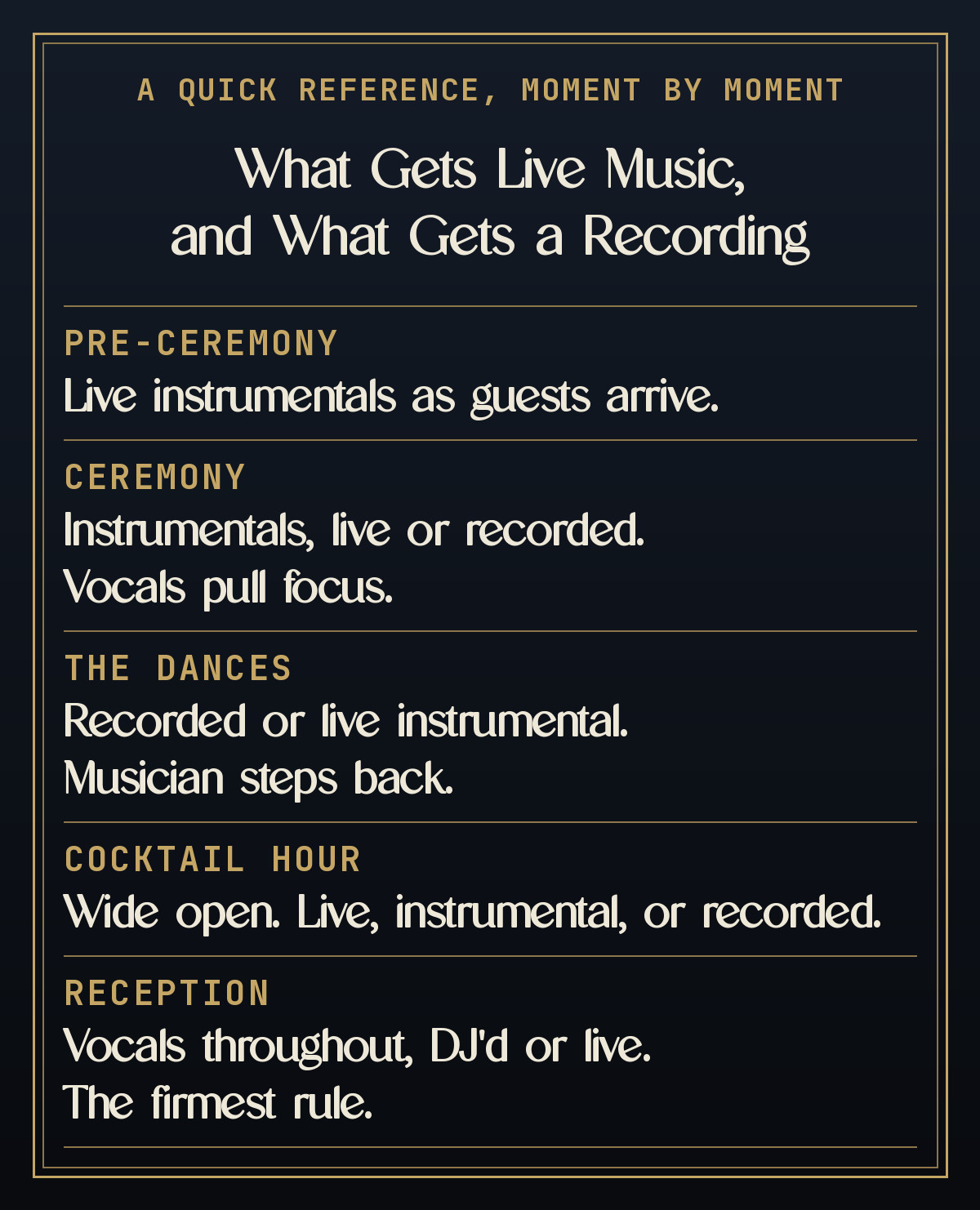
One musician's own observation, built from hundreds of weddings played, comes down to something closer to a moment-by-moment rule than one blanket policy for the whole day:
pre ceremony - live instrumentals. ceremony - live instrumentals OR pre-recorded instrumentals. dances - pre-recorded (original recording, not an instrumental) or live instrumental. cocktail - live with vocals or instrumental or pre-recorded. reception - vocals all the way, either DJ'd or live performance, but vocals are a must.
Five moments, five different calls. Live instrumentals welcome guests before the ceremony because that moment is built for atmosphere. A real musician creates that mood as people arrive, and almost any song can carry it. Vocals during the ceremony pull attention toward the performer and away from the couple, the same reason televised talent shows build entire seasons around singers rather than instrumentalists, so instrumental versions work better there, live or recorded. Cocktail hour opens up to almost anything. The reception needs vocals the whole way through, DJ'd or performed live, the closest thing here to a hard rule.
The dances sit apart from that pattern, and the reasoning centers on who is doing the performing:
Just playing the recording is perfect for moments that depend on inexperienced people needing to do something on a very specific timeframe. Most of the bridal party and wedding guests are not performers and have no performing experience. Moments that require a lot of coordination... first dances, mother-son dances, father-daughter dances, all of those are from people who haven't performed before, putting on a performance (dancing) they might not be comfortable with, in front of lots of people... A live performance is almost never going to be exactly like the recording, so adding an unfamiliar element into an already unfamiliar live moment, for someone with no performing experience, is potentially nerve-wracking.
The reasoning comes down to timing, and who's under the most pressure in that moment: two people who have never performed anything for an audience, doing a rehearsed routine, once, in front of everyone they know. A recording removes the one variable most likely to throw that off, the chance that a live version drifts from what they practiced. The psychology of why a nervous dancer reacts to an unfamiliar version is covered in more depth on the site's guide to first dance songs, which reaches the same live-or-recorded conclusion from the anxiety angle specifically. That same moment-by-moment logic carries through the rest of the wedding music timeline as well.
Which Songs Hold Up on Solo Acoustic
Almost any song can be rearranged for solo acoustic guitar, regardless of genre or era. Whether it works depends on how it's handed to the musician for reinterpretation. Treated as a cover attempt, most full-band arrangements fight against one guitar. Treated as something meant to be reinterpreted, most of them can be rebuilt to fit. High-energy, full-band songs need the heaviest rework, and it's worth letting the musician attempt that rework before ruling a song out.
Live looping, where a single musician layers guitar parts and vocals in real time to build a full-band sound, works well at a wedding. It's a poor fit for this specific moment, though. Looping is built for higher-energy songs, and building one live pulls the room's attention toward the performer constructing it. A parent dance keeps that attention on the people dancing.

The Microphone That's Already on Standby
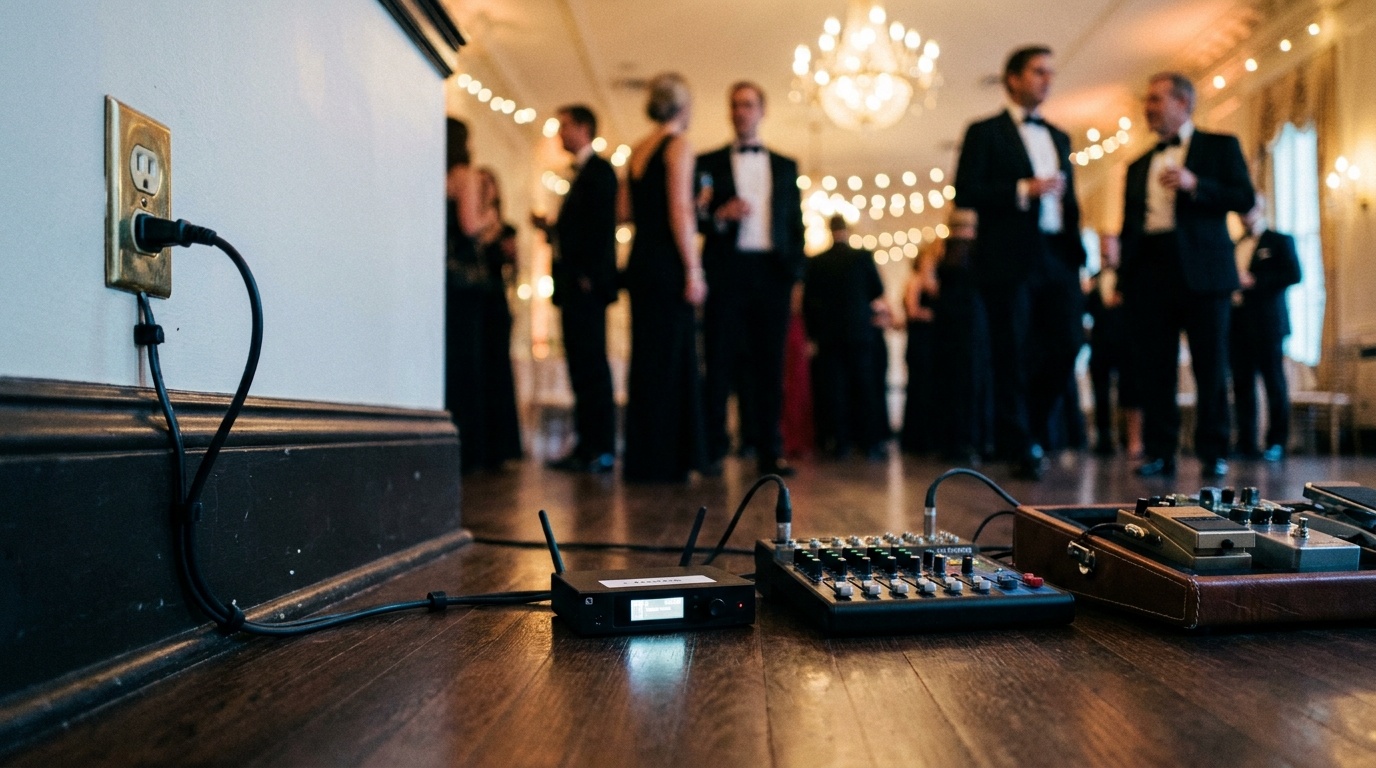
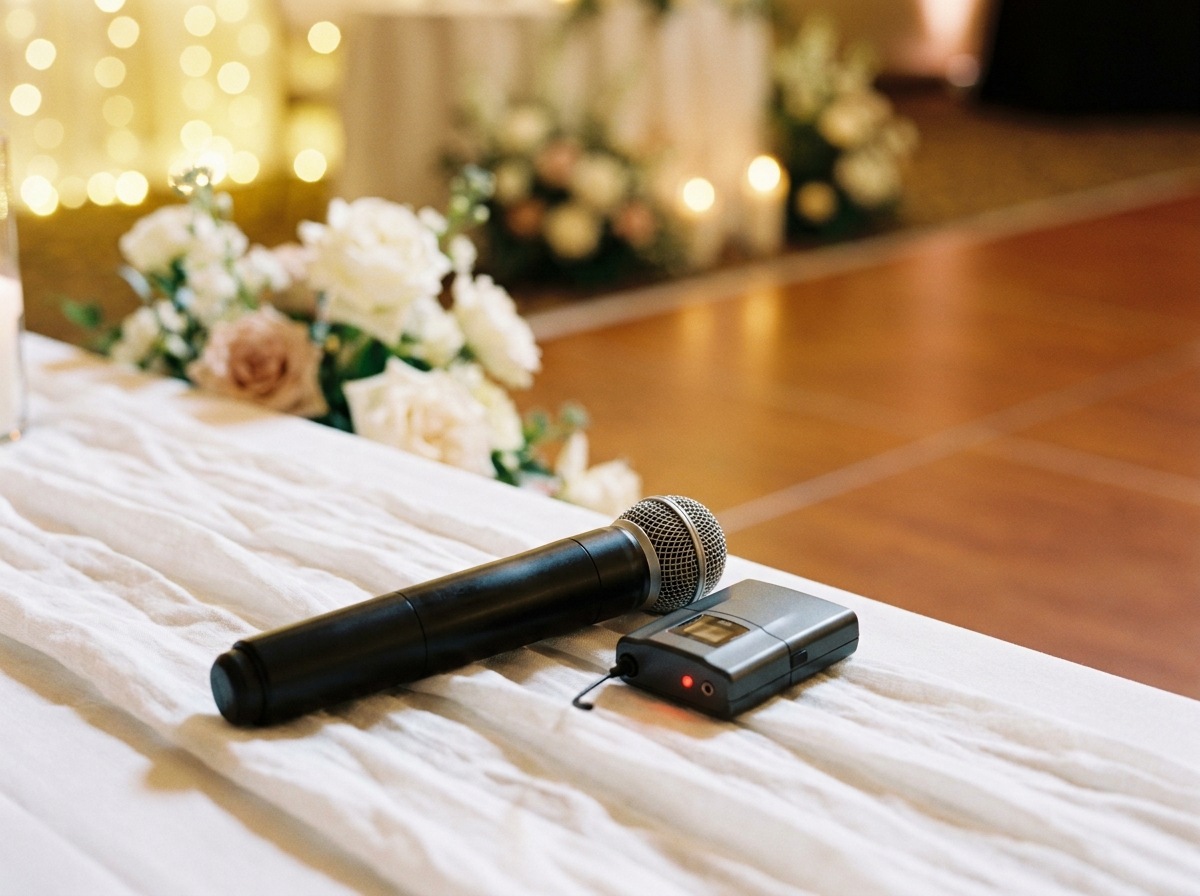
This is a piece of logistics most people never think to ask about until they need it mid-reception. A wireless mic, in this case a Shure QLX-D digital wireless unit, chosen because it scans for an open frequency automatically instead of sharing the same cell-phone and internet bands that cause interference and dropouts in cheaper wireless systems, sits on standby on a muted channel through the whole event. When a parent, sibling, or friend wants to say something unplanned, the musician flips the channel live, hands off the mic, and rides the EQ in real time, since everyone holds a microphone differently and volume swings fast when someone unused to speaking into one gets nervous.
Speeches are already built into most receptions: traditionally about five of them, typically from parents and the wedding party, with more couples now opening that list up to whoever else they want to include. That's before anyone factors in someone deciding, in the moment, to say something that wasn't on the program. Requests for exactly this happen often enough to be worth asking about directly. A parent wanting the option to say a few unplanned words during the reception is a common version of the request. It's worth asking any hired musician whether they carry a wireless mic they can hand off mid-reception. Settling that answer during planning means nobody is improvising with a dead mic while a parent is already standing up to speak.
When the Parent's Taste and the Couple's Taste Diverge
One parent's own taste ran heavily to 60s and 70s classic rock and country. The couple leaned toward 90s alternative and high-energy punk. The two ends of the family couldn't have been further apart musically.
The resolution starts with serving whoever is the client on the booking. A parent sometimes fills that role. From there, the goal is a musical a la carte: the parent, the couple, the rest of the family, and the guests filling the room each get real time inside the same set. Letting a single person dictate the entire setlist works against a room that's there to dance and have fun.

When Someone Else Wants Part of the Moment
The dances aren't the only moment where someone besides the hired musician sometimes wants to perform. It happens often enough to be worth planning for.
At a rehearsal dinner the night before a wedding in San Diego, the groom turned out to be a singer-songwriter. Ahead of time, the musician helped the groom arrange a surprise performance: the groom came up and performed three original songs he'd written, love songs, backed by the hired musician. He sang them to his bride-to-be. You could hear a pin drop in the room. Every person in it was holding their breath.
Frequently Asked Questions
If we want the parent dance performed live, how far ahead should we ask for a full arrangement?
As early as possible, ideally well before the wedding week. Rearranging a song for solo acoustic guitar and getting it ready for a specific dance takes time to work out. The earlier the song is named, the more room there is for that arrangement to come together.
If the hired musician doesn't carry a wireless mic, what covers reception toasts?
A lighter AV rental covers it. A basic wireless mic and speaker, sized for a handful of unplanned toasts, does the job without adding a second vendor's whole production to the day. Whoever provides it belongs on the same logistics list as the ceremony sound and the reception playlist, settled before the wedding day begins.
Besides nerves, is there another reason to choose recorded over live for this specific moment?
A live performer pulling some attention during the dance isn't automatically a downside. It depends on what the parent and the son or daughter dancing with them want from those few minutes together. A pair who doesn't mind sharing the spotlight can let a live performance take some of the nervous pressure off them. A pair who wants every eye and every camera on the two of them is exactly the case a recording is built for.
What if there's no traditional father or mother in the picture?
The framework doesn't depend on a traditional father or mother being in the room. Name who the moment belongs to, then decide live or recorded based on that person's own comfort level and performing experience, whatever the family configuration: a stepparent, a grandparent, an aunt, a family friend, two mothers, two fathers. A couple who skips the moment altogether skips the decision along with it.
The Case for Letting the Recording Play
Asked flat out what they'd tell a couple over coffee about the parent dance, the musician gives one answer: play the recording.
A good DJ can watch the room and fade a song out partway through if the people dancing start to look uncomfortable. That same musician lets the song run to its natural end: the full three or four minutes, once, then it's gone for good. The reasoning for playing a song out in full is covered in depth on the site's guide to first dance songs. The same logic carries over to this dance. When a live performance does happen for that moment, it needs a full instrumental arrangement, melody and chords worked out in advance and played all the way through.
Whether the rest of the day leans live or recorded is its own longer conversation. For this dance specifically, the choice gets made on purpose, ahead of time, before the people dancing are out on the floor.
Quick Recap
- The couple's own recording is usually the right call for the parent dance, because the dancers are not performers and a live version rarely matches what they rehearsed to.
- Live or recorded depends on the moment. Instrumentals suit the pre-ceremony and ceremony, the dances use the original recording or a live instrumental, and the reception needs vocals.
- Almost any song can be rearranged for solo acoustic guitar when the musician is free to reinterpret it. A live parent dance needs a full instrumental arrangement with melody and chords, and live looping is a poor fit because it pulls attention onto the performer.
- A wireless mic can sit muted on standby until a parent or friend wants to say a few words, and the musician hands it over live. Settling that during planning keeps it from becoming a scramble mid-reception.
- When a parent's taste and the couple's differ, a set built as a musical a la carte gives the parent, the couple, the family, and the guests real time inside the same set.
Questions about music for your own event? The contact page is here.
Latest Blogs