Wedding Ceremony Sound Systems Compared: Battery, Plugged-In, Venue and Unplugged
Dylan Galvin is a live events performer who performs across the United States, now based in the DMV (Washington DC, Maryland, and Virginia), and has played more than 1,500 events since 2009. Mentored by music legends John Mayer, Paul Simon and Livingston Taylor.
You may have seen a video of a guitarist walking through a ceremony with no speaker in sight, and that picture is easy to carry into your own planning. The player may have a wireless rig out of frame, with the guitar going through an amplifier without a single cable.
I think one of the biggest wrong assumptions couples make is not realizing how important it is to amplify the music for the ceremony. It makes a huge difference in how beautiful the sound is and how well people can hear it.
This page assumes you are hiring a musician or DJ for the ceremony and are not shopping for equipment. There are four setups to ask about: a battery-powered speaker, a plugged-in system your musician brings, the venue's own sound system, or no amplification.
In my experience, a plugged-in system your performer brings and runs is the most dependable. The venue's system is only as good as the person at its mixing board (the sound desk). By my rule of thumb, unamplified music gets harder to hear past about 30 guests.
My own setup is one example, and acts differ, so the sections below are the questions to put to each act. For what to ask any performer, see the sound, power and AV guide.
The Four Options, Side by Side
| Option | What it does well | What to ask about | Who runs it |
|---|---|---|---|
| Battery speaker | Most portable, quick to set up, goes anywhere, needs very little space, sound quality usually up to par | Whether the battery lasts through the ceremony, and Bluetooth dropouts in a crowd | Your musician or DJ |
| Plugged-in system your performer brings | The performer knows how it works and can do everything alone | How the cables are routed and taped down | Your musician or DJ |
| The venue's own system | Can be great when the system is good and a skilled person runs it | Who operates it that night | The venue's sound person |
| No amplification | Almost nothing to set up | Guest count, wind, traffic and water | Nobody |
My rough estimates for setup time:
- a battery speaker takes about 10 to 15 minutes
- a wired system I bring takes about 60 to 90 minutes (more with extra locations)
- no amplification takes about five minutes
The venue's own system varies widely with how simple or complex it is.
The wired range is wide because of venue logistics I cannot control before I arrive. A single tower speaker for a cocktail hour is quicker, about 45 minutes by my rough estimate. It has no wireless microphones for the officiant and the couple, and no extra locations to test and adjust. I cover cocktail hour sound on the cocktail hour music guide.
Put one question to every act: do you bring a system, or do we need the venue's or a rental? The answer varies by act.
Here is my order of preference:
- A wired system I bring and run. Running mine alongside the venue's, chained into it, fits here too.
- A battery-operated system.
- No amplification.
- The venue's own sound system on its own.
I put my own wired system first even though it takes longer to set up than a battery speaker, because I know exactly how it works, and cables mean fewer batteries to die and less interference.
That preference covers the cables and speakers. The officiant and vow microphones are the exception, and the microphone section below explains that choice.
Battery Speakers: Portable, With Two Risks to Ask About
Battery speakers are the most portable option and can go anywhere. Modern battery speaker technology has improved, and the sound quality is usually up to par with other speakers.
The first risk is the battery running out in the middle of the ceremony. Almost any professional charges it beforehand. In my experience a failure is rare, but there is no way to tell until you are on site.
Bose lists up to 11 hours for its S1 Pro+, and JBL lists up to 12 hours for its EON ONE Compact. Electro-Voice lists 12 or more hours for its EVERSE 8 at moderate volume and 6 or more at full output. Ask any act how long its speaker runs at the volume your ceremony needs, and what the backup is.
The second risk is the connection. Many battery speakers connect over Bluetooth, which uses a radio band called 2.4 GHz, according to the Bluetooth SIG technology overview.
In my experience, when a lot of guests are in one area, their phones and other devices can disrupt that band. The speaker can then drop out in the middle of a ceremony.
If the ceremony site has no outlet, the sound, power and AV guide has a section on battery versus generator power.
A Plugged-In System Your Musician Brings
This is my personal preference, and the reason is dependability. I know how my system works.
There are no unknowns I cannot account for, and I can do everything myself. Hauling and setting up the gear is the performer's job, so it adds no work for the person hiring.
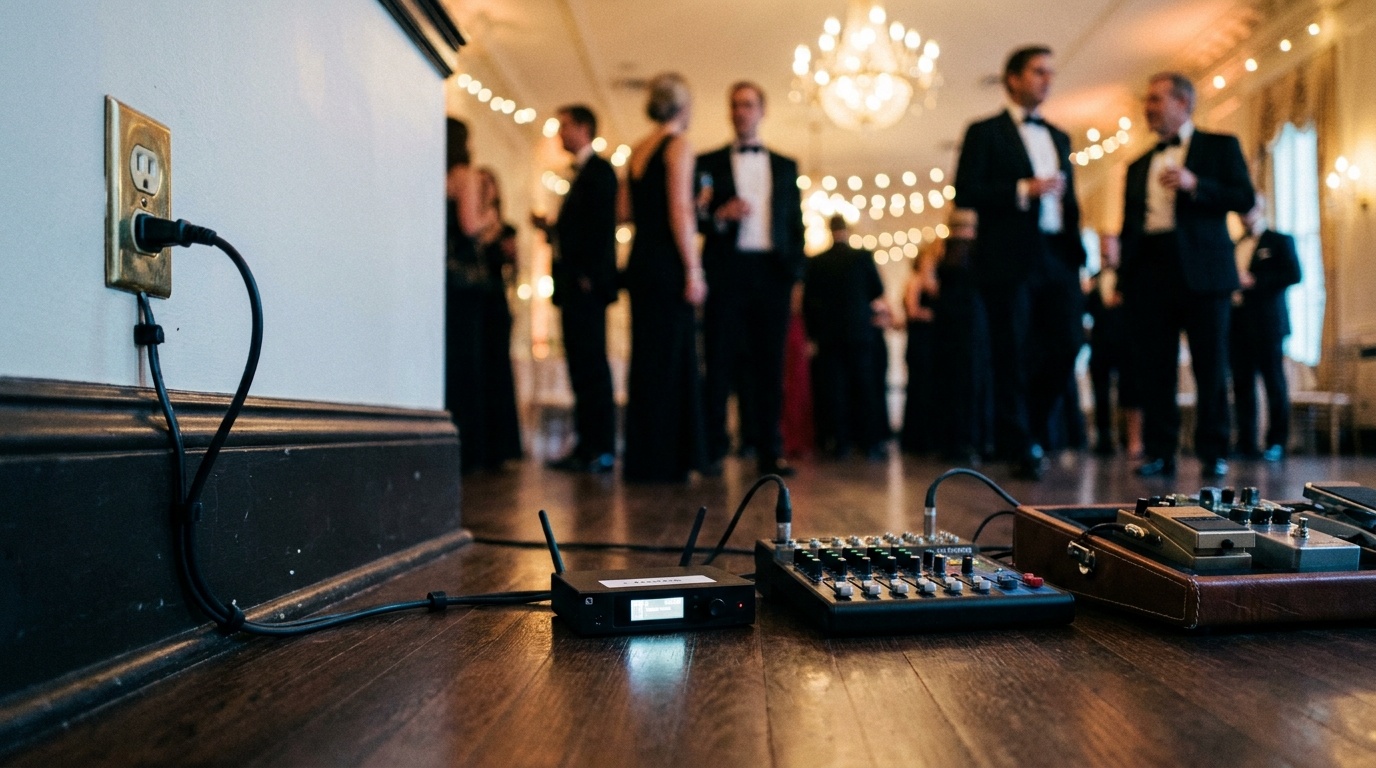
The one thing to ask about is the cabling between the speakers and the performer's setup. Where possible, I daisy chain several standard XLR audio cables together, joined end to end. Someone then tapes the cables to the floor with gaff tape so nobody trips.
Gaff tape is a matte black tape made to stick down and peel off floors and walls cleanly.
Also ask whether the system is a PA, a public address system with the full set of speakers and mixer, or a plain amplifier. I prefer a PA.
A PA plays music closer to how it was recorded, which suits playing DJ music through the speaker in an emergency. An amplifier adds its own tone to the sound, and it often lacks an input for a tablet or laptop. If something fails, that input decides whether music can still play.
For ceremonies I use an Electro-Voice EVOLVE 30M column array, a tall, slim speaker, or a Bose L1 Compact portable system. That is one act's choice, and acts bring anything from only an instrument to a full PA. A ceremony needs less power than a cocktail hour or a reception, so a smaller system does the job.

The Venue's Own Sound System: Ask Who Runs It That Night
I performed at a venue in Baltimore, Maryland that had a sound system, and the venue said it preferred that musicians use it. When I got there, it was not something I was familiar with. I had never used anything close to it, so I set up my own sound system instead.
Eventually the venue's sound person showed up and operated everything. I'm pretty sure I daisy chained my system into the house system. We got the best of both worlds, and everything worked out.
For how a performer connects to a house system, see the guide to roaming musicians.
In my experience, there is no way to work out the details beforehand. A venue manager generally has no idea how the system works, and sometimes does not know the model.
The person to talk to is the sound person. So ask the venue who runs the system that night, and ask to connect your musician or DJ with that person ahead of time. If there is no sound person, you are stuck hoping for the best.
House systems vary widely. Some are fantastic and some are terrible. Some are outdated or malfunctioning, and some have mixing boards so complicated that only certain people can run them.
Your sound is only as good as the person at the board, and it generally reflects on the musician, because guests do not realize the sound person is responsible. An inexperienced operator is like a student driver as your limo driver. You may get to your destination, but it will be a wild ride.
A wedding ceremony rarely needs to plug into a house system. Corporate events more often do, because the rooms are big.
No Amplification: The 30-Guest Number and What Breaks It
My rule of thumb is about 30 guests. You can probably get away with more, maybe up to 50, if it is very quiet outside or the ceremony is indoors. This comes from experience and is not a measured test.
Outdoors, there is no reverb (the echo a room adds), so sound dissipates the farther away a guest sits. Indoors, especially in an old historic venue, the room can act like an amplifier.
Some old churches and historic venues were built before electric equipment existed, so the room itself had to carry the sound. In one of those, a larger crowd may hear a speaking voice with no trouble. A modern venue or an outdoor space is another matter, and I would recommend totally unamplified music there for 30 people or fewer, possibly 50.
Wind, nearby traffic and ambient noise such as a river or other water can drown out much of the sound.
For the vows, in front of a large crowd with no amplification, most of the people in the back rows will not hear anything the couple says. I think a venue that forces no amplification does a disservice to the couple, the guests and the music.
The guide to hiring an acoustic guitar player puts the limit for a solo instrument at 30 to 40 guests, and I allow up to about 50 only indoors or when it is very quiet. You can also read how one wedding handled a no-amplification policy.
Microphones for the Officiant and the Vows
Lavalier microphones, the clip-on kind, are probably the ideal choice. They also mean putting a microphone on every person, which takes a notable amount of extra time that brides, grooms and officiants do not always have before a ceremony.
The quickest, most well-rounded solution I use is a wireless handheld microphone on a stand. I use a Shure Beta 58A. Everyone hears clearly, and the microphone lifts out of the stand and passes easily from one person to the next.
In my experience it still picks up a person speaking from a little distance. The officiant generally does not walk. Once they start speaking, they stand in place, and so do the bride and groom.
Vows can be quiet, especially with a large crowd, so a microphone matters for them. One microphone is enough.
It can be handed back and forth, or you can hold your vows in one hand and the microphone in the other. You can also re-angle it toward the bride, then turn it to the groom.
My wireless system is a Shure SLXD24 Plus. It does not use the 2.4 GHz band that Bluetooth uses.
My Shure system scans the available frequencies and picks an open frequency for the mic.
Shure states a working range of 100 meters (328 feet) for its SLX-D and SLX-D+ wireless systems. It says actual range depends on signal absorption, reflection and interference.
An earlier unit I used worked in the 2.4 GHz band that Bluetooth uses. It was cutting in and out, in little momentary dropouts, and that is why I switched to a unit that does not use that band.
I have also seen several ceremonies where a wireless system cut in and out, and in my experience that is common when many phones are in one area.
Ask your act which microphones it brings for the officiant and the vows. Toast microphones are covered in the sound, power and AV guide. The guide to choosing a ceremony musician lists more to ask before booking.
If You Hired a Band, a DJ or Strings Instead
This is what I have seen from other kinds of acts, and it varies by act, so ask each one.
A full band usually needs a second sound system for the ceremony. Some send only their singer and guitarist, or one instrumentalist, to play it.
A DJ uses the same gear and setup for the ceremony, the cocktail hour and the reception, and may add speakers for other locations.
A string group often brings no amplification at all. The players bring chairs, music stands, sheet music and instruments, and set up facing one another. A quartet projects better than a single instrument, so it works a bit better unamplified than a solo musician does.
I still lean toward amplifying a ceremony, except a small, quiet one.
One System or Two? Ceremony, Cocktail Hour and Reception
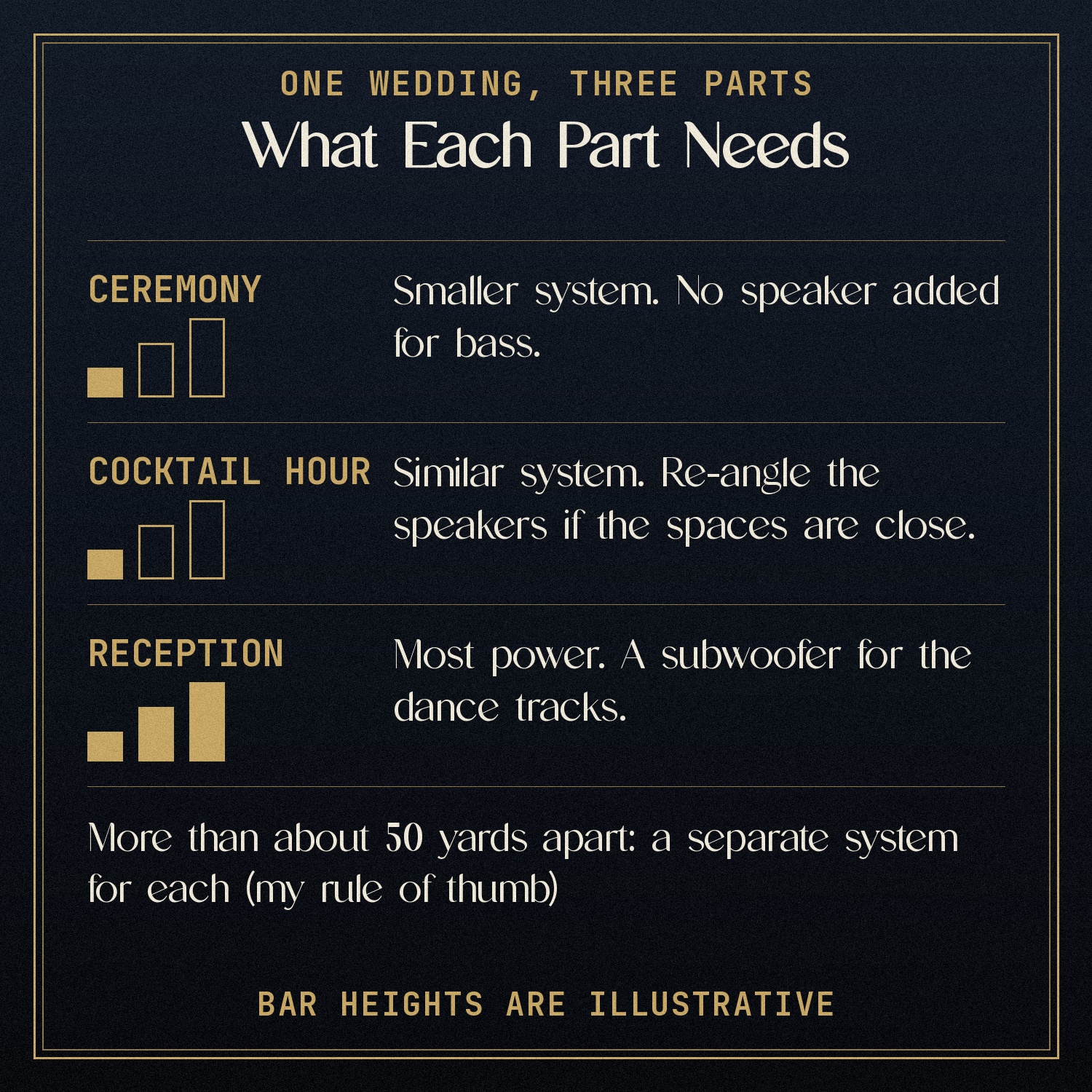
Think of the wedding in three parts. The reception needs the most power and volume. It takes a full sound system or a powerful column array, with a subwoofer, because it has to support dance tracks.
The subwoofer gives the low-end thump that you feel in your body when you are on the dance floor.
Bass frequencies are the longest wavelengths of the audible sound spectrum. Low-pitched sounds with long wavelengths carry farther, as the Physics Classroom explains. In my experience, bass is heard from a long way off, even through walls and trees.
The ceremony and the cocktail hour can probably use a similar system for each, and neither needs a speaker added just for bass. People do not dance at a ceremony, and they generally do not dance at the cocktail hour.
If the two spaces are close, the PA can be set up at the ceremony and re-angled toward the cocktail hour afterward. I have done that at several weddings.
If they are more than 50 yards apart (my rule of thumb), a separate system for each is a good idea. If the ceremony flows straight into a cocktail hour and reception blend, one smaller system for the ceremony and a bigger one for the rest of the evening works well.
For the hour after the ceremony, see the cocktail hour music guide. For help with consolidating segments and noise rules, start with the sound, power and AV guide. For music across the rest of the day, see the wedding music page.
Frequently Asked Questions
What do we do if our venue does not allow amplification?
Ask the venue before booking whether the rule covers battery speakers and microphones as well as plugged-in equipment. At one four-star resort wedding the ban covered battery rigs too, so I played completely unplugged and acoustic among the guests, and with a small guest list it worked.
Can we use the venue's podium microphone for the vows?
I would not. I do not use a podium microphone. It depends on the venue having one, it cannot be moved if it sits in the wrong place, and an outdoor ceremony in a field will not have one.
Podium microphones mostly suit churches, and in my view it is never the musician's or the DJ's job to run the venue's podium microphone. I treat a venue that relies on an outside vendor to run its podium microphone as a warning sign.
What happens if the wireless microphone starts cutting in and out?
Move the receiver so there is a clear line of sight between it and the microphone. Anything standing between the two makes interference worse.
Give Your Musician Two Facts and Ask One Question
The only technical information the person you hire needs from you is the number of guests and where each part of the wedding happens. From those two facts, they can size a speaker for each part.
Then ask one question: do you have microphones I can use for the ceremony and for the speeches? An act that brings them can save you from hiring a separate AV company just for that, and possibly a good deal of money.
- Four setups are worth asking about: battery, plugged-in, the venue's own system, and none. Each one comes with a different thing to check.
- My first choice is a performer's own cabled system, which reduces the chance of dead batteries and interference.
- Battery speakers carry two risks. The battery can run out, and a crowded Bluetooth band can cause dropouts.
- A venue's system depends on the person at the board. Ask who runs it that night, and ask to put your performer in touch with them.
- Without amplification, about 30 guests is the comfortable limit. Up to about 50 can work indoors or in very quiet surroundings.
- For the officiant and vows, a single wireless handheld on a stand is quick and works well.
- The reception needs a subwoofer. Spaces more than about 50 yards apart are worth a separate system each.
For questions about music at your own event, see the contact page.
Blog Categories
Latest Blogs