Wedding Music in Old Town Alexandria
Dylan Galvin is a Berklee College of Music graduate, magna cum laude, mentored by music legends John Mayer, Paul Simon and Livingston Taylor. Performing across the United States since 2009, now based in the DMV (Washington DC, Maryland, and Virginia), more than 1,500 events, including work for Coca-Cola, Wells Fargo, Lincoln, and CBRE.
A strict noise limit does not affect every kind of wedding entertainment equally. It hits a DJ's set harder than it hits a live musician's, for a reason almost nobody planning a historic-venue wedding has been told.
Old Town Alexandria is where that gap matters most in the DMV, because the neighborhood's own rules make the ceiling real instead of theoretical. The general picture of how live wedding music works, format by format, lives on the wedding music overview. This piece is about what changes once the venue sits inside Old Town's historic district specifically.
Why Old Town's Music Rules Aren't Just Preference
Old Town Alexandria's inventory of wedding venues is dominated by genuinely historic buildings, and historic buildings change the math before taste ever enters the conversation. Most of the marquee spaces are museums or preserved landmarks with hard curfews, no elevators, and rooms built to hold anywhere from a few dozen to a couple hundred guests, not the kind of hotel ballroom that swallows a 10-piece band without anyone noticing. A room that seats 72 for dinner under a plaster ceiling does not need, and usually cannot tolerate, the sound system that works in a 300-guest ballroom out in Tysons.
The budgets back this up. Alexandria's median household income is $113,600 (U.S. Census Bureau data via USAFacts, 2019-2023 estimate, updated February 2025), and Old Town weddings run on money to match. Small historic rooms and real budgets together are exactly the situation where the music decision deserves venue-specific thought, not a default package sized for a ballroom twice the size.
It also turns out to be the situation the whole DMV wedding market already flags as its top concern, just without the legal teeth. Sound, equipment, and power logistics are the single most common thing couples and planners ask about before booking wedding entertainment anywhere in the region, ahead of price itself: just over half of a counted sample of DMV booking calls (51%, 40 of 79) raise a sound or power question. Old Town Alexandria is the one neighborhood in the region where that same concern stops being a preference and becomes a legal ceiling, enforced by the city rather than left to a venue's house rules.
What Each Historic Venue Allows
Here is what each Old Town venue's own published rental information says about capacity and curfew. Confirm the current rules directly before booking. Venues update their policies, and the specific decibel number for a given address, covered in the next section, is worth confirming the same way.
Gadsby's Tavern Museum. The 1792 ballroom holds a 90-guest ceremony, 72 for a seated dinner, or 100 standing. Combining the Ballroom with the adjoining Assembly Room raises the reception ceiling to 160. Events end at 11 p.m., and the rental rooms sit up on the second floor with no elevator, so a full band's gear goes up a stairwell that was never built for it. The museum's own rental guidelines go further than logistics, too: amplified music is not allowed at all. A DJ is permitted, with a wireless system preferred, and museum staff monitor sound levels throughout the event; dancing is restricted to the Ballroom itself. A solo or acoustic act sidesteps the amplification question entirely, and the ballroom's wood floor and hard plaster carry acoustic volume well on their own.

The Lyceum. Alexandria's 1839 lecture hall seats up to 120 in theater-style rows for a ceremony, or up to 95 at tables for a reception, and runs until midnight, the most generous cutoff among the city's historic properties. The event space is on the second floor, reached by a light-duty elevator rated only for non-motorized wheelchairs, so gear still has to go up by stairs. A 22-by-9-foot platform stage gives a musician a genuinely elevated spot without extra staging, and unlike Gadsby's, The Lyceum's own rental terms allow either a DJ or a live band outright, with in-house PA rental available for $75.

Alexandria Black History Museum. A standing reception across both museum galleries tops out at 90 guests, with seated meetings or presentations capped at 45, and a firm 10 p.m. end time. A curfew that early reshapes the whole reception clock. If the ceremony starts at 5, cocktail-hour music has about five hours total to earn its slot rather than pad it. The museum's published rental terms don't spell out a specific live-band or amplified-sound policy, so that's a direct question to put to the venue rather than something to assume either way.
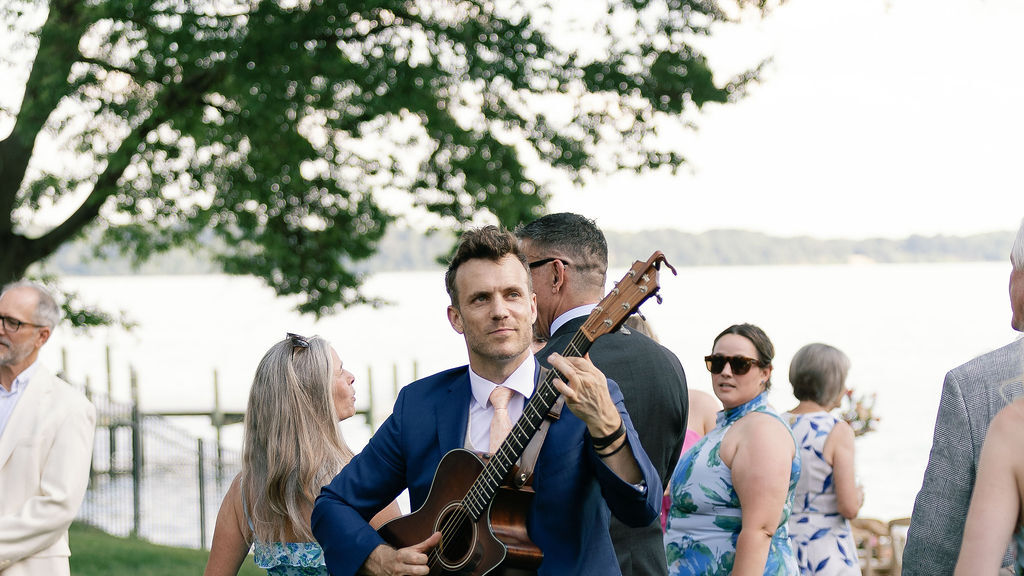
Carlyle House Historic Park. The 1753 stone mansion sits half a block off King Street. A ceremony alone can run up to 65 guests in the garden, 80 seated on the terrace, or 100 on the front lawn; book the full ceremony-and-reception package and the cap drops to 75 seated or 100 for a standing-only reception. Events run 4:30 to 10:30 p.m., with vendors required off-site by 11:30. Because the grounds sit in a residential area, NOVA Parks' own terms are explicit rather than left to inference: amplified music is highly restricted and any amplified instrument needs the site manager's advance approval, DJs and mic'd singers aren't permitted, and only small Bluetooth-style speakers are allowed outright. Acoustic string or guitar performers are the format the venue actually encourages, not simply "lightly amplified" ones.

The Athenaeum. The Greek Revival building run by the Northern Virginia Fine Arts Association hosts intimate events in one main room: up to 100 standing, 80 seated without a dance floor, or 60 seated with one, plus a smaller courtyard for a ceremony. Rental hours run mornings or 4 p.m. to midnight, Thursday through Sunday. NVFAA's own materials don't publish an amplified-music or live-band policy, so how the room actually handles volume is a direct question for the venue rather than an assumption to plan around.

Torpedo Factory Art Center. The exception to Old Town's small-room rule, at least on paper. Its waterfront main hall handles up to 220 seated, 400 theater-style, or 700 standing under high industrial ceilings, and the venue's own rental terms confirm dancing and amplified music are both permitted, making this the one Old Town venue actually built for a full band and PA rather than around one. Confirm availability directly before planning around it: the venue's own rental page currently states it is not accepting new rentals while the city works out new governance for the building, a status worth checking again closer to any given date.


What the Waterfront Adds
Wind is the part of a Potomac-side ceremony nobody plans for. It pushes sound sideways, so guests three rows back hear less than guests up front, and it hits a microphone or an instrument's top with low-frequency noise that no amount of skill fixes. Add water taxis, tour boats, and the general hum of a working waterfront, and amplification on the water stops being a luxury and becomes the difference between guests hearing a processional and watching it happen in mime. A windscreened microphone and a speaker placed with the wind in mind, not for looks, are standard practice for anyone who has done this kind of setup before. Boat-based receptions, City Cruises runs private charters from the Old Town dock, add engine noise and low hard ceilings to the same equation.
What Alexandria's Noise Rules Say, and Which Number Applies
Alexandria's noise ordinance does not hand a private wedding at a historic venue one clean number. Read the underlying code, not just the city's summary page, and two different decibel standards are both potentially in play, plus a third rule that applies no matter which one governs.
The ordinance's general public-places standard, §11-5-4.1, sets 75 dB(A) during the day (7 a.m. to 11 p.m.) and 65 dB(A) at night, measured at 10 feet or plainly audible past 50 feet, with nothing sustained longer than 60 seconds in an hour. That is the figure most summaries lead with. It is also written to cover public streets, sidewalks, parks, and private outdoor property that is open to the public for commercial or recreational use, and a private, invitation-only wedding reception, indoors or even outdoors, arguably is not "open to the public" in the way that section describes. The ordinance never states outright whether it reaches a private event at all.
A second, stricter standard almost certainly does reach one. §11-5-5's commercial-use table sets 65 dB(A) daytime and 60 dB(A) nighttime, measured at the property line, and it applies within 200 feet of any property where the predominant use is commercial. The code's own definition of "commercial" names entertainment facilities and hotels specifically, which describes a meaningful share of Old Town's historic-venue blocks. Settling which standard governs a specific address is a question for that venue's manager or the city's Office of Environmental Quality, case by case, since the code sets both standards without mapping either one onto individual properties. A third rule sits on top of both, the same for every property regardless of which standard applies to it: §11-5-4(2) covers any sound-reproduction device or musical instrument, amplified or not, at any hour, once it is plainly audible past 50 feet from the building it is coming from. That reach is what makes the acoustic-only recommendation below a partial fix rather than a full one: going unamplified shrinks how far the sound travels, and an instrument that still carries past 50 feet stays inside this same rule at whatever volume gets there. The ordinance's exemption list, §11-5-6, covers ten narrow categories: emergency vehicles and interstate trucking among them, along with activity permitted under the §11-5-7 variance process. A wedding gets covered the same way any of those other categories does: through that same §11-5-7 variance, the general permitting route behind the $50 Noise Variance Permit described in the FAQ below, open to any qualifying activity rather than reserved for weddings specifically.
The honest planning target is the stricter pair: 65 dB(A) daytime, 60 dB(A) nighttime. A format that clears that number clears the looser one too, and the 50-foot rule applies either way. A venue's manager or the city's Office of Environmental Quality can confirm which standard governs a specific address, and settling that question before a contract gets signed saves a difficult conversation later.

A working performer's own experience points to a similar practical marker, distinct from those official numbers: the general rule of thumb is that a venue close to residential areas tends to cut the music around 10 or 11 p.m. That is not a legal citation, just a read on how enforcement plays out on a given night, and it is worth planning around alongside the formal ordinance and the venue's own stated curfew.
None of that changes what keeps a dance floor moving once the music starts. A working performer's real answer to a strict ceiling has less to do with the ordinance and more to do with the soundcheck: the band has to check its sound at the same volume it plans to perform at. Some acts check quietly and turn up once the room fills, and that habit is exactly what causes the problem later in the night. Nothing kills a party faster than a band mid-song being told to turn down. The energy the room built up disappears the moment the volume does.
The safer structural fix is choosing a format that never needs to be told to turn down in the first place. A solo harpist, violinist, or guitarist can dial a PA down to fit almost any ceiling, because the instrument itself starts quiet. A drum kit alone, even completely unamplified, can run louder than either decibel limit on its own, which is the real wall a full band or a DJ runs into.
DJ or Live Music Under a Real Decibel Ceiling
The standard way to compare a DJ and a live band treats it as a cost-and-vibe decision, largely interchangeable once the budget lines up. A real decibel ceiling breaks that symmetry.
A DJ's connection to a dance floor runs through volume. The skill behind it is real: reading the room, sequencing the right song at the right moment, anticipating what a crowd wants before it asks for it. But a guest on the floor is not watching any of that happen. They are experiencing the output, and the output's volume does a large share of the emotional work. Turn that volume down to satisfy a strict limit, and a DJ's set loses a real part of what makes it land, with no way to make up the difference from the booth.
A live performer's connection runs somewhere else. A band or a solo act is doing something visible in the room while the audience listens, which reads differently than hearing a mix through speakers no matter how loud it plays. A full band still needs real volume: drums alone can clear either decibel limit unamplified, so a strict ceiling narrows what a band can do. A solo act, duo, or trio has the most room to work within that same ceiling, since the instrument starts quieter and the performance itself, rather than the decibel meter, holds the room's attention.
A strict decibel ceiling changes what a DJ can deliver in the room more than it changes what a live act can, and almost no comparison of the two says so.
What Years on Old Town's Public Stages Teaches About Booking a Private One
Old Town's public-venue circuit runs on a different clock than a wedding does. The neighborhood's Irish pubs and music venues book live acts from 9 p.m. to 1 a.m., for a crowd that is already there for its own reasons: a high-energy room, televisions running behind the bar, people walking in and out all night because the door is open to whoever wants to come in. A performer on that circuit is one part of a much louder environment, competing for attention with everything else happening in the room.
A private booking in the same neighborhood works on a different set of terms. The host sets the guest list, the door stays closed to the street, and the room holds only the people who came for the wedding. What that buys a couple is a quieter room and a crowd already invested in the day. That combination is what lets an evening hold people's attention from start to finish.
That distinction matters more than which specific historic venue a couple ultimately books. A ceremony musician or a reception band walking into a private Old Town event is not managing the same room the public-venue circuit trains a performer for. It is a quieter, more attentive room by design, and the format and volume choices that make sense in it are different from the ones a 1 a.m. bar crowd would ever notice.
Booking Music for an Old Town Wedding, Step by Step
A couple set on the neighborhood can start with the Alexandria wedding musician page for local vetting basics, then work through the venue-specific steps below.
Start with the venue manager, not the musician. Ask for the venue's exact noise restrictions before booking anything: whether there is a decibel ceiling, what time it starts, and whether it is a house rule or something the city enforces. Most managers will hand this over without being asked twice, but a newer or less experienced one might not think to volunteer it, so it is worth asking directly.
Once that number exists, it has to reach every act working the day. The ceremony musician, the cocktail-hour act, and the DJ are typically three separate bookings, and each one needs the same restriction relayed to them directly. That step matters more in Old Town than in most of the region, because the limit there is enforced by the city rather than set by a venue's own preference. A shutdown or a fine mid-event is a real risk here, and a genuinely bad way to lose part of a wedding day that has already been paid for.
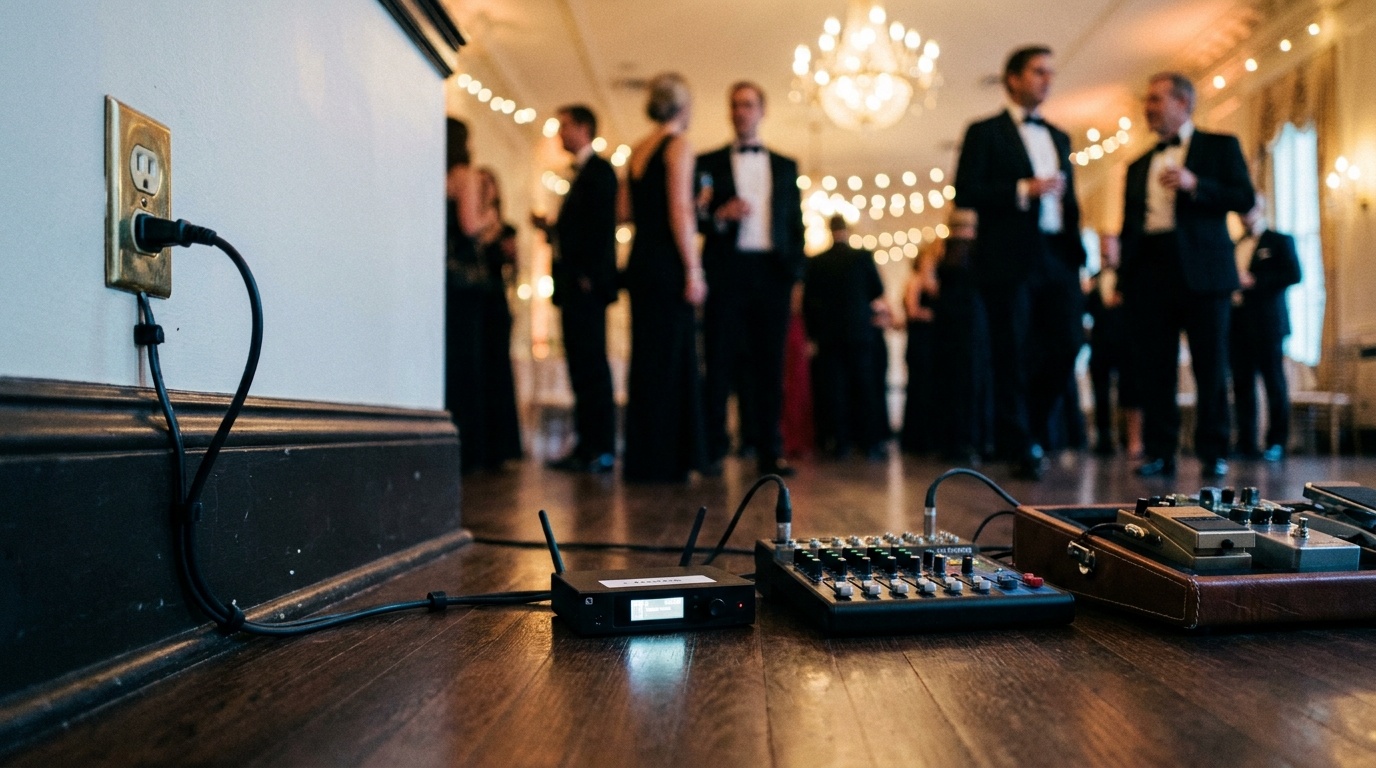
From there, match the format to the room rather than the other way around. In a 72-seat colonial ballroom or a single-gallery museum space, a solo performer or a duo fills the room with almost no equipment footprint, and a wireless setup can move from a garden ceremony to a terrace cocktail hour to an indoor reception without three separate load-ins eating into a tight curfew. In Old Town, a smaller format is simply the correct answer for the size of the room.
Musicians for popular Old Town dates get booked early, on the same general timeline as any in-demand DMV wedding vendor: 6 to 12 months out, sometimes longer for the venue itself, which often runs its own separate booking calendar. Once a couple has a shortlist, how to choose a wedding ceremony musician and the broader look at wedding musicians in Northern Virginia cover the vetting questions in more depth, and the Alexandria-wide guide to hiring wedding musicians is the better starting point for a couple whose venue is not in the historic district specifically.
Frequently Asked Questions
Do you need a permit for amplified wedding music in Old Town Alexandria?
Usually not for a private indoor event. Alexandria's $50 Noise Variance Permit, filed through the city's APEX system, applies mainly to amplified sound on city property: parks, plazas, and city-owned historic venues. A venue's own rental coordinator can confirm whether a specific booking needs one, and the city's Office of Environmental Quality (703-746-4065) handles the question directly.
What are Alexandria's noise limits, and can you play acoustic-only if amplification isn't allowed?
Plan around 65 dB(A) in the day and 60 dB(A) at night, the stricter of the two standards the ordinance could apply, plus the separate rule that amplified sound cannot carry past 50 feet from the building regardless of time. Acoustic-only formats, a solo or duo especially, clear both numbers in a way a full band or a DJ usually cannot.
What time does the music have to stop at an Old Town venue?
It depends on the venue, not a single citywide hour. The Alexandria Black History Museum ends events at 10 p.m., Gadsby's Tavern Museum at 11 p.m., and The Lyceum allows music until midnight. Build the reception timeline backward from whichever curfew applies.
Is a DJ or a live performer the safer choice for a noise-restricted venue?
A live performer generally, and a solo or small group specifically. A decibel ceiling affects a DJ's set the most, a full band less, and a solo or duo act the least, because a DJ's connection to the room runs entirely through volume.
What does a wedding musician cost for an Old Town-size venue?
The Wedding Report's 2025 Alexandria estimate for a wedding of 50 to 100 guests puts the entertainment line item at $1,796-$2,196, with DJ/MC service alone estimated separately at $1,209-$1,477. That guest-count range better matches most Old Town venues' published capacities, roughly 65 to 160 guests, than the same source's 250-guest estimate, which prices its combined DJ/MC line item at $1,733-$2,119. The Knot's Real Weddings Study puts the national average for a live wedding band alone at $4,500, well above either Alexandria figure. Both Wedding Report numbers blend format and guest count into one estimate rather than pricing a solo act, a duo, and a full band separately, so neither should be read as proof that a smaller act costs less locally.
How far ahead should music be booked for a popular Old Town venue?
On the same general timeline as any in-demand DMV wedding vendor: 6 to 12 months out, sometimes longer if the venue itself runs a separate, earlier booking calendar. Popular Old Town dates and venues go first.
What the Ordinance Can't Decide for You
Every section above is organized around what the ordinance and the venue decide: format, volume, timing. None of it decides who the music is for.
Once the noise rules and the venue logistics are settled, the honest answer to what matters comes down to the guest list. Think about who is in the room: parents, grandparents, and the couple's own friends, people who will not share much musical taste beyond the day itself. The songs that land with all of them at once matter more than a personal playlist, and the ceremony is generally the right place for the strictly personal choices, not the reception floor. How a performer talks about that, whether they are thinking about the whole room or just the couple's own list, is a better read on the booking than anything on a set list.
Questions about music for your own Old Town Alexandria event? The contact page is here.
Sources
- Alexandria Noise Control Ordinance (full text, §11-5-4 through §11-5-7)
- City of Alexandria: Noise Control (Noise Variance Permit, APEX system, Office of Environmental Quality)
- City of Alexandria: Rentals and Private Events at Historic Properties (capacities, curfews, access notes)
- The Wedding Report: 2025 Alexandria, VA average wedding cost estimate, 250 guests (total $59,060-$72,184, entertainment line item $1,733-$2,119)
- The Wedding Report: Alexandria, VA cost estimate, 50-100 guests (for a smaller Old Town wedding)
- USAFacts (U.S. Census Bureau data): Alexandria city, VA median household income, 2019-2023 estimate, updated February 2025
- The Knot: Real Weddings Study, average cost of a wedding band
- NOVA Parks: Carlyle House Historic Park
- Torpedo Factory Art Center: event rentals (includes current rental-status notice)
- The Athenaeum / Northern Virginia Fine Arts Association: rentals
- Library of Congress: Carol M. Highsmith Archive (hero photo, public domain)
- Library of Congress: Historic American Buildings Survey (venue photos, public domain)
- Gadsby's Tavern Museum: Rental Guidelines (amplified-music policy, capacities, curfew)
- City of Alexandria: Rentals at The Lyceum (capacities, stage, elevator, DJ/band policy)
- City of Alexandria: Rentals at the Alexandria Black History Museum (capacities, curfew)
- NOVA Parks: Carlyle House Wedding Rentals FAQ (capacities, hours, amplified-sound restrictions)
- Northern Virginia Fine Arts Association: The Athenaeum rentals (capacities, hours)
Blog Categories
Latest Blogs