Live Music and a DJ at the Same Event: How the Hybrid Handoff Actually Works
Most guides to hiring event entertainment treat live music and a DJ as a fork in the road: pick one. That framing falls apart the moment the venue itself refuses to cooperate with either choice.
Dylan Galvin is a Berklee College of Music graduate, mentored by music legends John Mayer, Paul Simon and Livingston Taylor. Performing across the United States since 2009, now based in the DMV (Washington DC, Maryland, and Virginia), more than 1,500 events, including work for Coca-Cola, Wells Fargo, Lincoln, and CBRE.
Why "Live Music or DJ" Isn't Always the Real Question
A single-room event with one dance floor and one guest list usually settles this question on its own: a band or a DJ, whichever fits the vibe better. Split the venue across two levels, or split the guest list between people who want to dance and people who came to talk, and that same choice starts failing no matter which side of it you pick. A full band can be too loud for half the room to hold a conversation. A DJ anchored to one booth can leave whatever space it isn't in feeling like the party is happening somewhere else. Neither format did anything wrong. The venue and the crowd just aren't giving either one a fair shot.
If you're still working out whether live music or a DJ is the better fit for your event in the first place, that comparison is covered here. That question already has its own answer elsewhere on this site. What follows is for the event where the venue has already pushed you past it, toward a format that does both.
What the Hybrid Handoff Looks Like
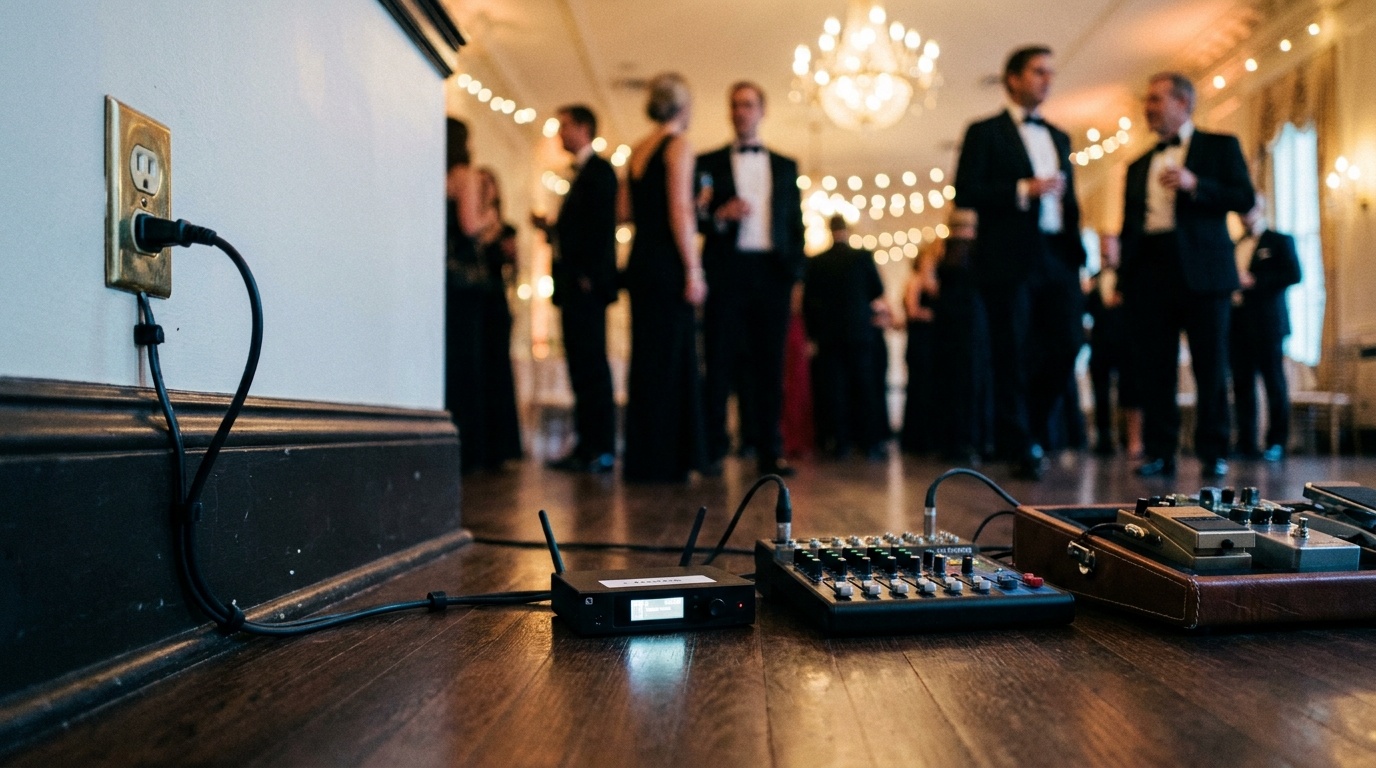
A hybrid live-and-DJ format is one performer, not two vendors coordinating a schedule. The same person who plays guitar and sings also runs the DJ portion, through the same rig, with no separate booth to build, tear down, or hand off to. During a break in the live set, recorded tracks take over on the same sound system the live performance was just running through. When the live set picks back up, it's the same performer stepping back in, not a second act arriving to take over. This is a different tool from live looping, which builds layered sound out of the live performance itself. Here, prerecorded tracks stand in during the break, the same way a stand-alone DJ set would.
That's a real structural difference from what most hybrid entertainment means nationally. The dominant version, the one most guides and vendor sites describe, still involves two separate acts: a full band or a group of ensemble musicians playing alongside an independent DJ, each running their own equipment, each with their own contract, coordinating a handoff between two businesses that may never have worked an event together before. The shift shows up in the wider market too. Madison Hernandez of Vignette Artists, quoted in The Knot's band-versus-DJ cost breakdown, describes it this way: "As technology evolves, hybrid entertainment, such as combining live musicians with DJ services, continues to grow in popularity, allowing couples to curate a dynamic, immersive experience throughout their event."
The switch back to live performance is not on a fixed clock. It comes from reading the floor: whether the energy calls for a song people can sing along to, or whether the room has thinned out enough that a quieter live set fits better. A wireless setup is what makes the return clean. The performer does not have to walk back to a fixed position to pick the guitar back up. The instrument and the mic go wherever the room needs them next. The roaming setup itself is covered in more depth here, since it's the mechanical foundation the whole hybrid format depends on.
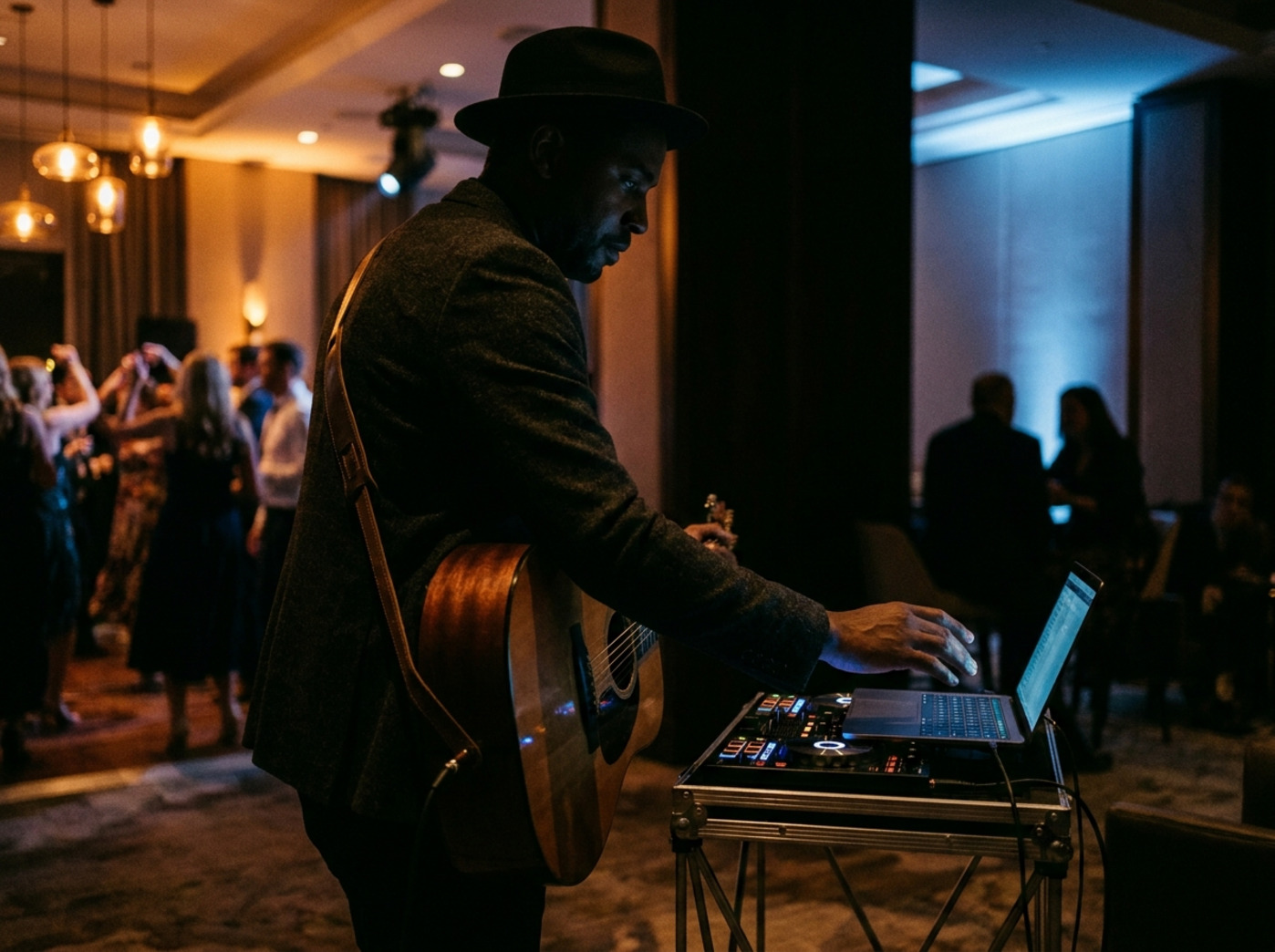
The switch is a read of the room, not a cue on a clock.
Whether a given musician can pull this off is worth asking directly and early. Playing guitar and singing is one skill. Reading a room well enough to pick the next track, and knowing when to set the tracks aside and pick the instrument back up, is a different one, and not every performer who can do one can do both. A hybrid setup only works when the same person owns both halves of it.
The Real Case: A Two-Level Venue Where One Format Wouldn't Have Worked
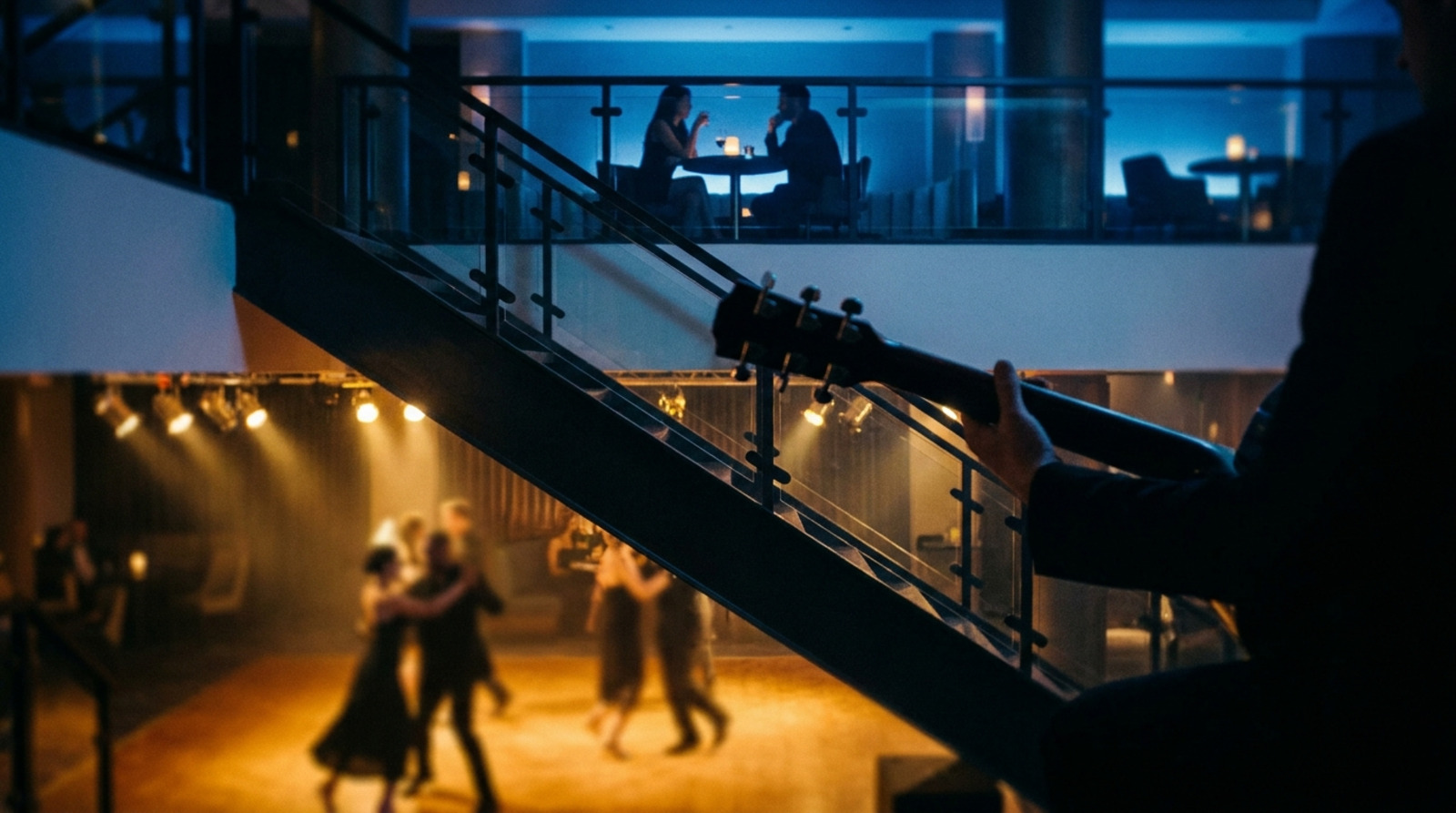
A Canadian company booked Dylan for its annual anniversary party at the Blackwall Hitch in Baltimore, a venue built on two levels, a main floor and a mezzanine, with somewhere between 150 and 200 guests spread across both by the time the night was underway.
A full band was the first idea the group considered, and the first one that didn't survive contact with the room. At that guest count, in a space with two open levels feeding sound into each other, a band loud enough to fill the main floor would have made conversation on the mezzanine, and probably most of the main floor too, close to impossible. A stationary DJ booth had the opposite problem. Wherever it was set up, one entire level would spend most of the night watching the entertainment happen on the other floor, never actually part of it.
What ran was neither. Dylan worked the night as one continuous set across both levels: performing live on guitar and vocals for stretches, then shifting into a DJ segment through the same sound system during a break, all while moving physically between the main floor and the mezzanine throughout the night, never anchored to either one. A guest upstairs was not waiting for the entertainment to eventually reach them. It already had, because nothing about the setup was anchored to a single spot to begin with. When a DJ segment ended and live performance picked back up, it picked back up wherever the room's energy was in that moment, not on a schedule set in advance.

The actual staircase, the actual night, Blackwall Hitch, Baltimore.
By the end of the night, the guest list had split itself into three groups without anyone planning it that way: a cluster still dancing, a group singing along near whichever level the live set had landed on, and a set of people who had talked through nearly the entire event and never left their seats. Nobody had to choose one experience for the whole room. The fuller case for when a single performer beats a full band or a DJ outright is covered here, for readers weighing that question on its own.
What This Format Actually Solves (and Where It Doesn't)
A hybrid live-and-DJ setup earns its place when a room is split: multiple levels or rooms that don't share one sightline, or a guest list with a real mix of people who want to dance and people who came to talk, spanning enough generations that no single format, band or DJ, would hold everyone's interest at once. The format solves for energy that is already fractured across the room. It doesn't try to force that energy into one activity.
It is not the better choice for every event, and it should not be sold as one. A single room built entirely around one big dance floor, where the whole point of the night is getting everyone onto it at the same time, is usually better served by a straight band or a straight DJ. Either format can commit fully to that one job. A hybrid setup is solving a coordination problem a simple room does not have, and adding that complexity where it is not needed does not add value, only an extra decision that did not need to be made.
The Blackwall Hitch case above happened to be a corporate event, and that is not incidental. Split-level rooms, mixed-generation guest lists, and crowds that want different things from the night show up just as often at a company anniversary party or a client dinner as they do at a wedding reception. Corporate and private events run into this exact problem regularly, and the fix is the same one either way. If a wedding is what's on the table, the same split-energy logic applies to a reception with guests who came to dance and guests who came to talk, and the wedding-specific version of this planning is covered here.
What to Ask If You Want This Format
Booking this format comes down to whether the performer you're considering can do both roles well. A few questions are worth asking directly before booking, not after.
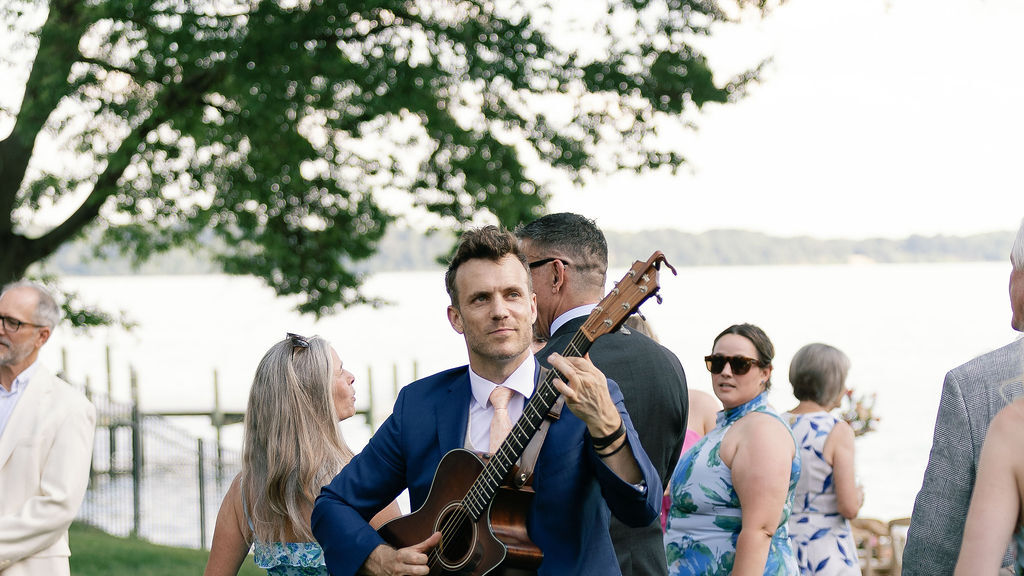
The person you're actually vetting against this list.
- Is this one performer running both roles, or two vendors who'd need to coordinate a handoff between sets? A hybrid setup only delivers the smooth version described above when it's a single person doing both jobs. Two separate acts trying to hand off to each other reintroduces exactly the scheduling and equipment coordination this format is supposed to avoid.
- How are the tracks for the DJ portion chosen? A pre-built playlist run on autopilot is a different product than someone reading how the room is behaving in the moment and picking accordingly. Ask specifically who makes that call and how it happens in real time.
- What triggers the return to live performance? A set time on a schedule or a read of the room in the moment produces a different result. Ask specifically whether the switch happens cleanly, with nothing playing in between, or whether there's a gap while equipment changes over.
- If the venue spans more than one level or room, how is sound coverage handled across the whole space? One setup carrying both the DJ segment and the live set consistently across a split venue is a different capability than a rig that only really covers whichever room it's physically standing in. This is exactly what made the difference at the Blackwall Hitch.
- Is there real footage of an actual handoff, or only a highlight reel of the live set? A polished clip of someone playing guitar does not show whether they can run a DJ segment and switch back cleanly. Ask to see the transition itself. Cocktail hour is one of the places this same hybrid format shows up, often before a guest realizes the entertainment has changed shape at all.
FAQ
Do you need two vendors for a hybrid live and DJ setup, or can one performer do both?
One performer can run both roles, and that's the version of this format worth booking. A single person playing live and DJing through the same rig skips the coordination two separate vendors would otherwise need, and it's what makes a clean handoff between the two possible in the first place. Not every musician who plays live can also run a DJ segment well, and that's worth confirming directly.
Does a hybrid live and DJ setup cost more than just a band or just a DJ?
It's typically a single vendor fee covering both roles, which usually puts the total closer to booking one band or DJ than to paying for two separate acts. A full band with multiple musicians and a standalone DJ are each their own line item. A hybrid setup with one performer covering both roles is not stacking those two costs on top of each other. The real number depends on the specifics of the event, so treat any online estimate as a rough starting point.
What kind of venue needs a hybrid live and DJ format?
A venue that physically splits guests across more than one level or room is the clearest case. Restaurants and event spaces with multiple levels, and any room with a separate lounge or mezzanine where a fixed booth would leave part of the crowd disconnected, both create the exact problem this format solves. A single open room built around one dance floor usually does not need it.
How does the handoff between live performance and DJ sets work without dead air?
The same performer and the same sound system carry straight through the switch, so there's no equipment changeover or second vendor arriving to take over. Recorded tracks start on the system the live set was just running through, and live performance resumes the same way when the moment calls for it. Nothing goes quiet, and no one new walks in partway through.
Is this only for weddings, or does it work for corporate and private events too?
It works for both, and the real-world case behind this post was a corporate anniversary party, not a wedding. Split-level venues and mixed-energy guest lists show up at company events and private celebrations just as often as at wedding receptions. The same format solves the same problem regardless of what kind of event it is.
The Bottom Line
A hybrid live-and-DJ setup solves one specific problem: a room, or a guest list, that no single format can serve all at once. A dance floor gets to stay a dance floor for the people who want it, while the rest of the room keeps talking, and nobody ends up on the wrong end of the night. That only works when one performer can run both halves. It means deciding what plays next by reading the room in the moment. It also means the performer moves through the whole space over the course of the night. When the venue itself is forcing that choice, that's exactly the problem this format is built to answer.
If a split-level venue or a guest list pulling in more than one direction is part of what's being planned, the contact page is where that conversation starts.

The Bottom Line.
Blog Categories
Latest Blogs