Corporate Events
Corporate Holiday Party Entertainment: How to Choose It and Book It Before December Fills
Performing across the United States since 2009, now based in the DMV (Washington DC, Maryland, and Virginia), more than 1,500 events. Mentored by music legends John Mayer, Paul Simon and Livingston Taylor.
Booking a band, a DJ and a fire poi dancer to perform at the same time wastes money. Each one asks the room to stop talking and watch, and a room can give that attention to only one act at a time.
Choosing corporate holiday party entertainment comes down to four decisions: what kind of act to book, how much holiday music a set can carry, how to book when the date is close, and what to confirm with the venue. The advice comes from one working performer. Set lengths, arrival times, song counts and quotes vary by act, so each one is worth asking about.
Does Your Evening Need a Spotlight Act or an Ambient One?
Start with what the act asks of your guests. A live band, a DJ or a fire poi dancer has a spotlight effect. It leaves little room for conversation and forces people to pay attention to it. That works well when spectacle is the goal.
One performer's rule is that two spotlight acts at once are a huge distraction. While a spotlight act performs, everything else needs to stop, or both acts are wasted. It is like trying to follow your favorite album and your favorite movie at the same time.
Ambient performers work differently. They can play through the night, and they can overlap with each other without getting in each other's way. Dancers and champagne-skirt-style performers, who add a wow factor without needing a stage, are examples. Ambient acts should stop when a spotlight act starts, and too many of them at once also make a mess. Spending the budget on the right type of performer for each moment of the night works better than spending a lot on the biggest show.
Advice to mix it up gives you no direction. Think of a recipe that says only to mix the ingredients. A better starting point is a set of three questions about your own evening. Do guests sit and watch? Do they talk to each other while the entertainment sets a background mood? Or do they do some of both? Once you have your answer, arrange the acts so each part of the night has one job. A dinner built for conversation and a wow moment built for attention belong at different times in the program.
For a side-by-side look at bands, DJs and solo formats, see the corporate and private event entertainment guide. The private and corporate events page covers how live music fits the wider range of company events.

How Many Christmas Songs Can One Set Carry?
In one performer's set of 10 to 14 songs, one to four are Christmas songs. That gives guests the feel of the season without being bombarded. Guests, the vendors and staff working your event have probably already heard a lot of Christmas music by the time they arrive, so the set mixes holiday songs in with the rest.
Clients put it in a few ways. One call asked for "elevated holiday music," and another asked for known songs people can sing along to, mixed with "one or two Christmas songs."
Listen for a specific number, since the exact figure varies by act.
Repertoire is usually clear before booking. If you want songs from one tradition, or none at all, you will find out on the first call. Many performers who are not marketed as exclusively religious can learn a few specific songs, and it is always worth raising before the event. Ask whether the holiday songs a performer plays are religious or secular Christmas songs.
Seated Dinner or Standing Mixer: What Changes in the Music
At a seated dinner the volume is lower. Guests eat and talk quietly, and the whole room is quieter. High energy competes with that part of the evening and is almost always obnoxious. Dinner also lends itself a little better to instrumental-only music.
A standing mixer runs louder. The chatter is louder, so higher energy works much better, though not maximum energy. Medium to medium high is the range that works. A performer who roams at a mixer can create a pleasant surprise for guests who had not noticed the performer, especially when the performer walks up and sings with them personally.
Song choice matters little in either setting, and both instrumentals and vocals work in both.

Close to a table is one of the most awkward places to put a live performer at a seated dinner. A performer can turn the PA down but cannot turn down the volume of the performance going into it. If the music is too quiet, guests far away lose it. If it is too loud, the guests next to it cannot hear each other. One performer's rule is several feet between the performer and the nearest table. Ask where the performer plans to stand relative to the tables.
If the evening splits between dinner and mingling, tell the performer where the room changes, since energy and volume change with it. A discovery call before the event is the place to do that. Also ask whether the performer can carry the whole arc of the night, from arrival ambience through dinner to an upbeat final hour.
If your party is built around remarks and an auction, the gala and nonprofit entertainment guide for DC covers how music fits around a program like that.
What Moves the Price of Holiday Party Entertainment
In one performer's experience, band size moves a quote the most. A ten-piece band costs more than a five-piece, and a four-piece costs more than a three-piece. Solo, duo and trio acts are generally a little more affordable. Weekdays can also lower a price, because musicians book less often on weekdays than on weekends.
Travel comes next. When a performer lives within two hours of the venue, travel usually adds little. Most large cities have a lot of professional musicians within two hours of a venue, which gives you plenty of options. Some performers include all travel in their rate, and travel adds a significant amount mainly when a performer has to fly.
A set list changes the price only when you request songs the performer does not already play, because learning them adds rehearsal time.
In this performer's view, December changes who is free, and demand is not much of a factor in price. If a quote adds a December charge, ask what it covers.
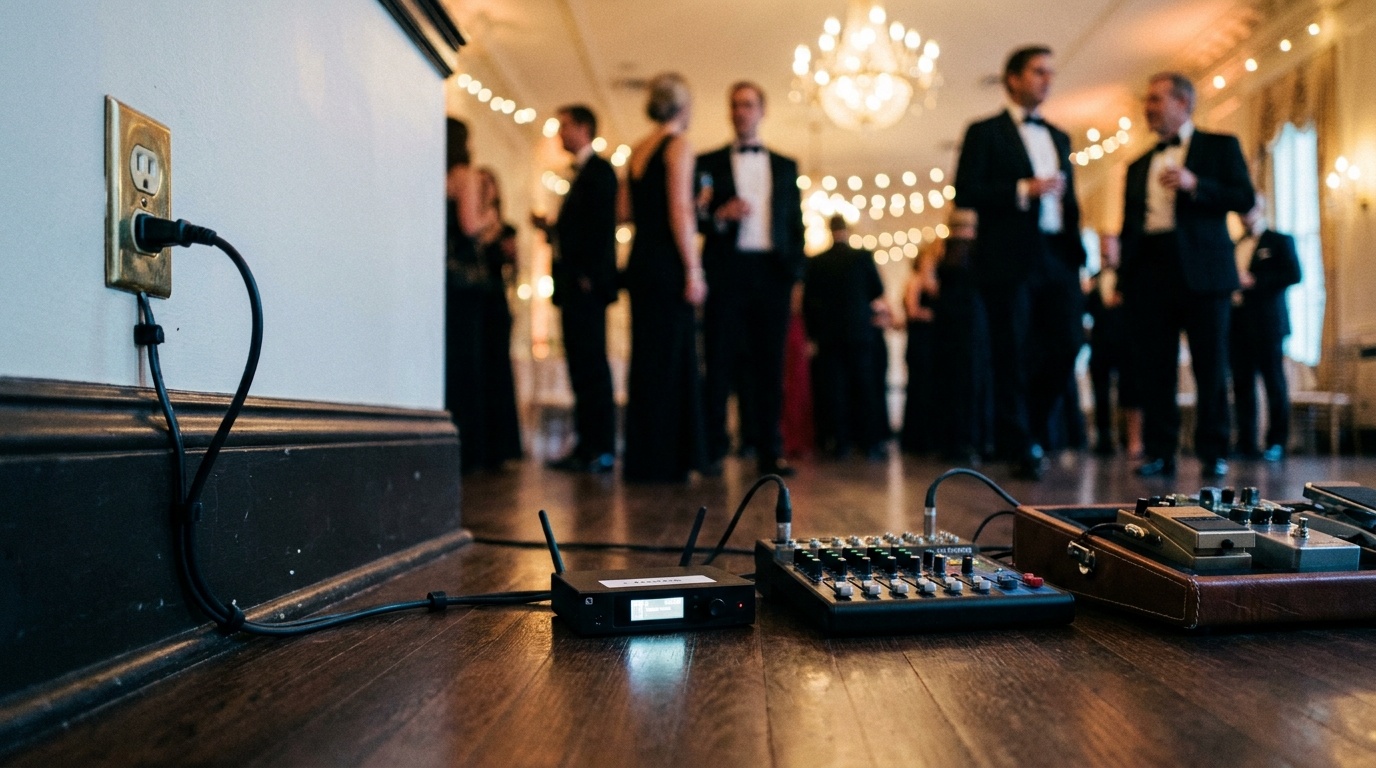
Sound equipment is the other cost to sort out. Almost every event needs audio, so it is worth asking an act whether it can cover it. A venue that needs many speakers across multiple rooms is typically a job for a dedicated AV company. One or two sound systems in a room with a few wireless microphones can sometimes be covered by a performer, a band or a DJ without a third party.
For market price comparisons across act types, the guide to hiring a musician lays them out.
Set the entertainment line before the catering tasting, while the whole budget is still open.
Calling Late: What Holiday Party Entertainment Is Still Available
ezCater's 2025 Workplace Holiday Party Trends Report, released in November 2025, surveyed 1,002 full-time employees and 603 workplace party decision-makers. It found 82% of employees planned to attend, up from roughly 70% the year before, and 51% of businesses increased their party budgets. It also found that 93% of planners agree food is the top driver of social interaction, and 83% of workers say holiday events help them bond with coworkers. Challenger, Gray & Christmas recorded in-person parties climbing from 27% of companies in 2021 to 64.4% by 2023.
In one performer's experience, October Friday and Saturday evenings are very, very unlikely to be available at the last minute. Weddings fill October, sometimes booked over a year out. December books up very quickly, though not as early as October, because everyone with a holiday event fills the calendar in one big rush.
The workaround is the day of the week. This performer says Sunday and Monday through Wednesday are generally available no matter what, and Thursday is possible. A morning or early afternoon start is a little more likely to be open. Friday and Saturday are generally booked far in advance. A party that falls on a slow day is one way to get a performer you want.
Song requests set the other limit. By this performer's estimate, it takes a few weeks to learn, rehearse and polish a song for live performance, and a few months if you want a long list of requests that are not already in the performer's repertoire. Some performers say a song takes only a few days, and some who say that work from a tablet or chart clipped to the mic stand. For background music that may not matter to you. A performer reading a screen cannot connect with the people in the room. A long list of specific titles is where a late call runs out of time. If you call late, loosen the set list or book the performer on an off day.
Before you book anyone, get on the phone. Make sure the performer understands what you want and can play the holiday songs you want. A good performer should be eager to talk. Contact three to five performers through their own websites, ask who is available, then call the available ones and give them the specifics of the event. If you need something quick and lower cost, marketplace and gig-booking sites exist. Going direct tends to cost more in this performer's experience, and it brings better service and direct contact. The tradeoff is availability.
Finally, ask whether your date is confirmed and what holds it.
Load-In, Arrival and Sharing the Room
One performer arrives 90 to 120 minutes before the start time, and sometimes earlier for a duo, a trio, a full band or a party in multiple locations. A hotel or venue with security, or a complicated elevator route to a rooftop, adds time. Keep at least 20 minutes between the end of soundcheck and setup and the start time, so the performer is not soundchecking as the first guests walk in. Arrival times vary by act and venue.
Washington-area corporate rooms include places like the Smithsonian's National Air and Space Museum and the InterContinental Willard. At large DC buildings, one of the trickiest logistics for a band is getting a lot of equipment through a security checkpoint and onto a small elevator. It can take multiple trips. Sometimes it also means walking across an upper floor to a second, smaller elevator bank. Stairs are out of the question, especially for a rooftop. Confirm that the elevator is big enough for every member's equipment, and settle the plan by phone beforehand. Power, wireless microphones for toasts and AV conflicts are covered in the guide to sound, power and AV for live music.
If a DJ shares the room, make sure the DJ and the performer talk to each other. They need to know when to perform and when to stay silent. It can work well with good communication. Without it, the result can be a total mess, and the frustration between them will be picked up by some of your guests.
Two rooms can change the whole plan. At one event, a client rented an entire restaurant and wanted live music in two rooms that were not next to each other, with no break in either. A colleague who ran a large entertainment agency said it could not be done. The solution was two sound systems chained to one mixer and a wireless unit. The performer played three to four songs in one room, then an instrumental that covered the walk to the other room, playing and talking with guests along the way. Three to four songs there, then an instrumental back. This went on all night. Guests in each room kept hearing live music, and the walk looked like part of the performance.
One performer's process starts with a discovery call and a written itinerary for each event, with room to change it on the night.
Two more confirmations belong on your list. In November, finalize the run-of-show, load-in details and special requests. In the final two weeks, confirm call times, parking and the on-site point of contact.

Questions to Ask Before You Sign
- "Can you play any Christmas or holiday music at our event, and if so, how many songs per set can be Christmas music?" A good answer is a specific yes with a number, such as two to five songs per set. Watch for vague answers such as "I might be able to play some Christmas music, I guess," or "Oh yeah, I can play Christmas music," with no detail on how, what, or whether the songs are religious or secular.
- "Are you able to provide AV and wireless mics as part of one of your packages?" Ask whether the act can cover the sound and wireless microphones and whether that is included in the quote. The answer decides whether you hire AV separately.
- "Do you include your travel costs in your quote, or is that a separate charge?" Some performers include all travel in the rate and others add it later, and surprise charges after you thought you were done paying are the risk here.
- "What happens if you're sick on December 13th?" A good answer is specific about who covers for the performer and how that is arranged.
- "Can I see unedited live footage?" Phone video from a live event shows what your guests will hear.
FAQ: Corporate Holiday Party Entertainment
Do we need a DJ or a dance floor at a corporate holiday party?
Usually not. One performer does not recall a corporate holiday party where everyone danced. Dancing is generally reserved for private parties and weddings, coworkers feel less comfortable dancing together, and the atmosphere is a little more formal. Christmas songs usually bring up nostalgia, warmth and a sense of being connected, and rarely open up a dance floor.
How long does a performer play, and what happens during breaks and speeches?
One performer's typical set lasts 45 to 55 minutes, and a break lasts 15 to 20 minutes. For some events sets and breaks run longer, up to an hour and 20 minutes or an hour and a half. They are always timed around presentations, speeches or the moments the host wants. If a speech needs a microphone, the handoff is covered in the sound, power and AV guide. Ask each performer what set and break lengths they use.
Can guests request songs on the night?
Some performers take live requests, so ask. Plans and run sheets can change on the night. Sometimes the set list changes at the last minute, sometimes an extra microphone is needed, and sometimes guests walk up with a request. Ask whether the performer takes requests on the night and is comfortable with guests singing along or playing with them.
What if the songs we want are not in the performer's repertoire and there is no time to learn them?
Ask whether the performer can DJ those holiday songs as recorded music during set breaks. Recorded music through an amp does not sound great, because amplifiers color the sound, so ask whether the performer brings a full PA system. One performer keeps a few go-to holiday requests ready, so ask about those.
What should we tell a performer on the first call?
Have these answers ready, because a prepared performer settles them before the day. How many guests are coming? Is the music indoors or outdoors, downstairs or upstairs? Should the performer play instrumentals or sing? Should the performer roam or stay in one place? What type of songs, and from which genre and decade? Will anyone need a microphone? Each performer's process differs.
Decide Whether Your Guests Should Talk or Watch
A holiday party goes better when each part of the evening has one job. Decide first whether guests should sit and watch, talk while the music sets the mood, or do some of both.
- Ask what each act demands of your guests. Bands, DJs and fire dancers hold the whole room, while ambient acts share it with conversation, so give every part of the evening a single job.
- Song counts differ from one performer to the next. One performer plays one to four holiday songs in a set of 10 to 14, so ask each act for a specific number.
- Dinner calls for lower energy and a spot several feet away from tables. A standing mixer can take more energy, short of the maximum.
- Quotes rise with band size and can fall on weekdays. Ask whether travel and wireless microphones are in the quote, and ask if the act can handle sound itself.
- If you call late, aim for a Sunday through Wednesday date or a start earlier in the day, and be ready to loosen the set list. A long request list needs a few months.
- Arrival times vary by act, and one performer's is 90 to 120 minutes early. Check that the elevator will hold every member's gear.
Questions about music for your own event? The contact page is here.
Blog Categories
Latest Blogs