Private Events
Engagement Party Songs: How the Set Actually Gets Built
An engagement party plays a lot closer to a baby shower or a birthday than to a wedding: people catching up over dinner, no processional, no cued first dance, and no expectation that the whole room ends up on a dance floor at some point in the night.
Dylan Galvin is a Berklee College of Music graduate, mentored by music legends John Mayer, Paul Simon and Livingston Taylor. Performing across the United States since 2009, now based in the DMV (Washington DC, Maryland, and Virginia), more than 1,500 events, including work for Coca-Cola, Wells Fargo, Lincoln, and CBRE.
The Playlist Assumes a Schedule the Party Doesn't Have
Most pages about engagement party songs treat the event as a compressed wedding: pick fifteen or twenty good songs across a few moods, and the job is done. That framing borrows a structure this kind of party doesn't have. A wedding comes with built-in musical cues: a processional, a first dance, a reception that's generally expected to build toward a dance floor at some point in the night. An engagement party comes with none of that. The center of gravity is people talking, sitting down to eat, and telling old stories. A packed dance floor was never the goal for a night built like that.
Without a ceremony or a fixed dance-floor moment to plan around, a flat list of good songs, wedding-shaped or not, is the wrong tool for the job. This site's case for skipping a rigid engagement-party rulebook makes that same point about the whole event. This page picks it up specifically for the music: what a set needs when there's no ceremony, no first dance, and no guaranteed dance floor to build toward. For how that connects to music planning at the wedding stage as well, the broader approach is covered here.
A lot of this planning happens on the same clock every year: nearly 40 percent of all engagements occur between November and February, which puts a large share of engagement parties into the same few months, right when many of those same couples are also starting to plan a wedding.
Turning a Vibe Brief Into an Actual Set
A brief like "chill but upbeat" or "alt rock into country, 90s music" is all the information needed to know exactly what to do with it. The resulting setlist gets rooted in the songs that match that genre, then extended outward through complementary genres, styles, and artists, the same way Spotify's own recommendation engine strings related songs together, except the judgment call here comes from experience and taste, built up over time rather than pulled from a listening history.
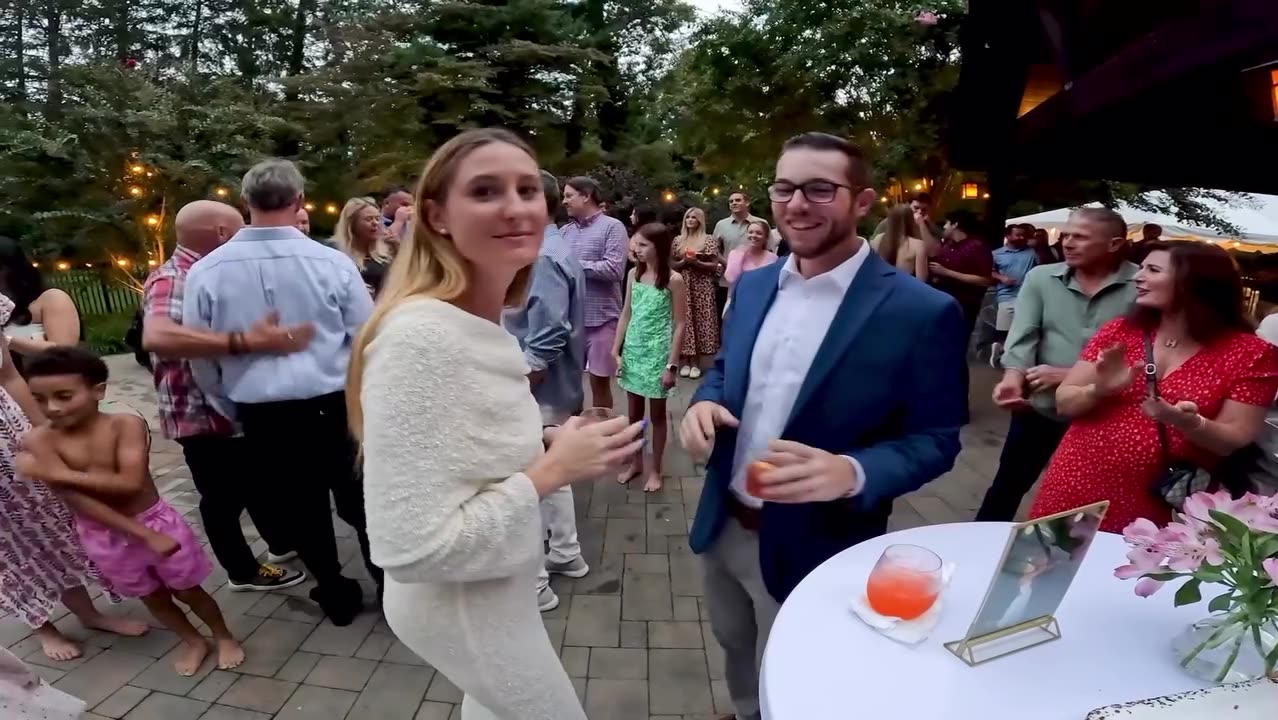
At one backyard engagement party in Lorton, Virginia, roughly 75 guests gathered for what the couple called a "fancy backyard barbecue." The booking was originally quoted as a one-hour window and grew to two hours once the couple decided they wanted more music time, after moving their own start earlier. Their brief, in their own words: "chill but not too quiet... nothing rowdy, but still enough upbeat." The genre ask covered two audiences at once: country and, in their words, "whatever you hear at a bar, covers of popular songs," for their own friends, plus "some classics mixed in" because the parents were "from the 60s."
The resulting set ran from Van Morrison, Tom Petty, James Taylor, and Sinatra up through Billie Eilish, John Mayer, and Taylor Swift, a real range built for one specific room and one specific brief. There was no dance floor, no ceremony, no formal reception. Just people who had flown in for the weekend, catching up over dinner.
A year later, the same couple came back to book their wedding ceremony and cocktail hour. Their entire instruction was "do what you did last time." The vibe and the emotion carried over unchanged, well ahead of any specific song choice, with one real exception: the ceremony itself needed exact songs at exact moments, vocals stripped from each one so the bride is spotlighted. Everything else about the booking stayed close to what had already worked the first time. The setlist itself remained only a template to work from, ready to bend if the room called for something different.
The Guest List Has More Than One Generation on It
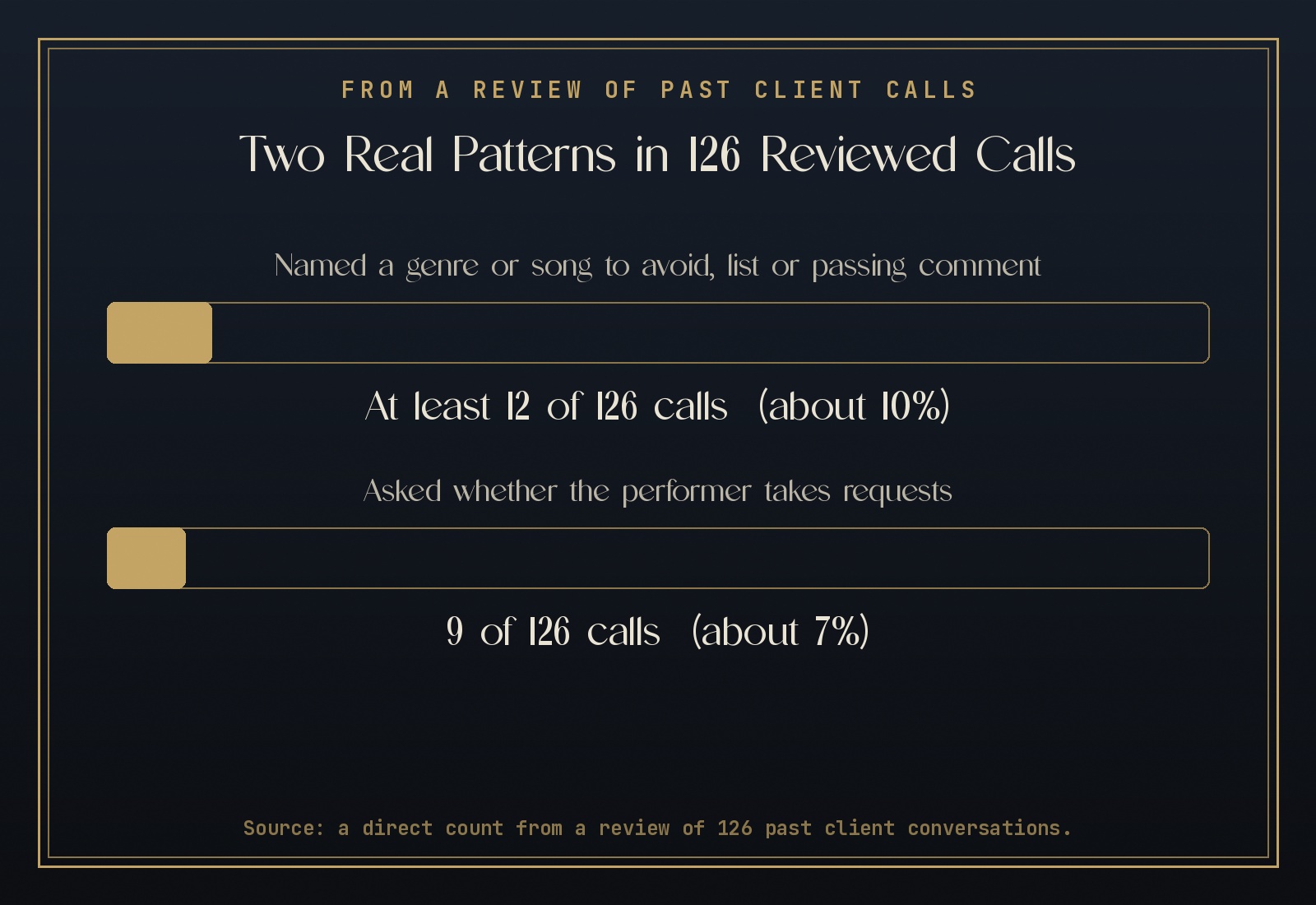
In a review of past client conversations, at least 12 of 126 calls mention a genre or song to avoid, whether as a formal do-not-play list or just a passing comment. That's different from a simple wishlist of songs to include, and it's a real, counted pattern most engagement-party song lists never account for, because they're built around a single taste profile.
The same Lorton brief that asked for "whatever you hear at a bar, covers of popular songs" for the couple's own friends also asked for "some classics mixed in" because the parents were "from the 60s." Two real taste profiles showed up in the same 75-guest backyard, on the same afternoon.
A genre mix built for only one of those profiles solves half the actual brief. The more useful question is which two or three taste profiles are going to be in the room, and how the set moves between them without leaving any one group sitting through a stretch of the night built for somebody else.
What Happens When a Guest Walks Up and Asks for a Song
Roughly one in fourteen client conversations (9 of 126) ask some version of the same question: does the performer take requests, or do we hand over a list ahead of time?
When a guest walks up to request a song, the performer can't stop playing. Performing while holding a conversation is a separate skill in itself, and so is thinking through a setlist in real time. If the exact song isn't one the performer can play, the job becomes finding the closest thing to it, instantly, without breaking stride. Not every performer is able to do this, so If you're interested in your entertainer being able to take live requests, it's worth talking about before you hire them. Your pushy Aunt Fanny Who wants to feel like she's 23 again and you're "one drink too many" uncle Chuck are both probably going to go up and talk to the performer in the middle of a song, completely ignoring the fact that performing music takes mental power - so choosing someone who's got an easygoing vibe in addition to being professional, it's going to be super helpful in that kind of scenario. You won't have to worry about them getting angry or annoyed at people. They'll be able to work everything into the performance without causing a scene. Be careful about this choice because some musicians get offended at these kind of things.
Occasionally a request lands on the couple's do-not-play list. When that happens, the couple gets asked directly, and the standing practice reserves the right to veto any of those requests on their behalf. Sometimes it's a grandmother asking for ABBA, and the couple waves it through happily. Either way, the veto power belongs to the couple. Whichever guest made the request doesn't get a vote in it.
Why "Read the Room" Isn't a Cliché Here
There's no formula that predicts how a specific room is going to behave. Some crowds don't want to party. Some do. Some want to stay laid back, some want to dance, some want to get nostalgic. Reading which one is in the room has to be intuited from subtle social cues in the moment itself, not planned out in advance. A performer with real experience can do this. A new performer is going to struggle with it.
A vibe brief and a genre map get a set built and ready to go. Whether the room responds the way that brief assumed is a separate, live judgment call, made in the moment, and it isn't a step that can be checked off a planning list ahead of time. Naming taste profiles and mapping genres gets a set built well. It doesn't guarantee how a specific room reacts once the party is underway. Knowing where the planning stops and the in-the-moment judgment begins is itself part of what the experience behind a set like this is for.

What the Set Actually Sounded Like
The Lorton set shows what one real vibe brief became, split cleanly by generation. Van Morrison and Sinatra covered the register the parents wanted, the "classics mixed in" the brief specifically asked for. Billie Eilish and Taylor Swift covered the register the couple's own friends wanted, the "whatever you hear at a bar, covers of popular songs" half of that same brief.
Neither register replaced the other. They ran side by side across the same afternoon, because the brief asked for both, and the room had both generations in it. A reader planning their own engagement party shouldn't lift this exact list. The songs that worked in one backyard in Lorton, Virginia answered one specific vibe brief for one specific room. The more useful takeaway: name the taste profiles that are going to be in the room, then build outward from there, the way this set did.
Frequently Asked Questions
Can we just reuse our wedding playlist for the engagement party, or vice versa?
An engagement party and a wedding share a couple, but they don't share a structure. One event has no ceremony, no first dance, and no guaranteed dance-floor moment, while the other is built around exactly those cues, so a set built for one usually needs real adjustment before it works for the other. Hopefully you're engaged before you're married, so you can't really reverse engineer your wedding songs for your engagement party, but yes, you can use songs from your engagement party at your wedding. There's no rule that says you can't just be aware that the three songs people are going to really be focused on during the day are the processional, the bride walking and the recessional and possibly a first dance, mother-son, father-daughter, etc. but all the rest of the music is going to serve as more of a backdrop while you and your guests interact.
Do you take song requests at an engagement party, or do we hand over a list ahead of time?
Personally I do both, working together rather than against each other. A prepared set, built from the couple's own vibe brief, is the starting point, and live requests get worked in as the party unfolds.
What happens if a guest requests a song that's on our do-not-play list?
The couple decides in the moment. When a request lands on the do-not-play list, the performer asks them directly, right then, and the couple holds the veto.
What genre mix actually works when parents and grandparents are at the same party as our own friends?
Naming both taste profiles up front works better than picking one and hoping it covers everyone. A brief that specifies the couple's own music alongside something for the older generation in the room, the way a "classics mixed in for the parents" instruction does, is what makes a mixed-generation set land.
Does the music change over the course of the engagement party, or is it one set the whole time?
Yes, it adjusts live, following the room's actual energy rather than running as one fixed set from start to finish. That's different from a wedding's structured arc, where specific songs get cued to specific moments.
Is there a first dance or other formal music moment at an engagement party, the way there is at a wedding?
No. There's no ceremony or reception structure to build a formal musical moment around, which is exactly why a wedding-style song list doesn't transfer directly to this kind of event. You can use The same songs for your engagement party and then your wedding, but just know the engagement party tends to be a little bit more chill than the wedding. Not quite as focused as the ceremony, but not as energetic as the reception. The engagement party has a more similar energy to the cocktail hour of the wedding than any other part of the wedding.
The Playlist Was Never the Point
Handed one piece of advice over coffee, the answer wouldn't be to send over a song list. It would be to go for feeling over appearance. There's a natural pull toward picturing exactly what the night should look like and chasing that picture detail by detail. What matters to the people in the room is how the night feels, far more than how it looks. Deciding how everyone should feel comes first. The visuals and the specifics follow from that decision.
A song list is what a search for "engagement party songs" asks for on the surface. What makes an engagement party feel right is the set of decisions behind that list.
Questions about music for your own event? The contact page is here.
Blog Categories
Latest Blogs