Private Events
What Makes a Luxury Musician (And How to Hire One for a High-End Event)
By Dylan Galvin, a graduate of Berklee College of Music, magna cum laude, mentored by music legends John Mayer, Paul Simon and Livingston Taylor. Performing across the United States since 2009, now based in the DMV (Washington DC, Maryland, and Virginia), with more than 1,500 events behind him.
You hire a technically flawless musician, and your guests still forget the party by brunch the next morning. It happens constantly, at events that spared no expense on anything else. The difference between good event music and luxury entertainment is not the price on the invoice. It is what happens in the room. At the high end, music is not there to fill silence. It is there to shape how a night feels and what guests carry home, which makes hiring the right performer less about a genre and more about judgment.
That judgment is hard to spot on a website. Most guides on hiring a luxury musician are written by booking agencies selling a roster or by market-research firms selling a report. What follows is neither. It is a straight explanation of what actually separates luxury entertainment from ordinary event music, and how to evaluate it before you book.

What actually separates luxury entertainment from ordinary event music
Luxury entertainment is defined by judgment and adaptability, not by genre or gear. The technical skill is table stakes. What sets the high end apart is a performer who can read a room full of people, feel where the energy is drifting, and move it, sometimes without anyone consciously noticing why the night suddenly feels alive.
Plenty of talented players can perform a flawless set list. Far fewer can abandon that set list in real time because the room told them to. Performers who work at this level tend to describe the job the same way: the set list is a starting point, not a script. A reserved corporate room and a loose family celebration call for two different nights, and the moment to shift from one to the other rarely lands where the timeline said it would.
That is the real dividing line. Ordinary event music executes a plan. Luxury entertainment executes the plan when it works, adjusts when it does not, and knows the difference in the moment.
The luxury shift: why experience now outranks the object
The money at the top of the market has already moved toward exactly this kind of thing. In the 2025 Bain-Altagamma Luxury Goods Worldwide Market Study, the global luxury market held broadly flat at 1.44 trillion euros, but underneath that flat number sat what the study called a "tectonic shift" toward luxury experiences such as fine dining and hospitality and away from traditional luxury goods.
Bain senior partner Claudia D'Arpizio put it plainly: "After the shopping spree era, experiences and emotions have become the true engine of luxury growth." Looking ahead to the next decade, she named the new formula directly: "entertainment, emotion, and ethics are the real sources of value."
For anyone planning a high-end event, that is the point in one sentence. The guests you are trying to impress are, as a group, spending less on objects to display and more on moments to feel. Live entertainment is not a line item at the edge of that trend. It is close to the center of it.
What high-end hosts and planners are really buying
At a luxury event, the real purchase is how the room feels and what guests remember, not background sound. That reframes the entire hiring decision.
The wedding data makes the stakes concrete. In The Knot Worldwide's 2025 Global Wedding Report, drawn from 33,174 couples married in 2024, entertainment was named among the details most likely to make a wedding memorable, cited by 21 percent, behind personalized details at 36 percent and food and drink at 23 percent. A separate 2025 poll in the same report found that nearly half of couples said their single biggest worry was that guests would not have fun, ranking that fear above budget and above logistics.
"Couples today are rewriting the rules, placing more emphasis on the guest experience," said Raina Moskowitz, chief executive of The Knot Worldwide, in the report. The instinct is not limited to weddings. Corporate hosts, gala committees, and private estate hosts are buying the same intangible, which is a room that feels considered rather than catered.
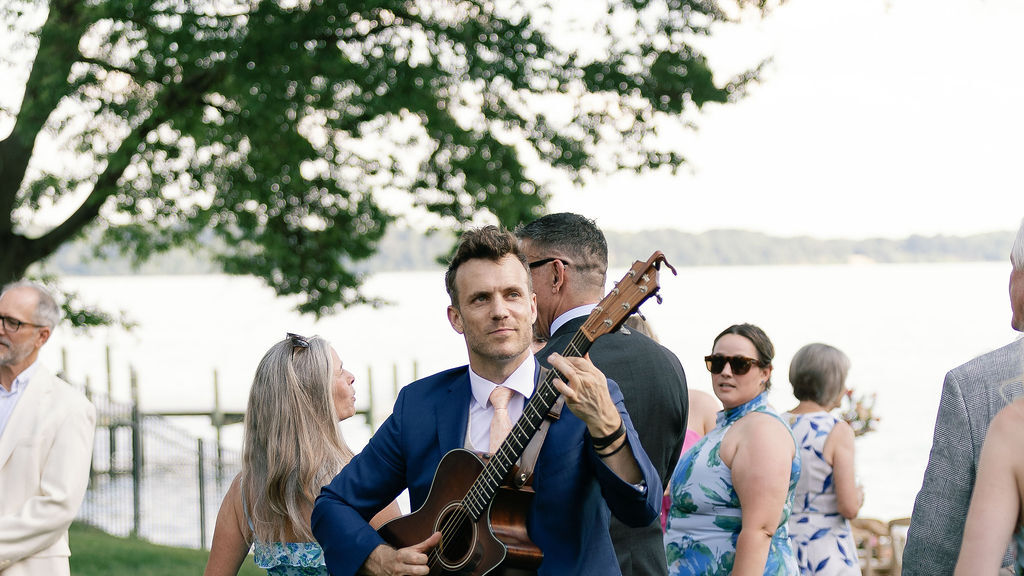
It also explains why formats that keep a performer mobile have grown popular at the high end. A musician anchored in one corner functions as furniture. A performer who can move through the room, playing near guests during dinner and drawing them toward the floor as the night opens up, becomes part of the experience rather than a soundtrack to it. If that idea is new to you, this explainer on what a roaming musician is covers how it changes the feel of an event.
How to evaluate a luxury musician before you book
Because the top of the market has no licensing body and no quality control, the burden of vetting falls on the host. Directory listings will happily sell you a five-star profile with no way to verify the performance behind it. A few honest criteria separate a genuine luxury musician from a good-looking listing.
Start by not trusting the marketplaces. Sites like The Bash, GigSalad, Thumbtack, and Bark have no real quality control. They accept payment from any performer who signs up, regardless of how weak the act is or how many past clients walked away unhappy. A profile on one of those platforms tells you a performer paid to be listed, and nothing more about whether they can carry your event. Treat those listings as a starting point for names to investigate, never as proof of quality.
Ask for real event footage, not a studio reel. A polished studio recording proves someone can play in a controlled room. Video from a live event, with a real crowd and real acoustics, proves they can perform in yours. When a performer only has studio content, that is a signal worth noticing.
Ask for direct references from past clients or planners, and actually call one. The strongest performers in this space are built on relationships, and a real reference conversation surfaces the things a profile hides, including how someone handles the moment when the schedule falls apart.
Test versatility, not just repertoire. A luxury event is rarely one mood. It moves from a quiet ceremony or a reserved reception into cocktails and then into a full room. Ask how a performer bridges those phases. The strongest answers involve real range, which is why formats like live looping, where one guitarist builds a full-band sound in real time, have become common at high-end events. One performer can cover ground that used to take a band.
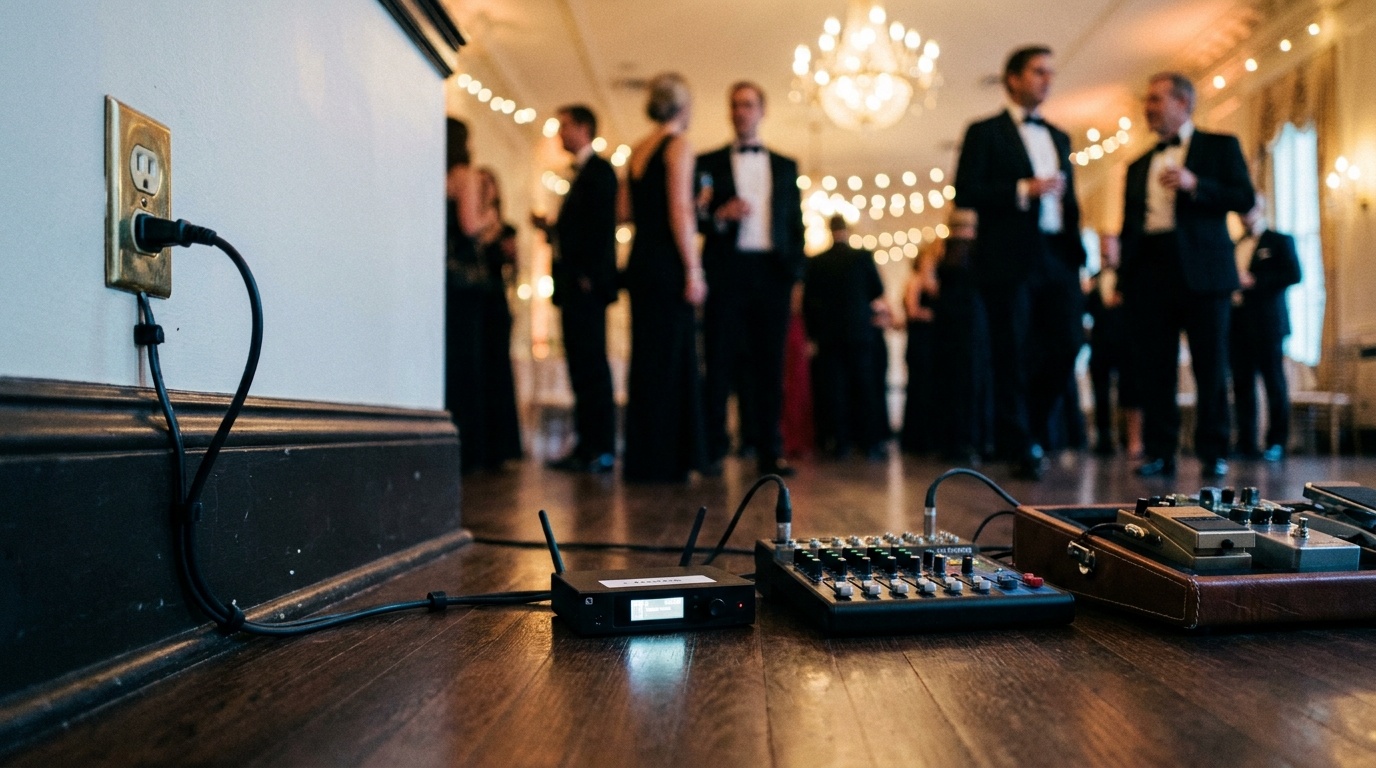
Ask about the setup and the room. Luxury venues have real acoustic and logistical demands. Large formal spaces need a proper professional sound system, a wireless setup that lets the performer move without the sound thinning out, and clean cable management, not a compact battery amp built for a coffee shop. The wording on a listing will not tell you this. A direct question about how they handle a large room will. The broader habit of vetting any live entertainer before you book is covered in this guide on how to vet a live entertainer or event vendor.

Luxury entertainment in the DMV specifically
Washington is not a secondary market for this. In The Knot Worldwide's 2025 report, Washington D.C. ranked among the top three wedding destinations in the United States, alongside New York and Chicago. The region also runs on a steady calendar of galas, embassy functions, foundation dinners, and private estate celebrations, a concentration of exactly the audiences the experiential-luxury shift describes.
The venue landscape rewards a performer who can handle a formal room. The Willard InterContinental, the region's storied hotels, the Eastern Shore estates, and the private clubs of Northern Virginia and Maryland all expect entertainment that matches the setting, which is precisely where the evaluation criteria above earn their keep. For a closer look at the rooms and what they demand, this guide to live musicians for luxury DC wedding venues breaks it down venue by venue.
If you are planning a wedding, the same standards feed directly into choosing your wedding music. For a gala, corporate function, or private party, they apply just as cleanly to private and corporate event entertainment. The venue changes. What makes the entertainment feel luxury does not.
Frequently Asked Questions
What is a luxury musician?
A luxury musician is a performer hired for high-end events whose value is in judgment and adaptability, not just technical skill. They can read a formal room, shift its energy, and adjust in real time as an event moves from ceremony to cocktails to a full reception. The gear and the repertoire are baseline. The ability to make a room feel considered is what puts a performer in the luxury tier.
How do you hire a luxury musician for a private event?
You hire a luxury musician by vetting the performance, not the profile. Ask for real event footage rather than a studio reel, request and actually call a past client reference, and confirm the performer can adapt across the phases of your event. Confirm the sound setup suits the venue, which for a large formal space means a professional wireless rig, not a compact amp.
What makes luxury entertainment different from regular event music?
Luxury entertainment is defined by how the room feels and what guests remember, while regular event music is defined by filling silence. Research backs the distinction. The Knot Worldwide's 2025 report found entertainment among the top drivers of a memorable wedding, and nearly half of couples named guest enjoyment as their single biggest worry, above budget and logistics.
Do you need a full band for a luxury event?
No, a full band is not required for a luxury event, and it is often unnecessary. A single skilled performer using tools like live looping can build a full sound and cover the entire arc of an event, from a quiet ceremony to a lively reception, while staying mobile in a way a stationary band cannot. The right choice depends on the room, the guest count, and the feel you want, not on headcount.
Is Washington D.C. a strong market for luxury event entertainment?
Yes, Washington D.C. is one of the strongest markets in the country for high-end event entertainment. The Knot Worldwide's 2025 Global Wedding Report ranked D.C. among the top three U.S. wedding destinations, and the region hosts a dense calendar of galas, foundation dinners, embassy functions, and private estate celebrations that draw exactly the audiences driving the shift toward experiential luxury.
What should you look for in a luxury musician's setup?
Look for a professional sound system built for real venues, which means a wireless setup that lets a performer move through the room without the sound thinning out, paired with proper cable management. A compact battery-powered amp is built for small casual spaces and will not carry a large formal event, regardless of how a listing describes it. If a performer cannot explain how they handle a big formal room, treat that as an answer in itself.
The Bottom Line
Luxury entertainment is not a bigger version of ordinary event music. It is a different job, defined by reading a room and moving it rather than filling it, and the top of the luxury market has already voted for that kind of value with its money. The way to hire it well is to stop trusting profiles and start testing performances, using real footage, real references, real versatility, and a setup that fits the room. Get those right, and the music stops being a line item and becomes the part of the night your guests actually take home.
Sources
1. Bain & Company and Altagamma, "Global luxury stays resilient despite economic headwinds and shifting consumer trends that reshape market," November 20, 2025. bain.com
2. The Knot Worldwide, "The Knot Worldwide's 2025 Global Wedding Report Reveals Bold New Era of Personalization and Purpose," Business Wire, August 14, 2025. businesswire.com
3. The Knot Worldwide, "2025 Global Wedding Report" (full report). theknotww.com
4. CNBC, "Luxury spending now driven by experiences and 'inheritourism,'" June 25, 2026. cnbc.com
Blog Categories
Latest Blogs