Live Looping: The Technique That Makes One Guitarist Sound Like a Band
Dylan Galvin is a Berklee College of Music graduate, mentored by music legends John Mayer, Paul Simon and Livingston Taylor. Performing across the United States since 2009, now based in the DMV (Washington DC, Maryland, and Virginia), more than 1,500 events, including work for Coca-Cola, Wells Fargo, Lincoln, and CBRE.
A room full of people who had no plans to dance stood up and started dancing, and most assumed there had to be a backing track running somewhere. There wasn't.
Live looping is a performance technique, documented as a real practice in music technology well before it reached weddings and corporate events. A musician records a short musical phrase on stage, then plays it back instantly, and builds an arrangement from there, one layer at a time:
- Rhythm guitar. The musician plays a short chord or rhythm pattern and records it into the loop pedal, setting the foundation for everything that follows.
- Percussion. A percussive layer, often tapped or slapped directly on the guitar body, or triggered from a pedal, adds drive and a sense of a full kit.
- Bass line. A bass line layers in next, looped on top of the rhythm and percussion, giving the arrangement its low end.
- Accents. Other rhythmic elements that complement the original rhythm part layer in next, rounding out the groove.
- Vocals and main melody. The actual melody of the song, sometimes sung and sometimes played on acoustic guitar, stacks in last, completing the arrangement.
Nothing is pre-recorded. Done well, it turns one guitarist into something that sounds like a full band walked into the room.
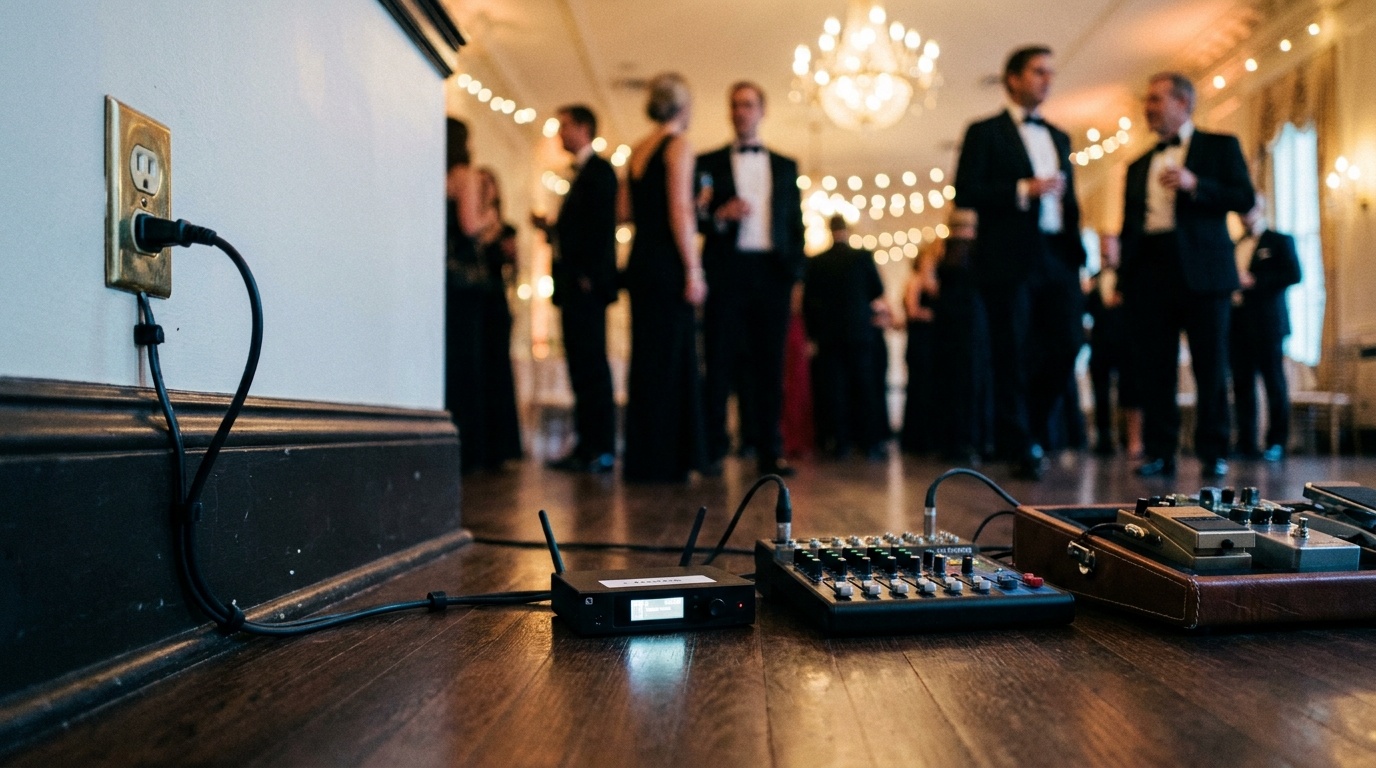
The gear behind that build stays the same from one layer to the next: a loop pedal or dedicated looping processor built for multi-track, synchronized loops, a guitar or bass run through amp modeling and effects to give each layer its own distinct tone, vocal processing to stack backing harmonies from a single voice, a mixer or audio interface to balance the layers against each other as they build, and in-ear or stage monitoring so the timing stays locked while all of it runs at once.
None of that gear does the work on its own. A listener identifies a full band less by counting people on stage and more by hearing distinct frequency ranges and rhythmic roles stacked together: low end carrying the rhythm, mid-range carrying the harmony, a lead voice or instrument riding on top. A skilled looper builds each layer to sit in its own space in that spectrum, bass low, rhythm guitar in the mid-range, vocals and lead lines up top, the same separation a full band gets naturally from having different musicians on different instruments. One performer is just building and balancing that whole mix alone, live, while it's happening.
Key Takeaways
- Live looping runs on a loop pedal, not a backing track. Every layer in the arrangement, from the first chord to the last, gets recorded and played back live, in real time, while the set is happening.
- The real advantage is flexibility. Each layer is built fresh in the moment, so a looped set can bend on the spot, stretching a song, dropping a layer, or shifting direction well beyond what any preset backing track order allows.
- Most people don't know to ask for this technique specifically. They find out it exists when they see it, then ask how it's being made.
- A skilled looper can build a full arrangement at the reception and strip down to something restrained and precise for a ceremony processional, on the same rig, same performer.
- Ask any performer offering this for real footage of the technique in action. Watching the layers actually get built tells you far more than any description ever could.
What Live Looping Actually Sounds Like
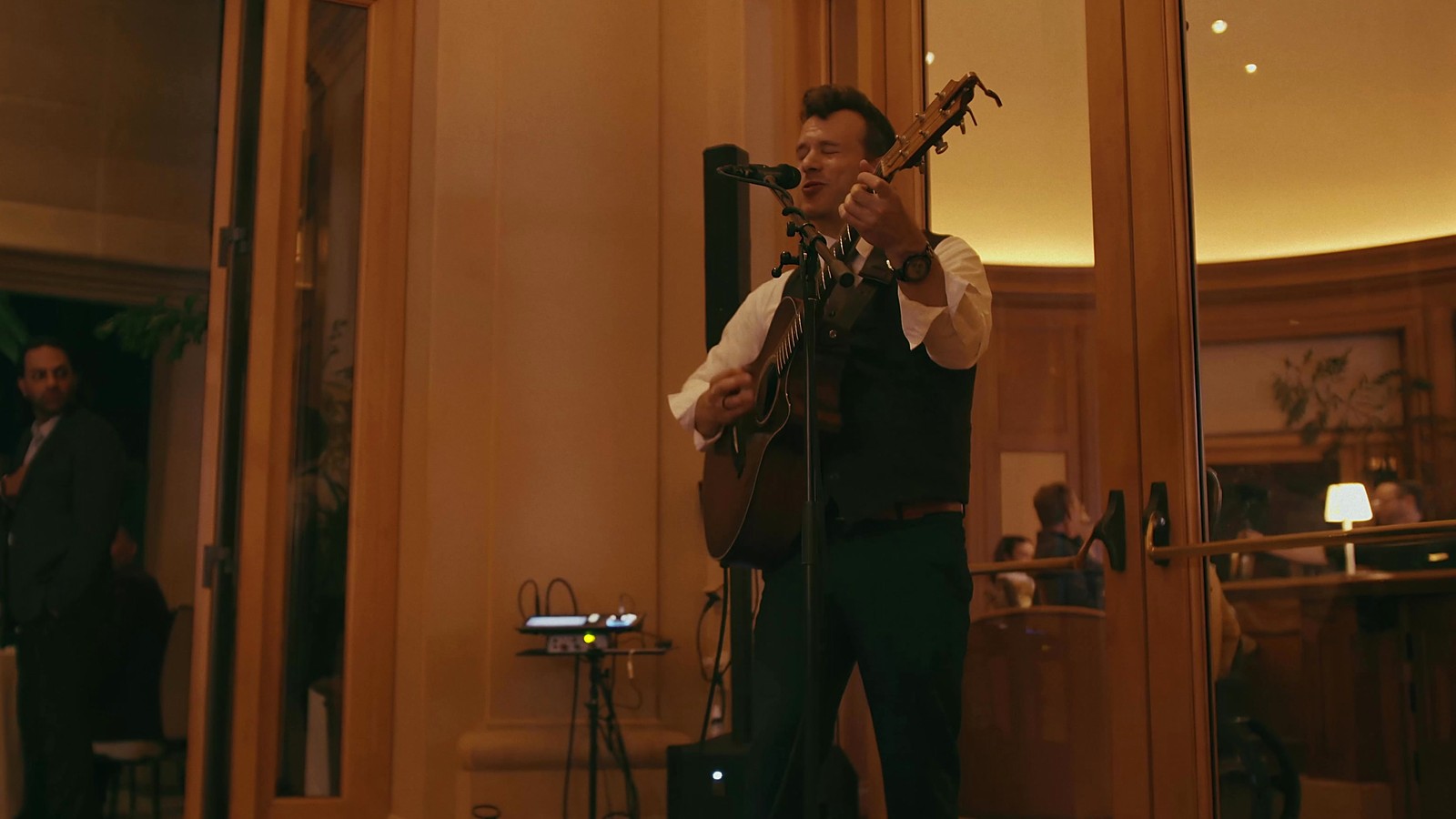
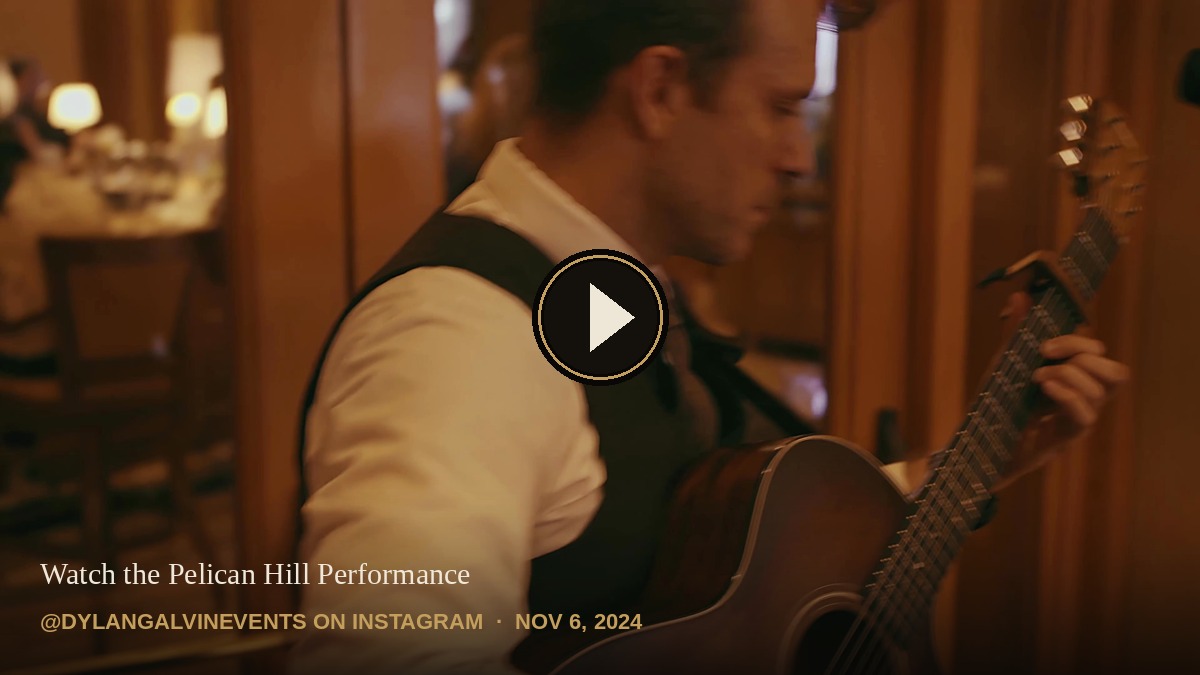
That was a corporate and private event at Pelican Hill in California. The room started reserved, a modest, buttoned-up group of people sitting at their tables, not really engaging. A loop pedal set changed that. Building layers of rhythm, bass, and guitar in real time, one by one, until the sound filled the room like a full band was on stage, brought people up from their tables and onto the floor.
"A real skilled looping artist is able to create something on the fly for the first time," Dylan says. "They're able to experiment as well as have their polished set and deviate from it at will. That's a huge skill that not a lot of people have."
That's the real case for live looping: the ability to respond to a room while it's happening. A backing track locks a set into a fixed order, every song cued up in advance, in the sequence it was built. A loop build doesn't have to follow a script. Because each layer is built from scratch in the moment, the arrangement can change on the spot. Stretch a song longer while the floor is full. Strip it back down if the room calls for something quieter. Build an entirely different version of a song than the one that was planned, live, while it's happening.
There's a practical side to this too. A DJ, band, or solo musician each solves a different problem, and format changes what a room takes on to host it. The same responsiveness that worked at Pelican Hill applies just as directly to a private or corporate event, where a room's energy is often harder to predict than a wedding reception's.
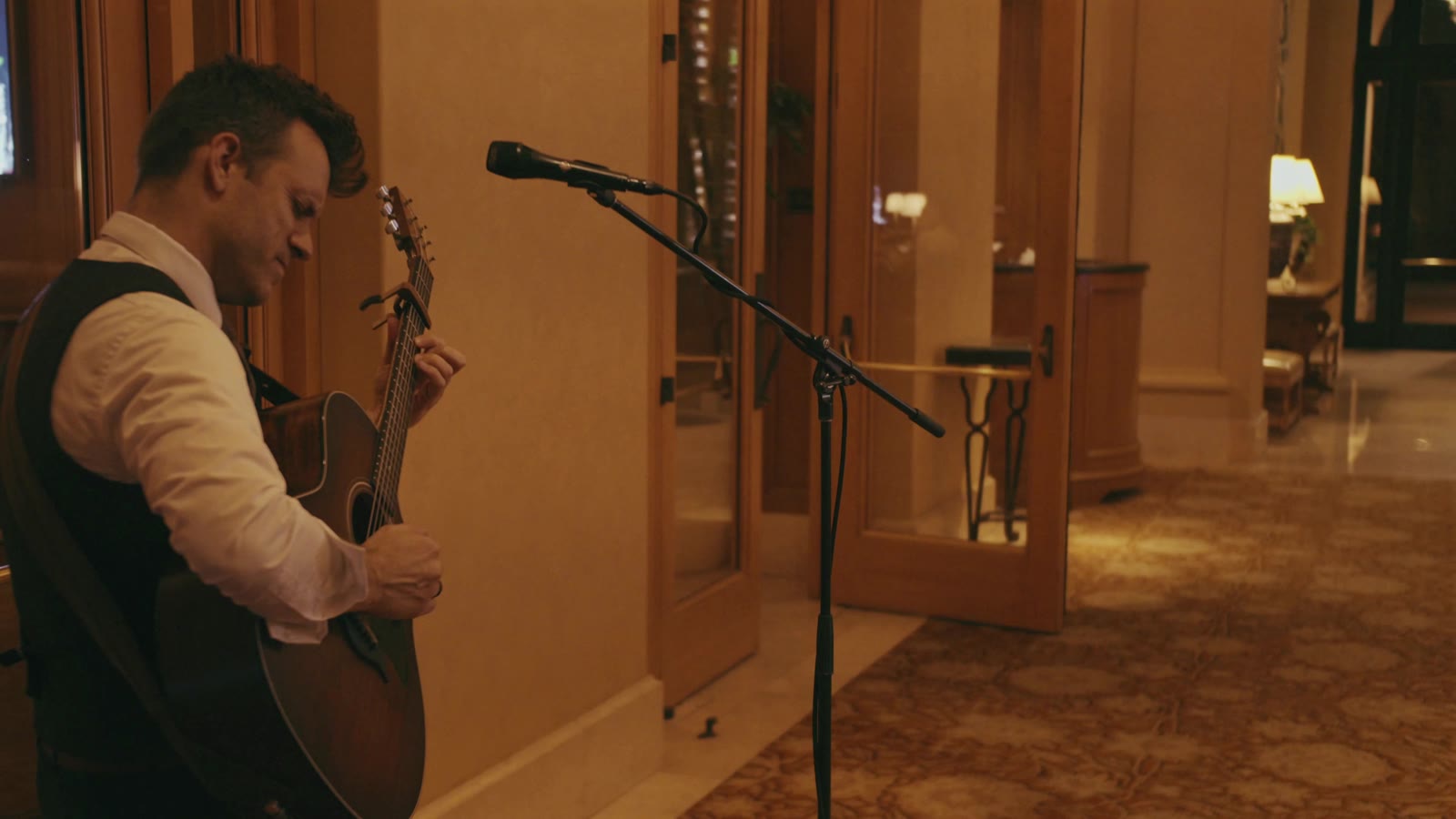
This is on video. A short clip from that night is up on Instagram, if you want to watch the room actually turn.
Live Looping at a Ceremony: A Harder Case
Live looping shows up most often at receptions and cocktail hours, where the room is loose and the goal is energy. It's rarely requested for a wedding ceremony itself. There's a real reason for that: timing a loop build to a processional is one of the hardest things to do with the technique.
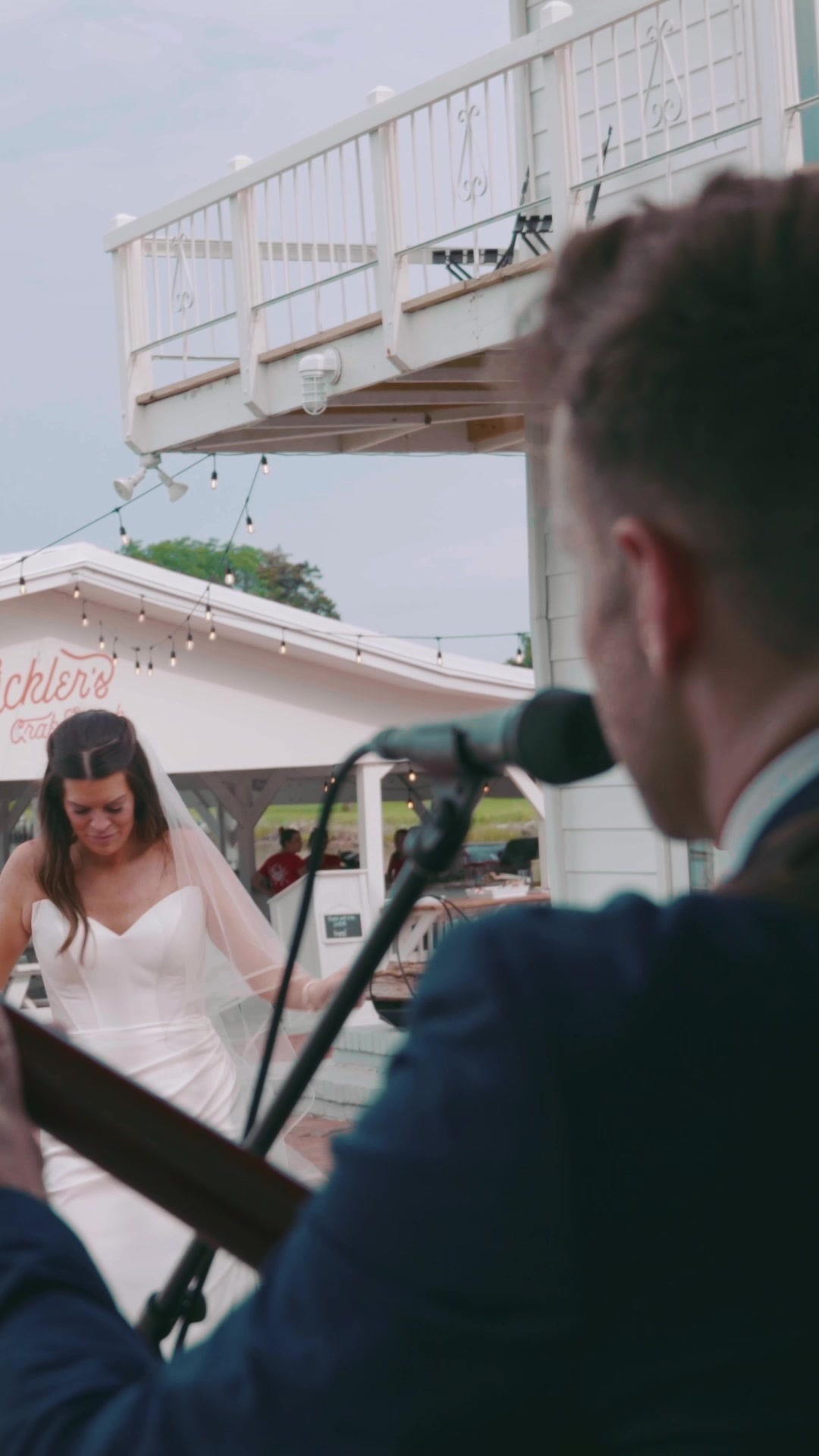
One wedding made that clear: Sean and Tara Bassett's, June 25, 2022, at Monserate Winery in Fallbrook, California. The bride walked down the aisle to "Here Comes the Sun," built entirely on the loop pedal, live, with no backing track underneath it. A second piece, Coldplay's "Viva la Vida," was also built the same way that day, layer by layer, from scratch, with zero room to restart if a layer landed wrong. Every layer had to be recorded and played back in real time, one of the more technically demanding pieces this technique gets asked to carry.
A reception rhythm loop has room to breathe. A processional doesn't. There's no second attempt once a couple starts walking. Anyone can loop a rhythm part where the timing is forgiving. Landing a layered piece of music on a couple's exact footsteps is a different question entirely, worth asking about directly if a timed ceremony piece matters to you. For more on picking ceremony music generally, see how to choose a wedding ceremony musician.
Why This Isn't a Common Request, and Why It Should Be
Most couples and planners never ask for live looping by name. They simply don't know it exists until they see it. The Knot's Real Weddings Study, covering couples married in 2025, found only 12% hired a live band, against 71% who went with a DJ. Live bands are already the rarer booking, which is exactly why a technique that recreates one from a single guitarist rarely crosses anyone's mind to ask about. The usual reaction, mid-song, is some version of: "Wait, are you playing along to a track, or is this all you?" Once it's explained, the answer is usually the same: they wish they'd known to ask for it up front.
That's worth knowing before you book anyone. If a full-band sound at solo-musician logistics is what you're after, whether for a reception, a cocktail hour, or any other stretch of your event, the technique is worth asking about directly, even when it's buried somewhere past the marketing headline.
How to Tell a Real Looper From Someone Who Just Owns a Pedal
The clearest sign of a skilled looper is musical intention. Layers build toward a real arrangement, with real direction behind each one.
- Ask for video. Audio alone doesn't show the layering process, and a confident looper will have real footage, because the visual is part of what makes the technique work live.
- Ask them to explain their gear in plain language. A loop pedal is simple hardware at its core. Someone who can describe their signal chain clearly, without hiding behind jargon, is demonstrating real fluency. Plain language is what real skill sounds like when it's asked to explain itself.
- Ask whether the sound can scale up or down across your event. A ceremony calls for restraint. A reception calls for fullness. The same rig, played well, should do both.
Where People Get This Wrong
People often assume a loop performance is quietly running on a track underneath, since a layered, full-band sound is exactly what a backing track is designed to fake. The giveaway is watching it happen: if you can't actually see each part get built in real time, ask directly, and expect a straight, specific answer.
A close second: the idea that more loops always sound better. Overstacking layers buries the melody. Most of the craft is knowing when to stop, and subtraction is often the harder skill to learn than addition.
It works across genres: pop, rock, acoustic wedding sets, jazz-leaning cocktail hour arrangements, the same skill in different vocabulary. On the hiring side, the one real mistake worth avoiding is booking off audio samples alone. The layering process is part of what makes the technique compelling in person, so video gives a far more accurate sense of what a room will actually experience than a recording ever could.
"A great looper knows what not to put in the loop," Dylan says. "Some people just layer way too many things in, and it sounds like a big cacophonous mess. It's like using all the colors on a palette at once. Knowing how to create the layers so that they don't fight with one another helps create a really balanced backdrop that sounds a lot more pleasant than just trying to ram a hundred loops over top of one another."
The Footprint, Load-In, and Room a Full Band Needs
A full band needs a stage. Performing on the floor is "bizarre," Dylan says, and impractical besides, and that one requirement pulls a long list of others behind it: cable runs, amplifiers, fans, lighting, all crowded into a footprint that gets hard to manage the moment a room isn't large. A four-piece band alone can run through a long list of separate audio inputs: kick, snare, overheads, bass DI, guitar mic, keyboard stereo DI, lead vocal, backing vocals, per the Musicians Institute's own breakdown of concert planning, and every one of those inputs is a cable, a stand, or a piece of gear that has to load in, get placed, and get checked before a single note reaches a guest.
Every member of a full band needs a vendor meal and parking. A green room is more commonly a band's request than a solo performer's, nice for either but rarely essential for one. Load-in alone can run several hours for a full band, then two more hours on top of that for setup and soundcheck. A solo performer's rule of thumb, wireless rig and all, is roughly 20 to 60 minutes total. Booking a solo act also settles who actually shows up: the performer met at the consultation is the performer working the event, with no rotating cast of substitute musicians standing in if someone in a larger lineup can't make the date.
The room itself changes the math too. A poorly treated space can make even a great band sound bad. Dylan compares it directly to "a five-star chef with no access to good ingredients." A room full of bodies actually helps here, dampening some of the harsh frequencies an empty, hard-surfaced room throws back at the stage, but the real fix is acoustic paneling or bass traps, planned and installed well before the event.
The Exception: When a Full Band Is the Right Call
There's an honest exception to nearly everything on this page, and it doesn't have anything to do with how good the solo performer is. If the goal is dancing all night, sustained high energy from the first song to the last, with a real production behind it, a stage, heavy lighting, a crowd that wants to be captivated, that's a full-band night. "It's not about skill sufficiency, it's about the literal interaction and energy of multiple musicians playing together on stage, which isn't replicable solo," Dylan says. A great solo performer can stretch a long way toward that kind of night. A wedding or event built entirely around it, for 500 or more guests, genuinely wants the band.
The difference shows up most in what a band can do that a single performer structurally can't: a real brass section, several musicians trading solos and reacting to each other in real time, dense four- and five-part vocal harmony built from several distinct voices singing together. It essentially comes down to headcount: how many people are physically standing on the stage.
Song choice is really important too. A song built around guitar, voice, and rhythm, the bulk of modern pop, folk, and acoustic-rock repertoire, loops naturally. A song built around a horn section or dense studio production asks more of the illusion, and sometimes more than one performer alone can deliver.
The One Real Caveat to the "Near-Indistinguishable" Claim
Most places you hear about looping, you'll hear that a skilled looper sounds close enough to a full band that a non-musician ear can't tell the difference. Most people, If casually listening will think a great looper is a playlist or several musicians playing together. That claim mostly holds, with one real caveat.
A skilled looper is, in effect, recording themselves live and layering it back in real time, and when it's built well into a set, an audience just hears music. Nobody in the room is thinking about the technique mid-song. Crowd size alone doesn't break that illusion either. Ed Sheeran's 2026 Loop Tour runs on the same idea: he works a loop pedal solo for the bulk of the show, then brings out the band Beoga for six songs a night. One review of the tour's MetLife Stadium stop confirms both halves of it: Sheeran "was joined by Beoga," and "he brings them out for six songs every night."
"The real variable is what the crowd wants to do," Dylan says.
If the goal is sustained maximum energy for an entire night, a skilled looper can likely sustain it. It's just an easier lift for a full band to do the same thing, for the reasons the sections above already cover: more people on stage means more sound, more simultaneous energy, and less strain on any one performer to carry a room alone for hours.
The Real Cost Gap, and Why It Doesn't Scale the Way People Assume
Every page comparing a solo performer to a full band says the solo option is "more affordable." Almost none of them explain why, or by how much.
A full band generally easily runs upwards of $10,000 for starters. A solo performer typically comes in at under half that. The scaling in between follows its own logic. The first musician, who is usually also the one booking the act, managing logistics, and taking on the responsibility that comes with running the show, costs disproportionately more than each additional player added after. Every musician layered on top of that first one functions more like a hired-gun addition, priced as a straight per-person add-on to the lineup. Cost efficiency improves per person as the band gets larger. The total price still grows with each addition.
Space is a real constraint on top of the price. Plenty of historic venues, the kind with real character and real limits, don't have the power or the stage area a full band needs. A solo performer generally doesn't need a stage at all, which makes the format far easier to fit into a small or unusual room. And once a band's base rate is set, a sound engineer, a full sound system, and lighting production add a real layer of cost on top, a genuine "wow factor" that comes bundled with the format itself.
The Full-Band Buyer, and the Habit Booking
Put the cost, the logistics, and the energy tradeoff together, and a real pattern shows up: budget explains part of who needs the full band, but preference is what actually drives the choice.
"Someone with a big budget who wants their wedding to be a massive party should get the full band," Dylan says.
His own test for who that actually is comes down to a simple divide: people who reject "less is more" and believe "more is more." "The type who throws themed birthday parties, books the penthouse suite at hotels," as Dylan puts it. That personality is the real signal, well beyond what the budget alone can predict.
Plenty of people with the budget for a full band still don't want one. They want music that sits in the background instead of taking over the night, with the cost and complexity of a six-person production spent on something they actually wanted. Booking the full band because "that's just what you're supposed to have" is its own kind of overspending, a fit better suited to a different kind of night.
A Simple Way to Decide
Strip away the budget question and the decision usually comes down to three practical factors.
- Indoor or outdoor. Indoors, room size is the first real test. A cramped, small, or historic venue is a real red flag against a full band, before energy or budget even enter the conversation.
- Outdoor, with real power access. This tends to favor the band more, but it comes with its own catch worth knowing before setup day: running extension cables with adequate amperage draw to the band's location, so the sound system doesn't blow a breaker.
- What the night is actually for. If the goal is party mode, dancing, sustained energy, a room that runs loud from the first song to the last, go with the full band. For anything more mellow or space-constrained, go with the looper instead.
Dylan's own bottom line is direct: a full band means guests "basically can't hear each other talk" and will be dancing through nearly the entire time it plays. If conversation, catching up, or actually hearing each other matters to the people at the event, that's reason enough on its own to skip the full band and go with the looper instead.
Expert Tips for Getting the Most Out of a Live Looping Performance
Booking someone who can technically loop is the easy part. Getting a performance built around your actual event takes a few more direct questions.
- Ask for a moment-by-moment plan. A looper who can describe exactly how the arrangement builds during your processional, first dance, or cocktail hour window is planning for your event specifically.
- Ask for a short live demonstration if a consultation allows it. Even two minutes performed in person, with no chance to re-record a bad take, tells you more about arrangement skill than a polished audio sample ever will.
- If a ceremony moment matters, say so early. Timing a loop build to a specific point in a ceremony is one of the harder asks in this technique, and a looper needs real lead time to plan for it.
- Ask how they'd handle your specific must-play song. A looper who can talk through, in real terms, how they'd build a particular song live tells you more about their process than a general pitch does.
- Weigh musical instinct over technical showmanship. The goal is a performance built for the room, and musical judgment is what actually builds it, however much or little gear happens to be on the floor.
Frequently Asked Questions
Does a live looping musician need a click track or metronome to stay in time?
No. Every layer is cued and recorded by ear, against the tempo the musician just played a moment before. There's no metronome running underneath a loop build. The same internal timing that carries any live performance is what keeps the layers locked together.
Can a live looping musician play an entire ceremony and cocktail hour alone?
Yes, though ceremony work built entirely on a loop pedal is technically demanding and not every performer offering the technique will do it. Ask specifically whether timed, ceremony-length looping is something they've actually done before. That real ceremony experience, not the pedal itself, is the qualification that matters.
Is live looping limited to certain kinds of songs?
No. It adapts to whatever a wedding or event actually calls for: acoustic sets, jazz-leaning cocktail hour arrangements, singer-songwriter ceremony music. The real limit is the performer's own range.
What happens if something goes wrong with the gear mid-performance?
Any performer who's done this long enough has already planned for it: backup cables, a spare pedal, and the ability to drop into a stripped-down set with no looping at all if it comes to that. What actually carries the performance is the musician standing there, gear working or not.
Is live looping harder to perform than playing with a backing band?
In some ways, yes. A backing band gives a musician other players to lean on if a moment goes sideways. A solo looper builds and controls every layer alone, in real time, with no one else to fall back on if a loop is cued wrong. That demand is exactly what separates the guitarists who can pull this off from the ones who just have the gear for it.
Can a looping musician build a timed piece for a ceremony processional?
Yes, though it's a request most performers rarely get, and not every looper has done it. If you want a specific piece timed to land as you reach the altar, ask directly whether they've built a ceremony-length loop before. Timing a piece to a ceremony is its own harder skill, layered on top of looping itself.
Reading the Room Is the Real Skill
The difference between an average loop performance and a great one isn't the gear. It's whether the person behind it can read a room and build toward it, not just play a pattern on repeat. That's true whether it's turning a reserved corporate crowd into a dance floor, or stripping that same full-band sound down to something restrained enough for a hushed ceremony processional. Ask to see it before you book it. That's the one thing that actually tells you what you're getting. If you're weighing a looping performance for your own event, get in touch and ask to see it firsthand.
For what live looping costs in the DC market and how to vet a looping performer before you book, see the live looping musician in Washington DC guide.
Blog Categories
Latest Blogs