
Wedding Events
Wedding Musician Contracts and Deposits: What's Normal Before You Book
The difference between a wedding musician's deposit and a retainer already shows up in a few contract guides, laid out as a plain legal definition. It's rarely paired with a number, or with what happened the one time a real booking fell through. Only one of those two things is really a deposit.
Dylan Galvin is a Berklee College of Music graduate, mentored by music legends John Mayer, Paul Simon and Livingston Taylor. Performing across the United States since 2009, now based in the DMV (Washington DC, Maryland, and Virginia), more than 1,500 events.
"Deposit" and "Retainer" Aren't the Same Word
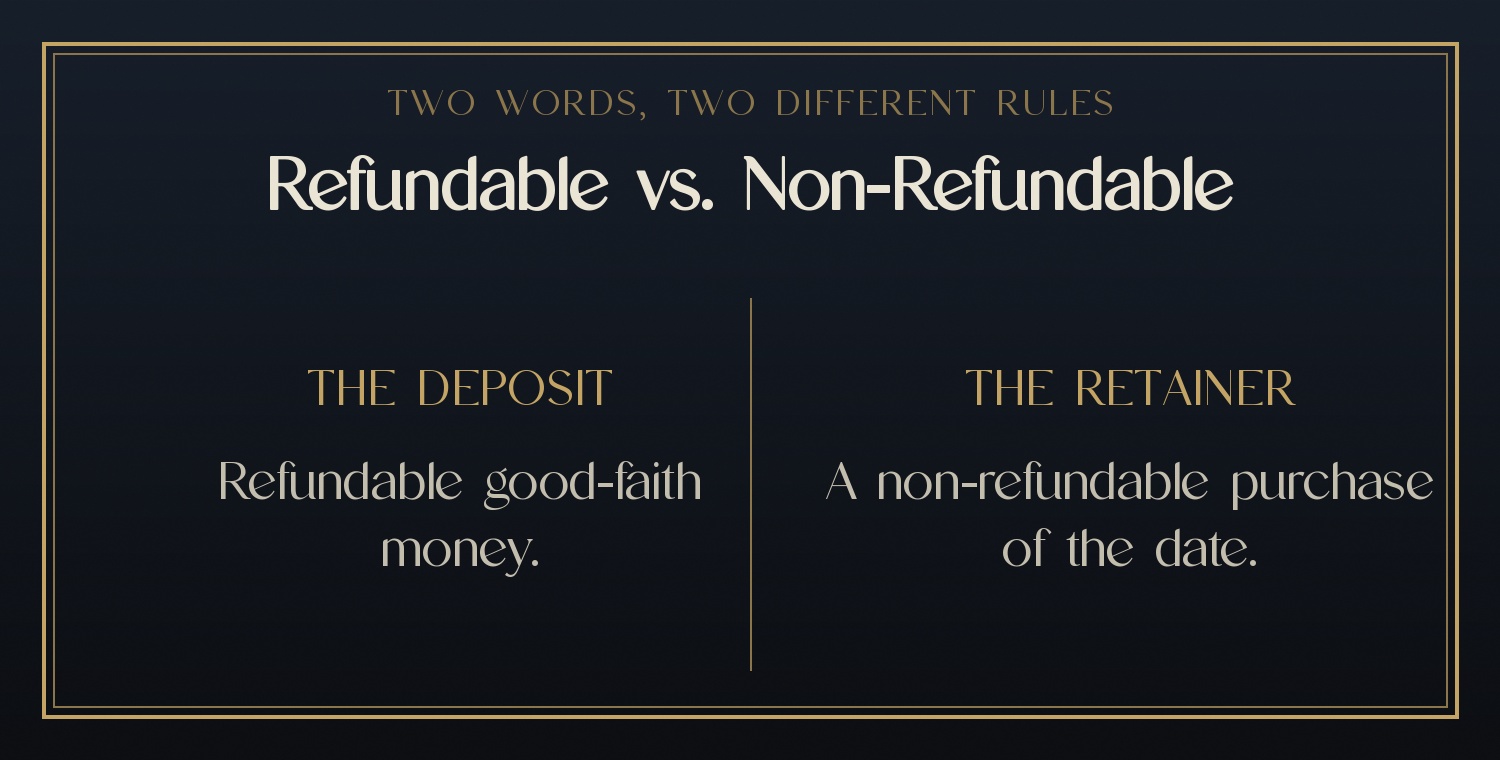
A deposit is generally a refundable good-faith payment that can be given back at any time. A retainer works differently. It's the client purchasing a performer's time for that date, and once it's paid, that date is off the market for anyone else. That's why a retainer is generally non-refundable, with one specific exception: when the performer is the one who cancels. The legal distinction between the two terms holds up outside the music industry too, and it's why the wrong word in a contract can turn into a real dispute over refunds.
Those two arrangements answer two different buyer questions. "How do I hold the date" is a retainer question. "What happens if this falls apart" is a cancellation-policy question. Most contract guides treat them as one undifferentiated bucket, which is a large part of why so much of the advice out there reads like boilerplate.
How Holding the Date Works

A straightforward structure is a 50/50 split: half of the total due upfront to hold the date, the other half due after the event is complete. That upfront half is the retainer described above, and it's the first line on the wedding music planning checklist.
Splitting payment this way gives both sides something at stake. The client has money down. The performer has turned away every other inquiry for that date. Cancellations are rare across the board. By one performer's own count, fewer than 1% of bookings ever cancel at all, whether or not the cancellation clause itself ever gets invoked. That figure is an estimate. It hasn't been audited. But it points to something real: the overwhelming majority of signed contracts are contracts nobody ever has to enforce.
That 50/50 split is common. Plenty of performers use something else, including asking for the full balance upfront. A performer with no deposit or retainer policy at all is worth a second look. That gap often points to someone newer to the business, still building out a standard process. Talent and experience don't always move together, so it's worth weighing both.
A different pattern deserves real caution. Heavy pressure to pay in full upfront, paired with an unconventional payment request, sending money to cover a different vendor and asking to be reimbursed is one real example, shows up often enough in entertainment-industry scams to name directly. Getting a performer's real contact information and confirming it independently, before any money changes hands, is one of the simplest ways to avoid the whole problem.
The retainer's whole job is holding the date. What happens after that is a separate question, covered next.
What Happens When Something Falls Apart
One booking tested the policy at its hardest point. Several months after the booking was confirmed, a severe illness in the family forced a full cancellation. The retainer wasn't proactively refunded, matching stated policy, but it was offered once the cancellation was confirmed. The client didn't take it. Both sides understood the arrangement going in, and nobody involved treated it as a dispute.
A different case makes the same point from the opposite direction. A wedding was postponed indefinitely, for personal reasons, as the date drew closer. The retainer stayed with the performer. It had already done its job: the date was held, other bookings were turned away for it, and the remainder due on completion was never in question, because the delayed wedding simply hadn't happened yet.
Both scenarios sit under the same policy, and the policy held the same shape in each case: the retainer reserves the date regardless of why a booking doesn't move forward as planned. A refund past that point is a courtesy the performer can choose to offer. The contract doesn't require it. The reverse situation, a vendor cancelling on the client, flips the calculus entirely, with its own separate playbook for handling it.

When the Performer Is the One Who Cancels
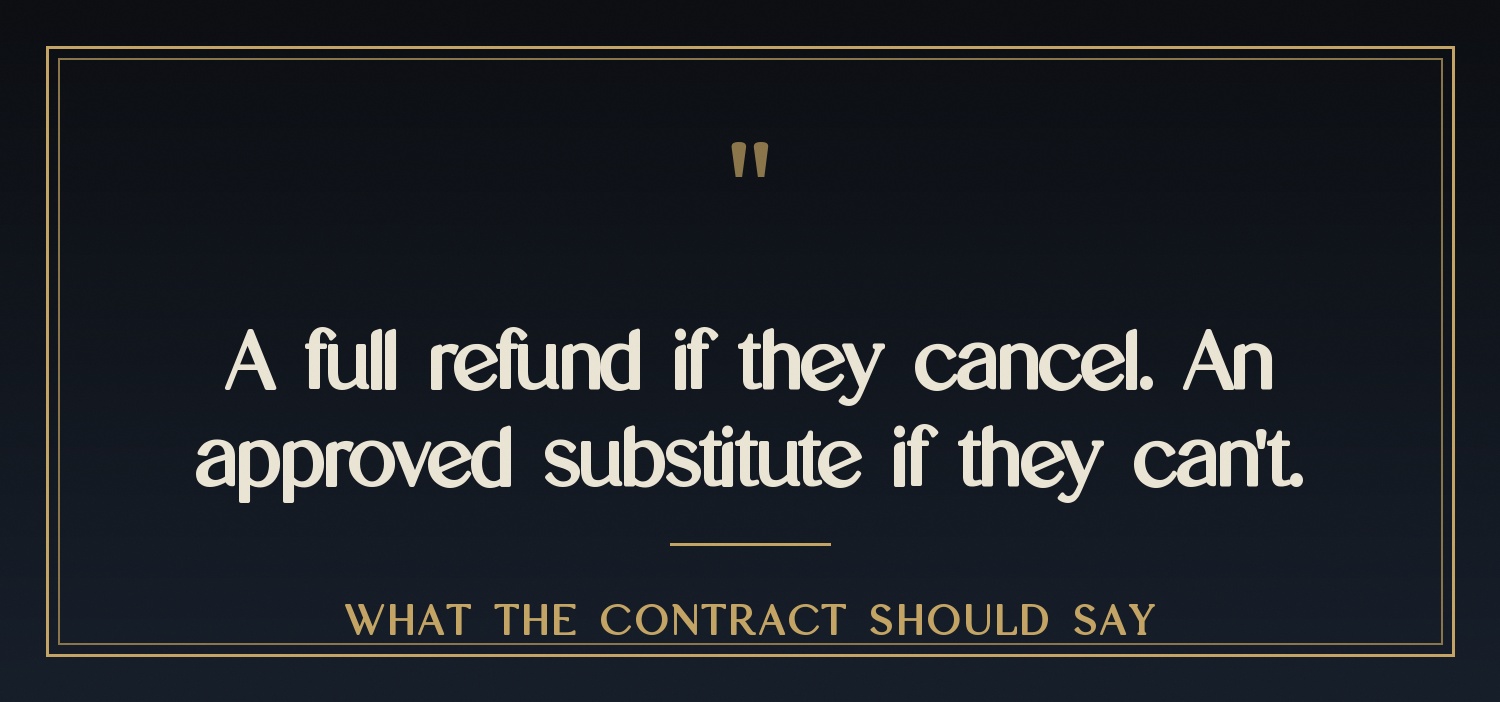
A serious contract also spells out what happens if the performer cancels. That standard runs in the opposite direction from a client cancellation, and it should. An emergency on the performer's side calls for a substitute the client signs off on before the event happens. When no acceptable substitute turns up, the client gets a complete refund. In practice, this clause almost never gets used. Its value shows up at the signing table, before anything goes wrong: a contract that skips this clause entirely is the real thing worth catching. This full breakdown covers what happens on the day.
When the Contract Gets Complicated: Anonymity, Government Clients, and Corporate Buyers

One negotiation tested how far a standard contract can bend. The booking normally runs as a one-page agreement, easy to sign and return. This client needed changes: full anonymity, and specific stipulations tied to a government affiliation with strict protocols. Accommodating it took real back-and-forth, all of it routed through a planner, before every term was settled. It got done, and it took longer than the standard one-page signature.
That case points to the real variable: outside constraints that can attach to either kind of booking, an individual wanting anonymity for a high-profile wedding, or a corporate client whose financial policy (a government affiliation that restricts which payment forms it can offer, for instance) a contract has to work around. The contract itself stays the same either way, and corporate and private event bookings both run into this same variable from different directions.
Booking Through an Agency or a Multi-Member Act? Put This in the Contract
One standard applies no matter who's being hired: a cancellation clause belongs in the contract, full stop. Any performer working without one "is not a professional" by this standard, and paying anyone without a signed contract leaves very little recourse in court.
Booking through an agency or a multi-member act adds a second thing worth putting in writing. A client should request that the specific band or musicians they saw on the website, the lineup in the video, are the ones showing up. A rotating lineup performing under one band's name is exactly the risk that request is meant to catch. With a solo performer, that particular risk doesn't apply. There's no lineup to substitute.
That covers the contract-specific terms. The fuller vetting checklist goes beyond contract terms alone. For the wider hiring picture, including how travel is charged and what a fair contract should include, see what actually matters when hiring a musician near you.
FAQ
What's the difference between a wedding musician's deposit and a retainer?
A deposit is refundable good-faith money. A retainer is a non-refundable purchase of the performer's time for that date. Most contracts calling themselves "deposits" are functioning as retainers without saying so, which is why the refund question so often catches people off guard. Contract attorneys draw the same distinction across freelance and service businesses generally. One exception keeps a retainer from being absolute: if the performer is the one who cancels, it gets refunded, or a substitute gets found.
Does the deposit or retainer count toward the total cost, or is it separate?
It counts toward the total. A common structure is a straightforward split: half due upfront to hold the date, the other half due after the event is complete. It's one payment schedule, split into two installments.
What happens if I have to cancel because of an emergency? Do I get anything back?
Generally, the retainer stays with the performer, because it already did its job of holding the date and turning away other bookings for it. In practice, some performers offer a refund anyway once a genuine emergency is confirmed, even when the contract doesn't require it. Ask directly what a specific performer's policy is before signing, and get the answer in writing.
What happens when the performer is the one who cancels?
A serious contract addresses this too, and the standard should favor the client: an approved substitute performer, or a full refund if no substitute can be found. That policy's fuller version spells out what happens next, step by step.
If I'm booking through an agency or a band, what should the contract specify?
Name the specific performer or lineup in the contract itself, and don't rely on the act's brand name alone. That's what protects against getting a different set of musicians than the ones in the audition video or website photos.
Is a wedding musician's contract different for a corporate or company client?
Not structurally. The contract itself is generally identical for a corporate client and an individual couple. What changes are outside constraints, like a corporate client's payment-method restrictions or an individual's anonymity request.
The Bottom Line
Before signing anything, four things belong in plain language: start time, end time, how long breaks run, and who has access to any content filmed during the performance.
Questions about music for your own event? The contact page is here.
Blog Categories
Latest Blogs