What Is a Roaming Musician? (And Why It Changes the Whole Feel of Your Event)
Dylan Galvin is a Berklee College of Music graduate, mentored by music legends John Mayer, Paul Simon and Livingston Taylor. He has performed across the United States since 2009, is now based in the DMV (Washington DC, Maryland, and Virginia), and has played more than 1,500 events, including work for Coca-Cola, Wells Fargo, Lincoln, and CBRE. Learn more about Dylan's background and training.
Roaming, strolling, roving, wandering: the words get used interchangeably, and most people assume they all mean the same thing, an unplugged musician working the room. That assumption is backwards. An unplugged instrument works in a near-silent room. It does not hold up in a room of a few hundred people who are talking, eating, and having a good time, and it does not survive much outdoor noise either. A saxophone or a snare drum is the one real exception, and even that only works as a spotlighted, full-attention moment where the whole room is listening. Neither one works as ambient background music playing quietly under conversation.
Key Takeaways
- A wireless roaming setup keeps a fixed PA and speaker in one place, while a wireless guitar and microphone carry the sound with the performer as they move.
- The workable range is hundreds of feet, but past roughly 100 feet from the speaker an audible timing delay shows up, and it gets worse when combined with live looping.
- About 6.3 percent of recent client inquiries, 8 of 126 in one internal review, ask specifically about power access or venue AV before booking a roaming setup.
- Roaming and wireless performance correlates with a higher price mainly because it's a skill set more experienced musicians tend to have, built up over years of higher-end bookings.
What Is a Roaming Musician?
A roaming performance runs on one rule: the instrument still feeds a sound system the room can hear, whether the performer is standing still or moving through it.
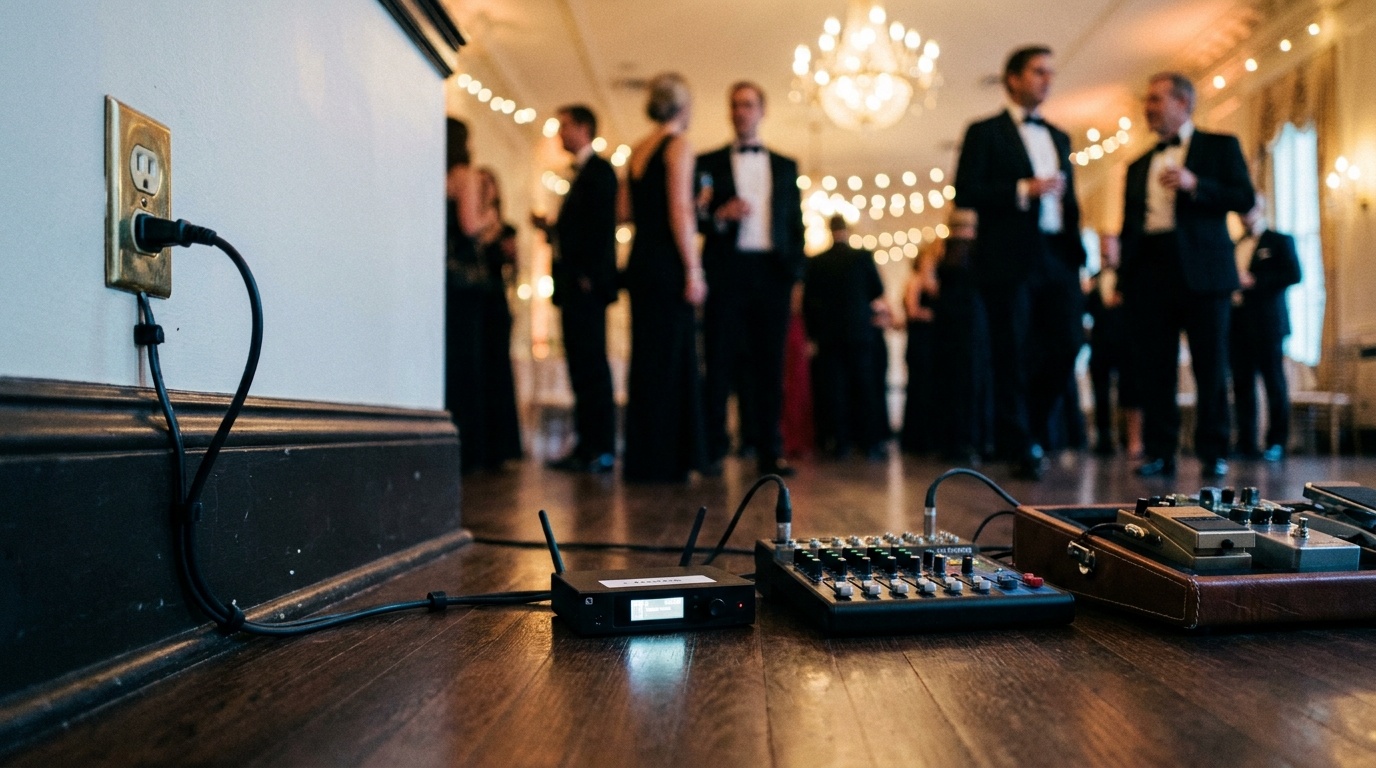
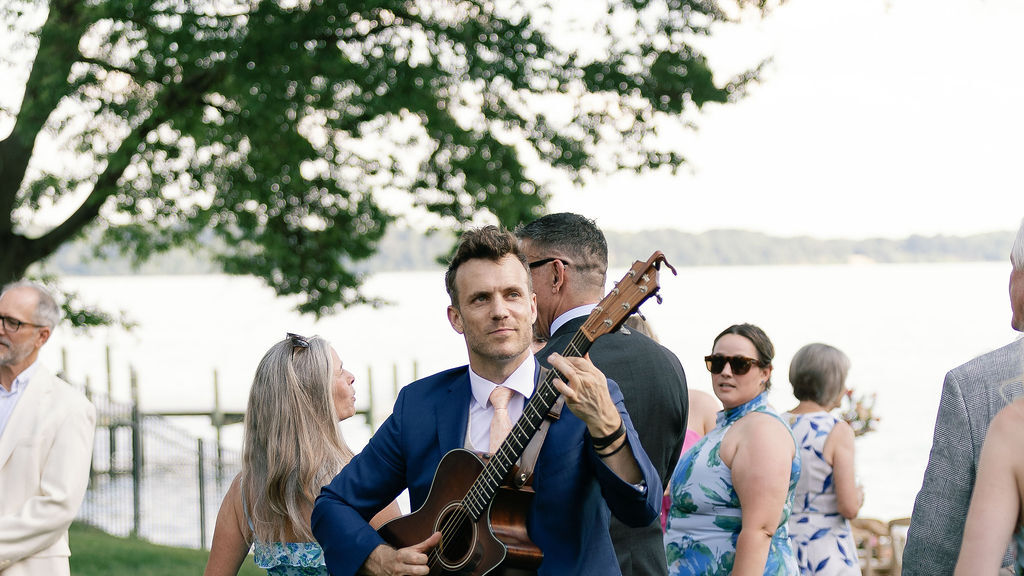
A roaming musician is a performer whose sound system stays in one place while the performer does not. A full professional PA, a real tower speaker with real output, sits fixed somewhere in the room. Live performances generally use a column-array tower speaker chosen to match the number of guests, rather than one generic size for every booking. A wireless guitar and a wireless microphone carry that same sound with the performer wherever they go: table to table, room to room, out to a patio and back. The performer and the wireless signal move. The amplification stays fixed. Nothing battery-powered travels along. The sound coming out of the room is the same fixed, full-quality rig a stationary stage performer would use.
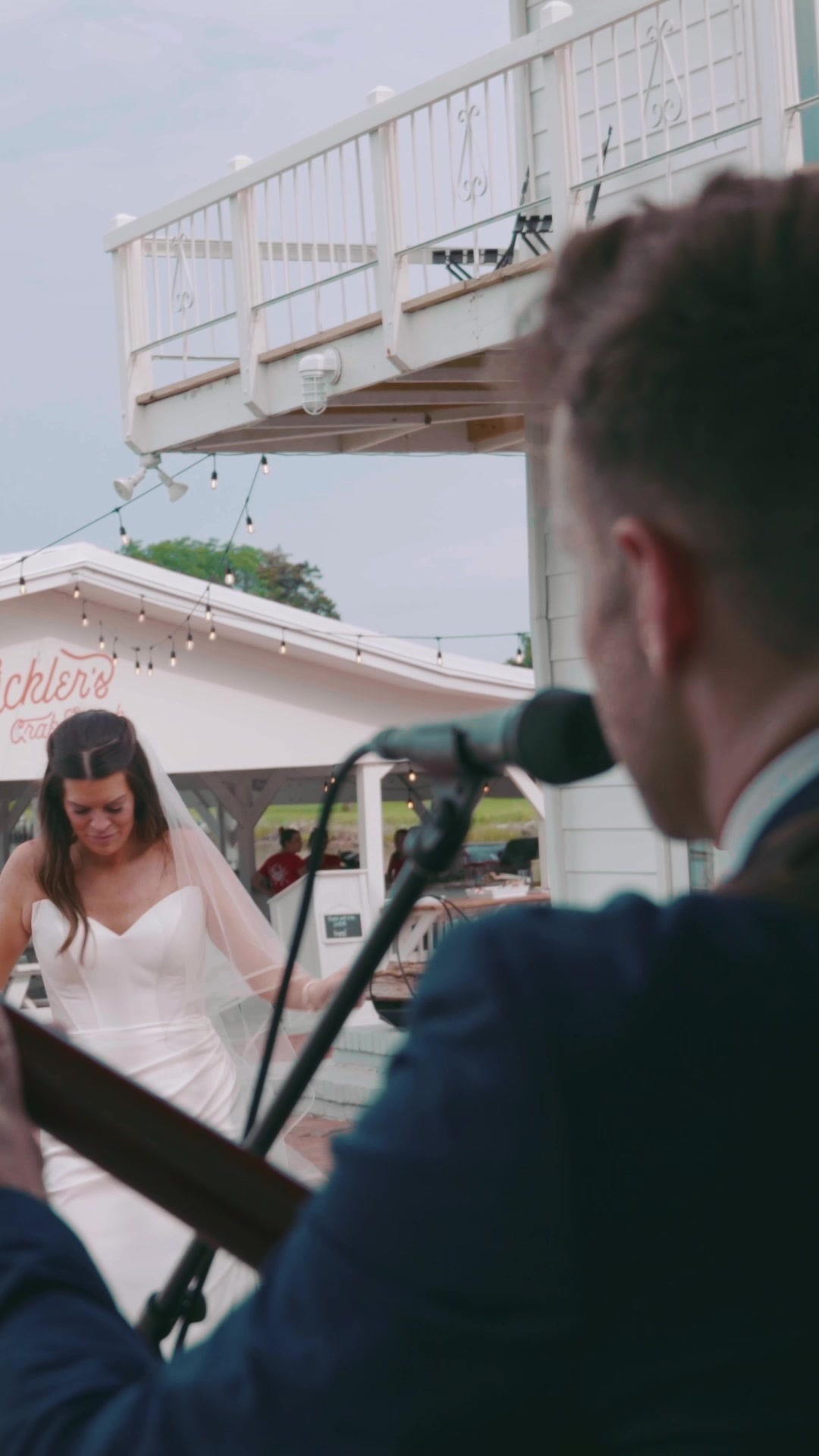
The instrument stays consistent too. A roaming performance runs on guitar, paired with a stationary microphone rather than a headset mic worn while walking. In practice that means alternating through the set: singing from the mic for a stretch, switching to an instrumental passage while moving through the room, then returning to sing again. That back-and-forth is what keeps both halves of the format, singing and roaming, working without either one being compromised.
For anyone booking the format, the distinction changes what to expect on the day. A performer whose setup is wireless and PA-fed sounds the same whether they're working a cocktail hour or standing at a reception table across the room. A performer who is truly unplugged, however talented, is only heard by whoever happens to be standing close enough, and that limits what the format can realistically do once a room has any real size to it.
How Far Can a Roaming Setup Go?
A wireless roaming rig has real range. With a quality wireless unit connecting the guitar and microphone to the sound system, a performer can walk hundreds of feet from the speaker, room to room, table to table, without losing the connection. No cable ties the performer to one spot, which is what lets the format feel less like a stage act and more like a guest who happens to be playing an instrument.
That range comes with a real limit, worth knowing before booking rather than discovering mid-event. Past roughly 100 feet between performer and speaker, the time it takes sound to travel from the speaker back to the performer's own ear becomes audible as a lag, enough to throw off the performer's sense of timing. In live sound engineering, a delay past about 35 milliseconds generally reads to the ear as a distinct echo rather than a single sound (NTi Audio's reference on the Haas effect), and at the standard speed of sound, roughly 1,125 feet per second, 100 feet of separation already works out to close to 90 milliseconds, well past that audibility threshold. That's why the problem shows up right around the distance the format's own limits describe.
The effect compounds for a performer running a loop pedal while roaming. A loop only stays in time with a source that arrives at a consistent moment. Once the audio from the speaker is arriving late enough to notice, the live instrument and the loop drift out of sync, and the drift worsens the farther the performer wanders. A performer using live looping has to be more careful about distance from the speaker than one who isn't. Either way, staying within a reasonable radius of the speaker is what keeps a wireless roaming setup sounding as good at the back of the room as it does standing right beside it.
That awareness changes with the room itself. Outdoors, a performer generally has more freedom to move, since open air carries far less feedback risk and there's simply more physical space to work with. Indoors, the calculus shifts: hallways, doors, and sometimes another event happening nearby all narrow the usable path, and staying far enough from the speaker to avoid feedback takes more conscious attention than it does outside.
What Happens at a Venue With No Power at All
A power outlet is not automatically available everywhere a roaming musician performs, and it's a real, common question. About 6.3 percent of client calls, 8 of 126 in one recent review, raise some version of it before booking, whether the venue is an outdoor ceremony spot or any other space with no power run nearby.
The workaround does not require the performer to go unplugged. It requires moving the sound system instead. The speaker sets up wherever power does exist, often a cocktail-hour area or another spot nearby with an outlet, and gets turned on there. The performer then physically walks out to the powerless spot itself, guitar in hand, wireless mic live, whether that's an outdoor ceremony space or wherever else the event needs music with no power run to it. The sound is still coming from the fixed speaker back at the powered location, carrying clearly to wherever the performer has walked.
The general rule holds regardless of the specific spot: when there's no power near where the performer needs to play, the sound system sets up in the nearest area that has power, and the performer walks to the area that needs the music. This solves a logistical problem that would otherwise rule the format out for a venue with no power option anywhere nearby, and it works for one simple reason. It's the same wireless-plus-PA mechanic described above, applied to the hardest possible case: zero power anywhere near the performance itself.

Plugging Into a Venue's Own Sound System
Not every roaming setup runs entirely on the performer's own gear. Sometimes the better move is using what the venue already has.
A performer with real studio and live-sound experience can work within more than one sound-system arrangement without missing a beat. In some cases, the client already has a preferred sound system in place, and the performer simply works inside it. In others, a venue's own AV team is running its own rig for the night, and the performer defers to that setup, either plugging directly into the venue's system or chaining a personal rig into theirs.
The decision usually comes down to one question: has the venue or client already invested in a house AV setup for the night? Where the answer is yes, working within that system is the simpler, more coordinated path, and it avoids two competing sound setups fighting for the same room. Where the answer is no, or the client specifically wants a dedicated rig, the performer brings a full standalone system. Keeping multiple options open, rather than committing to only one method in advance, is what prevents a bottleneck in problem-solving before the event even starts. In practice, this comes down to a short conversation about where a few cables go and where the extra speaker makes the most sense, handled ahead of time so nobody has to solve it on-site.
A venue that has already spent real money wiring its ballroom or event space for sound gets the most out of one coordinated system running the whole room, not two rigs competing for the same air.

The Building Matters as Much as the System
Coordinating with a venue's own sound system is only half the picture. Finding the right part of the building in the first place is the other half, and it isn't always obvious.
At one rooftop event booked by a law firm at the old Ebbitt Grill in Washington, DC, the rooftop turned out to be a separate space from the restaurant, reached through a side entrance around the block, past security, and up a different elevator, far from anything a map search of the address would suggest. Venue staff walked the performer to the right door and held it open along the way.
The lesson carries past that one building. A map app shows an address. It says nothing about a building's own side entrances, elevators, or the walk between them, and an out-of-town corporate client booking a DMV venue for the first time often knows those quirks no better than the performer does. A short conversation with venue staff ahead of load-in usually gets a performer to the right room faster than directions pulled from a phone.
What Happens When There's No Room to Roam
Space matters as much as power does. A cramped layout raises a fair question: does a roaming format make sense at all if there's nowhere to roam?
At one birthday party at Bridget's Steakhouse in Ambler, Pennsylvania, the client had rented the entire top floor, so there were no other guests to work around, but the layout itself left little room to move. A long, thin hallway ran between the bar and the tables, opening into a slightly wider area beyond it, and once the party filled in, it went shoulder to shoulder fast.
Wireless gear gives a performer the option to roam. It doesn't give them the obligation to. A performer tethered to a cable has no choice once a room tightens up around them. A wireless one can simply stand in place and play to the crowd instead, which is exactly what happened here. The set stayed in one spot, the sound held up fine, and the party went on without missing a beat. Later, during the break, the performer stepped away from that spot entirely, guitar still in hand, dancing and singing along with the DJ playlist right in the middle of the crowd.
A tight room is worth asking about directly before booking. A performer who can flex between roaming and standing in one spot, without the performance losing anything either way, is the one built for a room like this.
Where the Format Does Something a Stationary Performer Can't
A Different Kind of Connection
At one private event, a family had booked live music for a birthday celebration for a girl with severe disabilities. She was wheelchair-bound and had trouble speaking or seeing. Because the performer was not fixed to one spot, he could come to her directly, playing close, inside her own space, rather than somewhere she would have to be carried or wheeled toward.
She lit up. She began to engage, laugh, and visibly enjoy the moment in a way that clearly registered with everyone around her. Her mother said the reaction was huge, a clear sign her daughter was having a great time. It was, in the performer's own framing, a chance to create a moment of real connection for someone who doesn't often get many opportunities to have one.
A fixed-stage performance can be excellent and still require every guest, including one with a mobility or sensory limitation, to come to it. A roaming format carries the music straight to that guest, wherever in the room they happen to be.

Guiding a Room Without Saying a Word
A roaming performer can also do something else a fixed act generally can't: help move a room from one place to another without a single word of instruction.
The pattern follows a fairly consistent arc. As guests first arrive, the performer is already playing, usually walking through the space with ambient, instrumental music that signals the hosts put real effort into the evening. That welcoming stretch runs roughly the first 30 to 45 minutes. After that, the set shifts toward more familiar, recognizable material, and crowd interaction and requests tend to pick up once people have had time to settle in and loosen up. None of this follows a fixed formula. It's a read, learned mostly through experience rather than a checklist anyone could hand a newer performer.
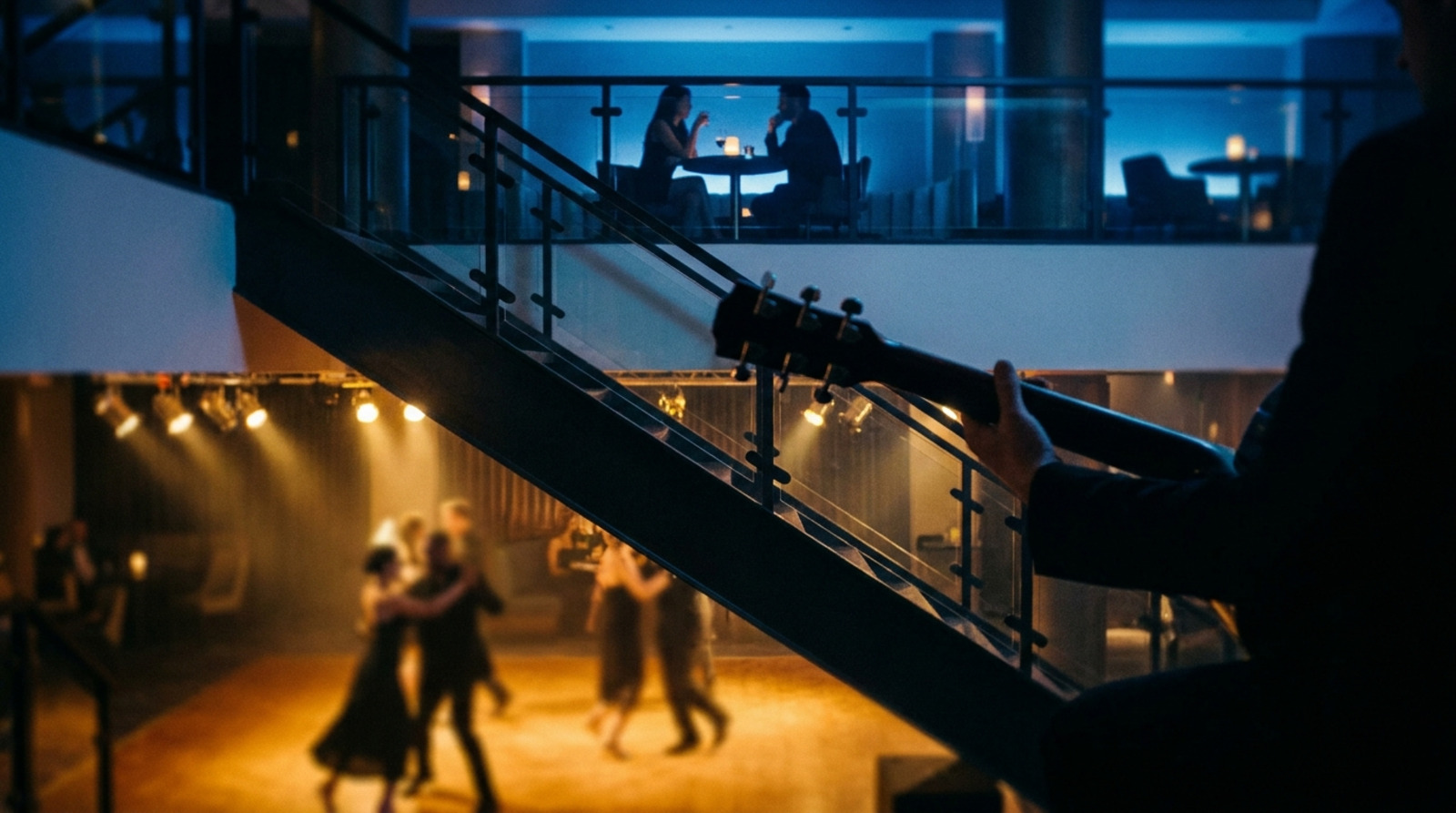
The most useful application of that instinct comes at transition points: cocktail hour into dinner, dinner into dancing, reception into a program. A roaming performer who is mindful of the event's timeline can time a set to end right as an announcement or a speech is about to happen, then physically walk toward wherever guests are supposed to go next, leading the way with the music itself rather than an announcement over a microphone. The technique traces back to a familiar sight in four- and five-star hotels, where concierge staff play a few notes on a small xylophone and walk toward the direction they want guests to go. Years spent performing in that kind of environment is where the habit came from, standing in for the concierge's xylophone with an instrument already in hand.

The format shows up across a range of events that benefit from exactly this kind of movement.
- Cocktail hours. A musician working the room gives guests something to gather around without anyone approaching a stage.
- Corporate receptions and networking events. Circulating music keeps the energy up without drowning out conversation.
- Private dinners. A performer can play tableside during courses.
- Grand openings and brand activations. Movement through the space keeps the whole venue feeling covered, corner to corner.
- Wedding receptions. Especially during the handoff from ceremony to cocktail hour, when guests are already moving between spaces on their own.
How a Corporate Booking Compares to a Wedding Cocktail Hour
Corporate roaming bookings and a wedding's cocktail hour sit closer together than the two categories suggest. The energy is nearly identical: of every phase in a wedding day, cocktail hour comes closest to a corporate event's pace and mood.
Where the two differ is song choice. A wedding cocktail hour leans toward romantic material, and wedding clients tend to be specific about what they want played, sometimes down to individual requests. Corporate clients are typically less particular about the exact songs and more focused on the overall vibe of the room. The performance itself, walking the floor, reading the crowd, filling the space without overwhelming conversation, works the same way either time. What changes is the playlist behind it.
Does a Roaming Format Cost More?
Roaming and wireless performance does tend to cost more than a stationary set. A handful of concrete factors move that number more than the format itself does. How much PA and sound system the room needs is one: a small private dinner and a few-hundred-guest reception call for very different amounts of gear. Travel adds something too, usually a modest amount rather than a major swing. Often the biggest factor is logistics: a tightly orchestrated itinerary that requires learning specific songs, rehearsing new material, or timing a set precisely around speeches and announcements takes real preparation before the event ever starts. Put those together and the total for a roaming set commonly lands somewhere in the few-thousand-dollar range, with the specifics of any given event moving that number up or down.
Skill level plays a role too, and it's a bigger one than the equipment list suggests. Roaming and wireless work is a format experienced musicians tend to have and entry-level performers tend to lack. Musicians who play mostly at bars or backyard barbecues rarely need a wireless setup and are rarely asked to roam in the first place. The performers who do offer it, and offer it well, tend to be the ones who have already put in years at higher-end events: corporate functions, larger weddings, formal private parties, where reading a room while circulating through it is a different skill than playing a stationary two-hour set.
The correlation between price and experience holds either way. Roaming and wireless performers do, on average, charge more. The cause is that this style of performance is one a musician generally grows into after enough professional experience, the same way a more seasoned contractor or accountant tends to charge more regardless of which specific tool happens to be in their hand.
For a buyer comparing quotes, both pieces matter. A wireless rig on its own says little about price. The scope of gear a room needs, the travel involved, the logistics of a tightly planned itinerary, and the performer's own years of experience all move the number in different directions, and a quote worth taking seriously accounts for all four. It's also why what looks like the same service on paper can span such a wide range: a newer performer offering a roaming set and a performer with fifteen years of it behind them are quoting two very different levels of experience, whatever the equipment list looks like.
Can a Roaming Musician Also DJ or Cover Breaks Without Dead Air?
Filling a Break Without a Gap
Yes. A live set generally runs 45 minutes to an hour, timed to the itinerary of the day rather than a fixed length. A standing, curated background playlist stays ready at all times, matched to the rest of the set and to the tastes of the people in the room. When the performer takes a break, whether for a few minutes or longer, the transition moves straight to that playlist rather than leaving the room in silence. Some roaming performers go a step further and build the live set itself into something closer to a full band's sound. How live looping turns one guitarist into a full band covers that mechanic on its own.
A jarring genre switch or a stretch of dead air between live playing and downtime is one of the more noticeable ways an otherwise excellent performance can start to feel amateur. A playlist chosen in advance to match the set, rather than whatever happens to be on a phone in the moment, keeps the transition from ever feeling like a gap in the evening.
For a roaming performer specifically, this pairs naturally with the format's own strengths. The same wireless setup that lets the performer move through the room during a live set carries that background playlist through the same speaker during a break, still filling the space, still consistent, with no second system or second person needed to run it. It's a small logistical detail with an outsized effect on how professional the whole evening feels, worth asking about directly before booking.
Roaming, Acoustic, and DJ, All in One Event
Covering breaks with a curated playlist is one thing. A smaller number of performers go further and DJ a full portion of the night, dance floor included, while also playing live and roaming through the room. Done well, that combination isn't a compromise on either half of it. It's rare for a reason that has nothing to do with whether it works. Very few musicians can DJ at all. Fewer DJs can play an instrument live. Almost none can do both in the same set.
A performer who can do both understands how a room's energy moves, then adds a DJ's sense of pacing on top of it, without needing a handoff between two separate vendors partway through the night. The risk lives on the performer's side. A musician-DJ trying to do too much at once, live-mixing a track while also soloing over it, tips into a moment that puts the spotlight on the performer instead of the room. The point of the format is to serve the event. Putting on a show about the person running it works against that.
What to Ask Before You Book a Roaming Musician
A handful of questions, asked before booking, separate a wireless, PA-fed roaming performance from one that only calls itself that.
Is the system fully wireless, feeding a real PA? This is the distinction the whole format rests on, covered above. Ask specifically whether the guitar and microphone are wireless and whether they're feeding a proper sound system. A performer who simply walks around while playing unplugged is offering something different.
How is volume handled across different spaces? A quiet dinner table needs different calibration than an open cocktail terrace. Ask how the performer adjusts between the two.
Does the performer take tableside requests? A performer working this format should be able to pull from a broad repertoire mid-performance, without stopping to dig through a setlist.
What's the equipment footprint? Ask what gear travels with the performer and how much space the sound system itself needs, separate from the wireless components that let the performer move.
Is there a plan for a venue with no power access at all? Not every performer has a workaround for a venue with zero power access. Ask directly whether they've handled this before and what the plan looks like.
Will the performer integrate with the venue's existing AV system, or insist on a separate rig? A performer comfortable doing either, depending on what the venue already has running, is generally easier to coordinate with than one who only knows how to run their own equipment.
None of these take long to ask, and the answers say a lot about how much of this a performer has handled before booking.
It's Better to Be a Warrior in a Garden
Deciding between a stationary performer and a roaming one usually comes down to a practical question first: how much room does the event have? A cramped upstairs restaurant space or a bar with a narrow walkway favors a stationary setup, and a roaming performer can always choose to stand still if the venue calls for it.
That flexibility doesn't run in both directions. A performer who has only ever played tethered to a cable can't suddenly work a room on the move the first time it's asked of them. That asymmetry is why roaming makes sense wherever the venue allows it: it keeps every option open, then lets the logistics of the space decide the rest. It's better to be a warrior in a garden than a gardener in a war.

Questions about a roaming or wireless setup for your own event? The contact page is here.
Frequently Asked Questions
What's a roaming musician also called?
A roaming musician is also called a strolling, roving, or wandering musician. All four words describe the same format: a live performer who moves through the room instead of staying fixed to a stage or corner. The label difference is mostly regional and stylistic. What matters is whether the instrument is wireless and feeding a real PA system.
Can a roaming musician play at a venue with no power at all?
Yes, as long as power exists somewhere reasonably near where the music happens, even if not in that exact spot. The sound system sets up at the nearest powered area, and the performer carries the wireless rig out to wherever the music needs to happen, ceremony space or otherwise. The only planning question is how far that nearest outlet sits from where the performer will be standing.
Will a roaming musician use my venue's own sound system, or bring their own?
It depends on what the venue already has running. If a house sound system is already wired in for the night, the performer either plugs directly into it or chains a personal rig into it, whichever the setup needs, instead of adding a second, competing rig to the same room. If nothing is set up, or the event specifically calls for dedicated equipment, the performer brings a complete standalone system, speaker and all. Either way, that call gets made in the planning conversation, well before load-in.
How far can a roaming musician walk from the speaker?
Comfortably hundreds of feet under normal conditions, more range than a single room or a handful of connected spaces will ever need. The distance that counts for sound quality is shorter, closer to 100 feet: past that point, the one-way delay as sound travels from the speaker back to the performer's own ear climbs to somewhere around 90 milliseconds, well beyond the roughly 35-millisecond point where the ear starts to register it as an echo instead of one clean sound. A sprawling or multi-building venue is the scenario where that distance question needs to factor into setup planning.
Does hiring a roaming musician cost more than a stationary one?
Yes, on average, though the price difference rarely traces back to the equipment. Roaming and wireless work is a skill newer performers rarely offer and experienced ones build up over years of higher-end bookings, so a higher price on that kind of quote is usually tracking the performer's track record more than the gear. Two quotes that look identical on paper can represent very different amounts of that experience underneath.
Sources
NTi Audio, "Haas Effect".
Blog Categories
Latest Blogs