Corporate Events
The Complete Guide to Hiring Live Entertainment for Corporate Events and Private Parties (2026)
Dylan Galvin is a Berklee College of Music graduate, mentored by music legends John Mayer, Paul Simon and Livingston Taylor. Performing across the United States since 2009, now based in the DMV (Washington DC, Maryland, and Virginia), more than 1,500 events, including work for Coca-Cola, Wells Fargo, Lincoln, and CBRE.
Quick answer: Clarify your event type, headcount, and budget first. Then vet performers on video, contract terms, and references, not price alone. Professional live entertainment in the DC, Maryland and Virginia market runs $2,500 to $6,000 depending on format and duration.
Why Live Music Changes What a Room Feels Like
A 2018 study out of McMaster University found that audiences move differently when watching a live performance versus listening to a recording. [Swarbrick et al., Frontiers in Psychology, 2018] Researchers studying live classical concerts found that audience heart rate, breathing, and skin conductance sync up during live performance. A 2024 neuroimaging study showed live piano performance produced stronger amygdala responses than the identical recorded piece. [PNAS, 2024] Oxford researchers Tarr, Launay, and Dunbar found that shared musical activity releases oxytocin and endorphins, the neurochemical pathways involved in trust and social bonding.
What that means for a host is simple. The entertainment choice is shaping, in a literal biological sense, how connected guests feel to each other and to the person who invited them.
What That Looks Like in a Real Room
An Unexpected Format Beats an Expected One
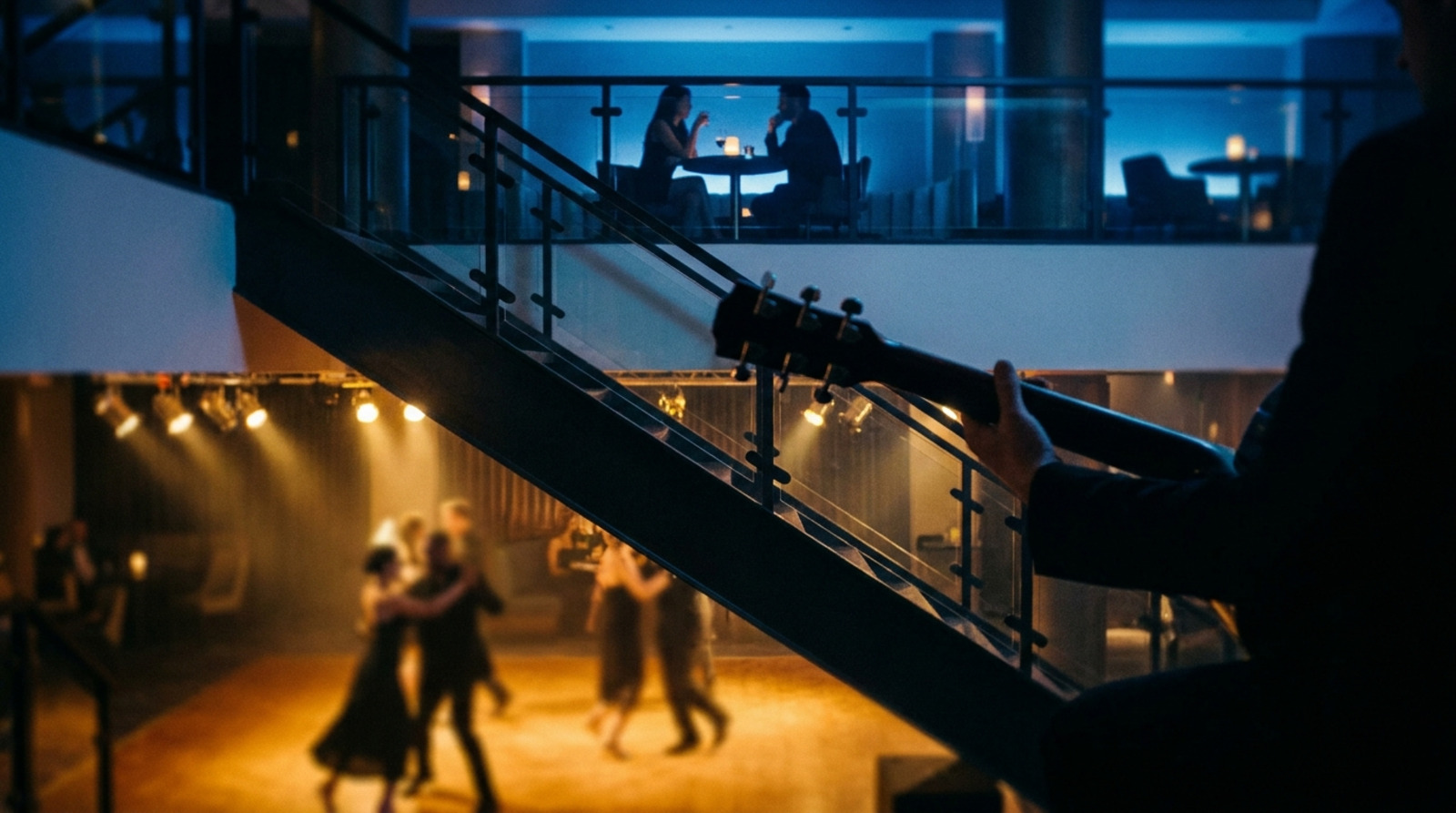
Consider an after-hours corporate event held inside the Smithsonian National Air and Space Museum. Guests came through a private entrance after closing, several hundred people in a building that normally asks visitors to keep their voices down. The musician booked for the night did not set up in a corner and stay there. He played while walking the museum floor, greeting guests as they arrived, riding the escalators between levels mid-song. By the end, security staff and the crew working the theater entrance were dancing and filming.
The useful part for a host is the contrast. The effect came from something warm and high-energy turning up where nobody expected it. A venue that feels formal, cavernous, or unusually quiet is an argument for live entertainment, not against it, and it is worth asking a performer whether they are willing to leave the stage.
A Formal Crowd Is Not a Reluctant One
A Christmas party for a family in Virginia started the way most of them do. Friends and neighbors arrived dressed formally, dinner was served, and the guitarist played quietly underneath the conversation. Partway through the night he invited a few guests to sing with him. By the end, roughly half the room had taken a turn, including the host, who sang a song with his daughter over a backing track cued up on the spot. None of them had arrived planning to sing.
What changed was permission. A live performer is visibly a real person taking a real risk in front of a room, and that is what makes it safe for a guest to try something. A playlist does not carry the same invitation. A guest list that skews formal or reserved is not a reason to keep the entertainment in the background, it is usually the reason to bring it forward.
2026 Trends in Event Entertainment
Memorable is the whole game. Amex GBT's 2026 Global Meetings and Events Forecast, surveying 601 meeting professionals, found 85% optimism about 2026, with "improve attendee experience with more memorable events" as the number one priority for the second year running. 42% of planners say demand for interactive formats is up, and 37% say personalization expectations are increasing.
Live performance is winning partly because of AI. GigSalad closed 2025 with 25,235 music bookings, up 10.6% year over year, and $12.8M paid to artists. Their CEO put it directly: "AI can write songs, generate beats, and simulate voices, but it cannot replace the energy of a great musician playing for a real audience." [GigSalad, 2026] The global live entertainment market sat at $202.9B in 2025 and is projected to reach $270.29B by 2030, a 5.9% CAGR. [MarketsandMarkets]
Live Music vs. DJ vs. Band
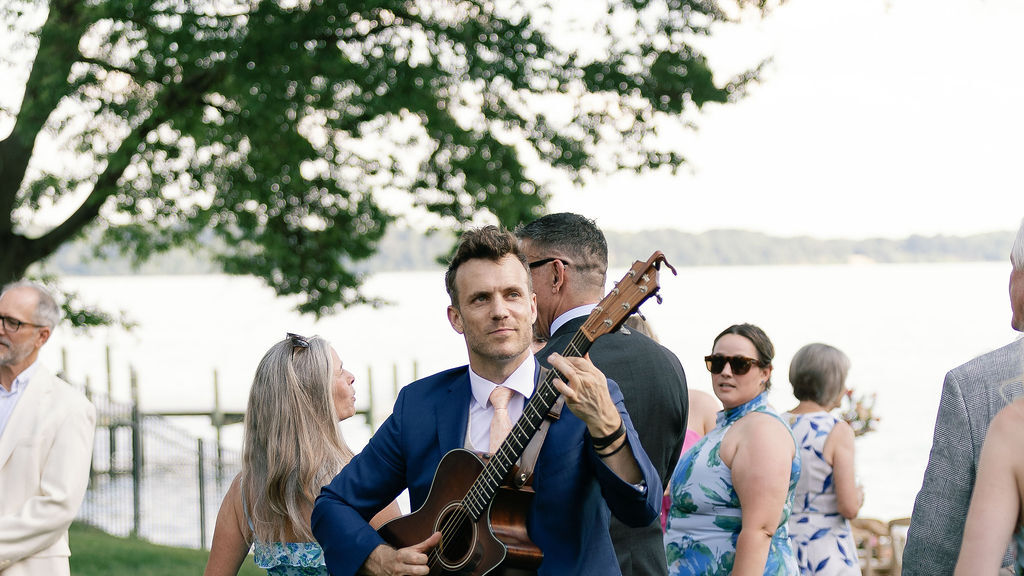
Solo Musician (Guitar, Vocals, Live Looping)
- Cost in the DMV, 2026: $2,500 to $4,000
- Atmosphere: Warm, intimate, unmistakably live
- Versatility: Very high. Pop through jazz, recorded music between sets, able to roam the room
- Best for: Cocktail hours, dinners, corporate receptions, birthdays, holiday parties
- Wow factor: High. Full-band sound from one performer
DJ
- Cost in the DMV, 2026: $2,500 to $3,000
- Atmosphere: High energy, danceable
- Versatility: High. Any genre, seamless transitions
- Best for: Dance-focused events and late-night receptions
- Wow factor: Medium. Expected, so it rarely differentiates the event
Live Band (4 to 5 piece)
- Cost in the DMV, 2026: $3,000 to $7,000 and up
- Atmosphere: Big, celebratory
- Versatility: Medium. Genre-limited and stage-bound
- Best for: Galas and events over 200 guests
- Wow factor: Very high, but it needs the right venue to land
String Quartet
- Cost in the DMV, 2026: $1,500 to $4,000
- Atmosphere: Elegant, formal
- Versatility: Low. Classical repertoire only
- Best for: Ceremonies and formal galas
- Wow factor: Medium to high. Elegant, but not interactive
A solo musician using live looping builds guitar, rhythm, and vocal layers in real time, which produces full-band sound from one performer at a price point below a full band. For events between 20 and 200 guests, that is consistently the highest-return format.
Event Type Matching Guide
- Corporate cocktail reception. Fills silence and eases networking. Best fit: a solo musician moving from ambient to upbeat, with recorded music between sets.
- Corporate gala or awards night. Elevates prestige and creates a ceremony-worthy atmosphere. Best fit: a solo musician with a full PA and a wireless mic for the program.
- Milestone birthday. Turns dinner into something guests remember differently. Best fit: a solo musician who roams, takes requests, and personalizes the set.
- Anniversary dinner. Intimacy amplified, with music reinforcing the emotional weight of the night. Best fit: a solo guitarist and vocalist.
- Holiday party. Seasonal sets create a shareable moment guests are still discussing in January. Best fit: a solo musician, plus a DJ for later dancing.
- Private dinner party. A roaming musician within six feet of the table is immersive in a way no speaker replicates. Best fit: a solo acoustic or electric guitarist.
- Nonprofit gala or fundraiser. Donor cultivation runs on emotional resonance, and live music primes generosity. Best fit: a live band or a polished solo act, with a PA and mic for speakers.
- Surprise party. Creates an undeniable moment on arrival, where the music is the reveal. Best fit: a solo musician cued to a specific arrival song.
The Vetting Problem Most Guides Don't Mention
Most of what ranks for hiring event entertainment is a directory listing, and directories like GigSalad and The Bash have no real quality control. They carry genuine professionals alongside hobbyists and part-timers, and the listing itself does not tell a host which one they are looking at. That gap is where most bad-hire stories come from, not from live music being the wrong call.
A few specific things separate a professional from a profile. Ask for footage from an actual live event rather than a studio recording, because footage of a real crowd shows how a performer holds a room. Ask for client references directly instead of relying on star ratings. And ask how they handle requests. A performer worth hiring should not have an ego about a guest wanting to sing along or a client asking for a specific song, because the job is to give the host and the guests a good night, not to protect a set list. A performer who treats a reasonable request as an imposition is worth finding out about before booking, not after.
Pre-Booking Checklist
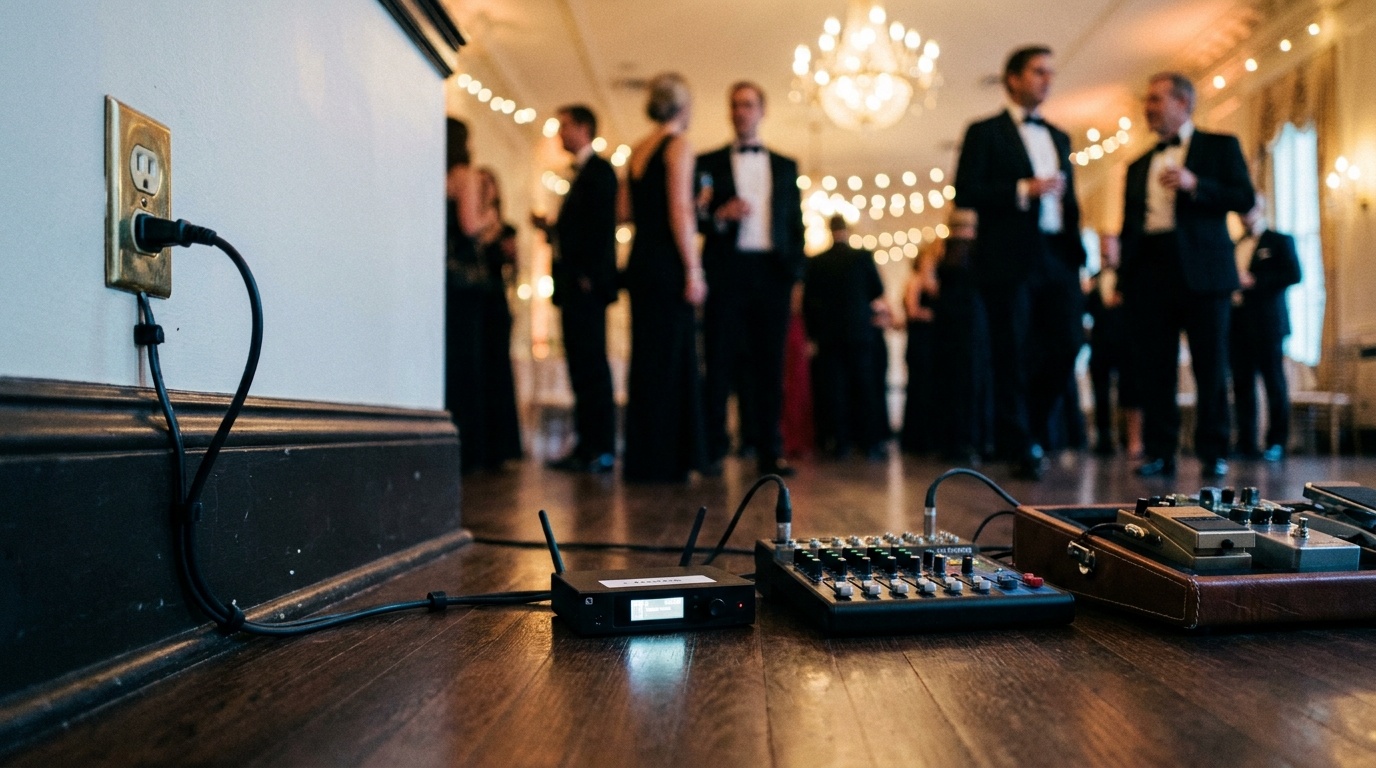
- Is professional audio included? The performer should supply broadcast-quality PA.
- Is there a wireless mic for speeches? Non-negotiable for any event with a program element.
- Is there music between live sets? Confirm the performer handles this seamlessly, with no dead silence on breaks.
- What is the actual repertoire range? Ask for specific songs, not just genre names.
- Is there live event video, not studio video? Real event footage shows how they hold a room.
- Are there client references? References confirm timeline discipline, volume courtesy, and awareness of how formal the room is.
- Are the contract terms clear? Deposit, cancellation, setup time, overtime, and illness contingency.
- How flexible are they logistically? Early load-in, backup equipment, venue-specific constraints.
Cost Breakdown: Live Event Entertainment in DC (2026)
Solo Musician with PA, $2,500 to $4,000
- Typically included: Performer, PA, 2 to 3 hours of live music, recorded music between sets, wireless mic
- Costs extra: Travel outside the metro area, overtime, early load-in
Professional DJ, $2,500 to $3,000
- Typically included: DJ services, lighting in some packages, 4 to 6 hours
- Costs extra: Lighting upgrades, overtime
Live Band, 4 to 5 piece, $3,000 to $7,000 and up
- Typically included: Performers, and PA depending on the act
- Costs extra: PA rental if it is not included, staging, green room
String Quartet, $1,500 to $4,000
- Typically included: Four performers, 2 to 3 hours
- Costs extra: PA rental for larger venues, overtime
Related Guides
- Hire a Solo Guitarist in Washington, DC and Alexandria, VA
- One Man Band Musician: How Looping Replaces a Full Band
- Wedding Cocktail Hour Music: The Complete Guide
FAQ
How much does live entertainment cost for a corporate event in DC?
$2,500 to $6,000 depending on format, duration, and experience. A solo musician with PA runs $2,500 to $4,000, a DJ $2,500 to $3,000, and a live band $3,000 to $7,000 and up.
What is the difference between a solo musician and a DJ?
A DJ offers broader genre range for dance-heavy events. A solo looping musician offers a third option: full-band sound, the ability to roam the room, and a live experience at a price below a full band.
How far in advance should I book?
Large events need 6 to 8 weeks minimum, and 3 to 4 months is better. Holiday parties should be booked by September. Smaller receptions are workable at 4 to 6 weeks.
What should a live entertainment contract include?
A deposit schedule, cancellation policy, overtime rates, illness contingency, setup time, and an equipment list.
How do I tell a professional apart from a hobbyist on a site like GigSalad?
Ask for footage from a real live event rather than a studio recording, ask for client references directly, and ask how they handle guest requests. A performer who treats reasonable requests as an imposition is a signal worth taking seriously before booking, not after.
Sources and Citations
- Amex GBT 2026 Global Meetings and Events Forecast, n=601, YouGov. 85% optimism, memorable experiences the number one priority, 42% interactivity demand, 37% personalization increase.
- GigSalad 2025 Year-End Report, 25,235 bookings, up 10.6% year over year, $12.8M to artists, up 12%.
- MarketsandMarkets, global live entertainment $202.9B in 2025 to $270.29B by 2030, CAGR 5.9%.
- Swarbrick et al. (2018), Frontiers in Psychology. DOI: 10.3389/fpsyg.2018.01341
- Tarr, Launay and Dunbar (2014), Frontiers in Psychology. DOI: 10.3389/fpsyg.2014.01096
- PNAS (2024), neuroimaging study, amygdala activation stronger in live versus recorded piano performance.
Blog Categories
Latest Blogs