Wedding Events
How to Choose a Wedding Ceremony Musician: The Complete 2026 Guide
By Dylan Galvin. Berklee College of Music, magna cum laude. Mentored by music legends John Mayer, Paul Simon and Livingston Taylor. Performing weddings across the United States since 2009, now based in the DMV (Washington DC, Maryland, and Virginia), more than 1,500 events.
Most couples pick ceremony music the way they'd pick a photo for the highlight reel: something guests will recognize, something that plays well on a thirty-second wedding video months later. That instinct gets the assignment backward. A wedding ceremony is a private pledge between two people, and the right processional song might be a Radiohead B-side or an instrumental nobody else in the room has ever heard.
This guide covers what a ceremony musician does, what current research says about why live performance affects people differently, how a couple's song list comes together, how the main musician types compare, what they cost in 2026, and the exact questions that separate a professional from someone who plays background sets at a restaurant.
What a Wedding Ceremony Musician Does, Cue by Cue
A wedding ceremony musician performs live across several distinct moments, and each one has a different job. The work is not one continuous playlist. It is a series of cues, most of which do not run on a fixed clock. It's almost always better to do instrumental versions of the songs than to have a live musician playing and singing during the ceremony. Shows like American Idol and The Voice feature singers for a reason. Live singing pulls in attention more than any other instrument. You don't want your guests paying attention to the singer and ignoring you on one of the biggest days of your life.
- Prelude. Twenty to thirty minutes of music as guests arrive and take their seats. A good ceremony musician spends this time reading the room, adjusting tempo and volume as the space fills and the energy builds. Usually an ambient performance, not usually specific selections, just ambient instrumental music being played while the guests arrive to give them a little bit of a wow factor and welcome them in.
- Processional. The wedding party walks to one piece. The couple usually enters to another, more prominent one. This is usually a song that has significant meaning to the couple. Slow to medium tempo works best.
Bride Walks. The centerpiece of the ceremony. The guests rise, and the song begins, usually the most meaningful song the couple has chosen and the focal point of the entire ceremony. Typically slow, emotionally powerful, familiar to the couple. Don't worry if a lot of people don't know this song. It's not for them. It's for you. - Interludes. Optional live pieces during a unity ritual, a ring exchange, or a reading. A skilled player stretches or shortens these in real time based on the officiant's pacing. Usually there's just silence during these moments, but you can always tweak the traditional format and have someone perform music during these moments as well.
- Recessional. The exit piece as the couple leaves together, usually brighter and more celebratory than the processional. Vocals here are okay - the silence is over and it's time to celebrate.
- Postlude. Continued music as guests file out and the day shifts toward cocktail hour. These can also be more up-tempo and either be instrumental or have vocals, think of it as the inverse of the guest arrival. So you're welcoming them to the cocktail hour, which is going to be the transition into the reception.
There is a specific quality of silence in a room right before a processional begins. Guests stop shifting in their seats. Someone reaches for a hand. Then the first note lands, the doors open, and everyone turns at once. That moment repeats at nearly every processional, and the version people remember is almost always the one where a live musician was reading the room in real time.
Here is the detail most couples never think about until it goes wrong. A processional does not start on a counted beat. It starts the instant the bride or the couple appears at the aisle entrance, which is never exactly when the timeline says. An experienced ceremony musician watches for that appearance, begins playing at the right moment, adjusts if the walk is slower or faster than rehearsed, and lands the final chord as the couple reaches the front. A recorded track cannot see the aisle. It plays whether the door has opened or not. Every awkward ceremony music moment traces back to that one limitation.
.jpeg)
The Science: Why Live Ceremony Music Affects People Differently
This is not a matter of taste. Live music produces measurably different responses in the brain than recorded music, and the difference is precisely what makes a ceremony feel the way it does.
A 2024 study from the University of Zurich, published in the Proceedings of the National Academy of Sciences (PNAS) and covered by ScienceDaily, scanned listeners' brains as a pianist performed. Live performance drove higher and more consistent activity in the amygdala, the brain's emotional center, than recorded versions of the same music. It also produced a more active exchange of information across the whole brain. Most striking, the researchers found that subjective emotional experience synchronized with the brain's auditory system only during the live performance, and only when the musician could adjust the playing in real time to heighten the response.
Translate that to your ceremony. A live musician watching your guests and shaping each phrase is doing exactly what the study measured: entraining a room in real time. That is why the room goes quiet in a particular way when a live processional starts, and why guests who barely know you still tear up. Recorded music, however high its fidelity, does not do this, because nothing about it is responding to the people in the room.
Types of Ceremony Wedding Musicians Compared
The choice between ceremony wedding musicians affects acoustic coverage, how flexible the repertoire is, budget, and how the ceremony feels. Here is an honest breakdown of the main options.
Solo guitarist or guitarist-vocalist
Best for: couples who want modern song arrangements, outdoor ceremonies, or the most flexibility in what gets played.
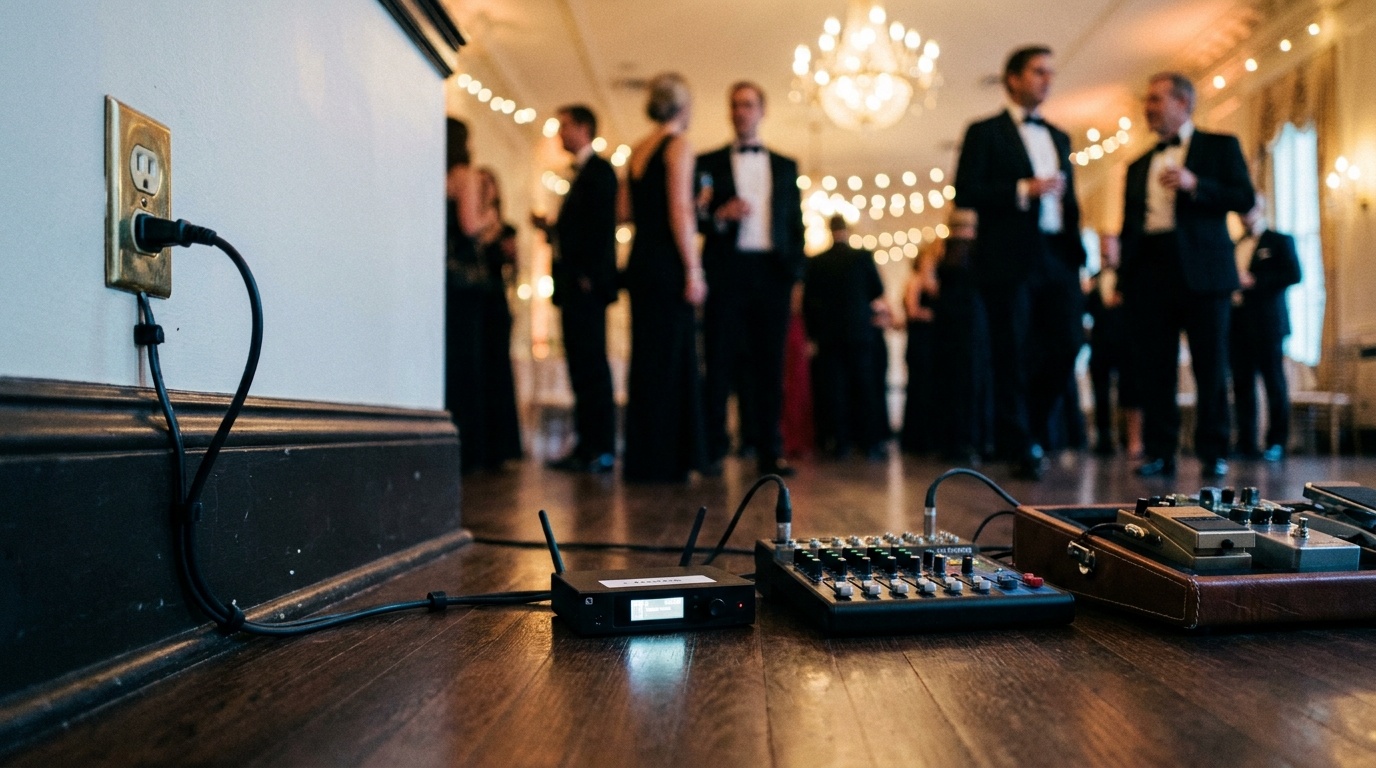
A solo guitarist can perform almost any genre with preparation and responds to ceremony pacing in real time. A guitarist-vocalist adds a live sung arrangement of your specific song, no backing track, which produces the most personal processional moments. The strongest setups are self-contained: a full PA with a large tower speaker, a wireless mic for the officiant, and a wireless guitar rig that lets the performer move through the space instead of standing behind a stand. The honest weakness is that one instrument does not fill a cavernous room the way an ensemble does, and quality varies enormously. The difference between a hobbyist and a conservatory-trained professional with hundreds of ceremonies behind them is not subtle.
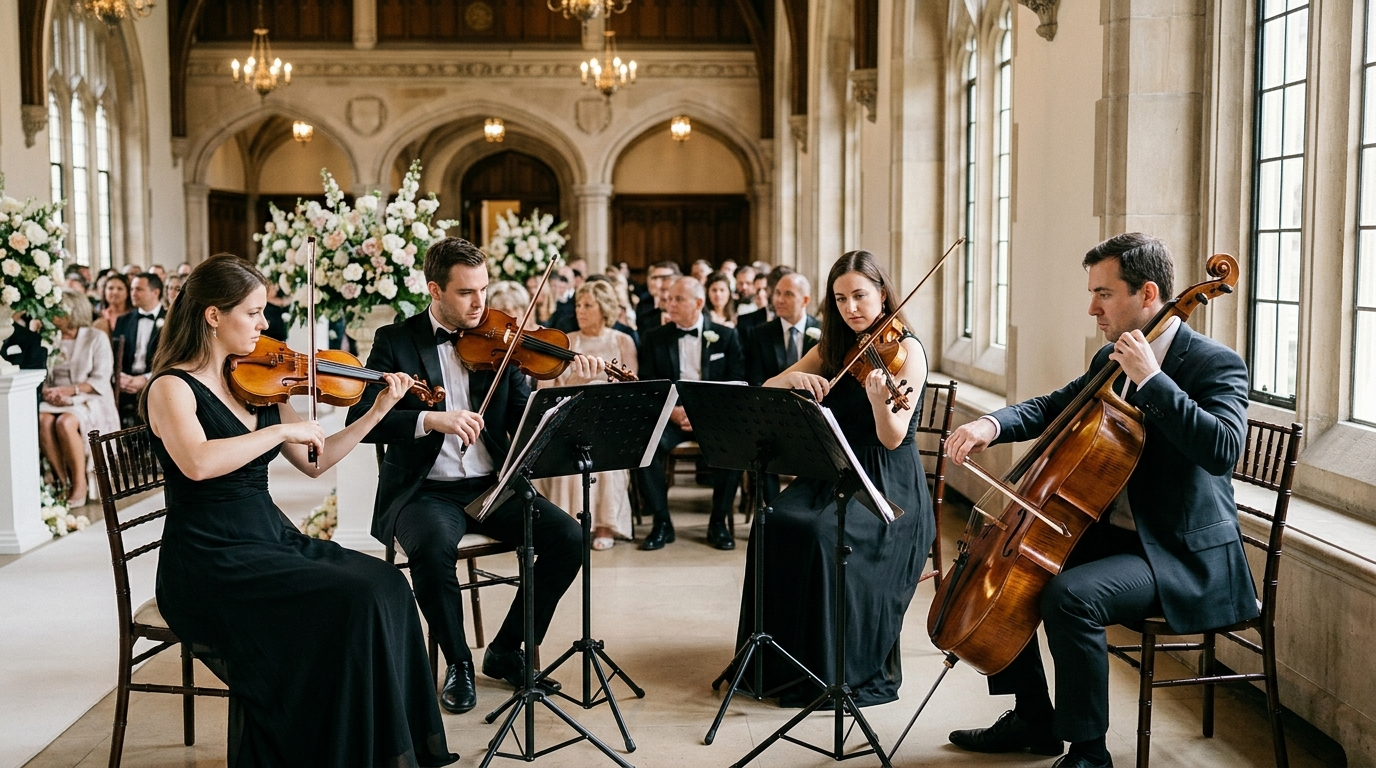
String quartet, duo, or trio
Best for: formal, traditional ceremonies with large guest counts in grand indoor rooms.
A string quartet is the most acoustically powerful option without amplification and reads as formal and classic. It requires more space than a solo musician, because you are paying four musicians, and it is less flexible for modern pop requests. Strings are sensitive to outdoor heat, humidity, and wind, which matters for the many DMV weddings held on terraces and in gardens. Also keep in mind if you want your string quartet in your photos, unlike a roaming or wireless musician, once they're set up, they're not moving.
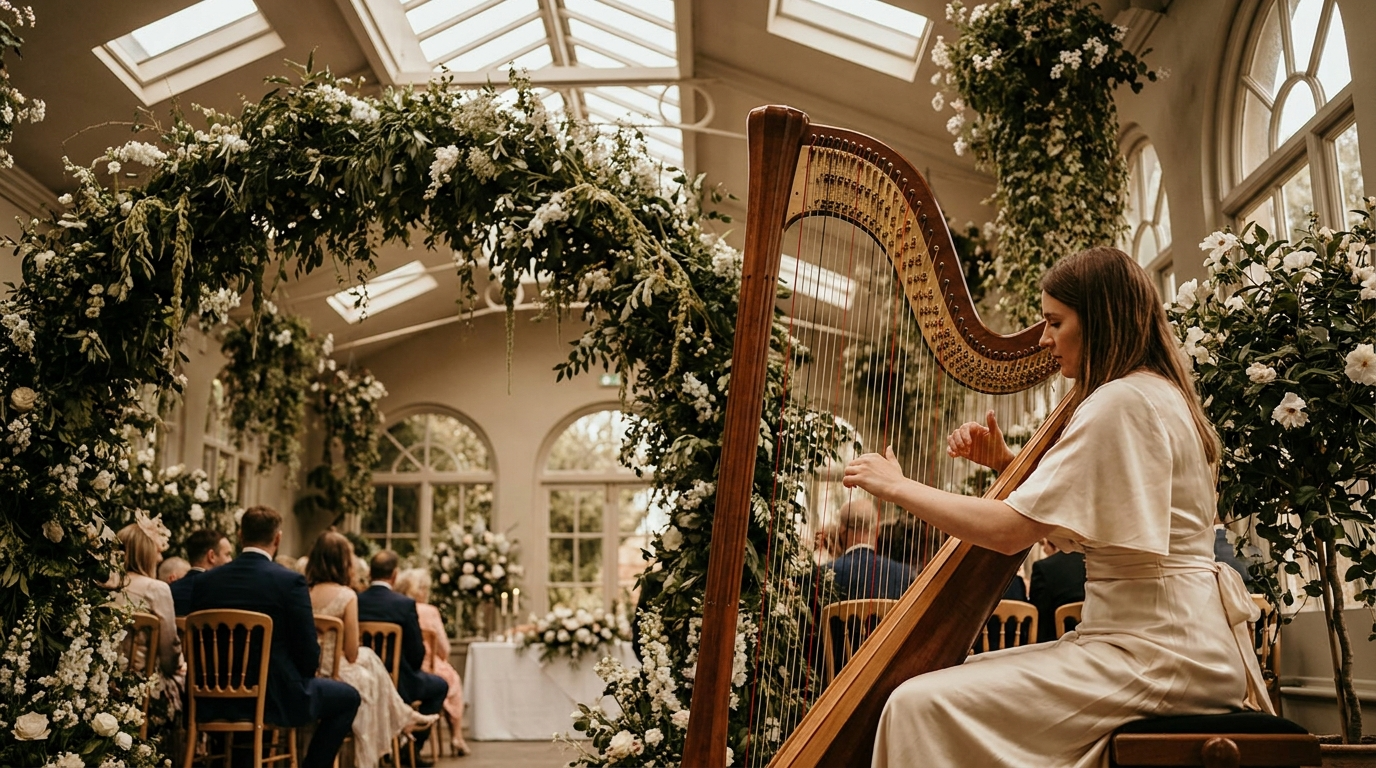
Harpist
Best for: indoor ceremonies or garden weddings where a distinctive, elegant sound is the priority. Beautiful for prelude music. The harp is a large instrument that needs special transport, has a limited contemporary repertoire, and does not love the outdoors. A harp is going to stay in place once it's set up. It's not able to move around, so consider this for photos as well. Thankfully, harps look beautiful on photograph, so it's not going to be an eye-sore, but just keep its placement in mind in proximity to the altar.
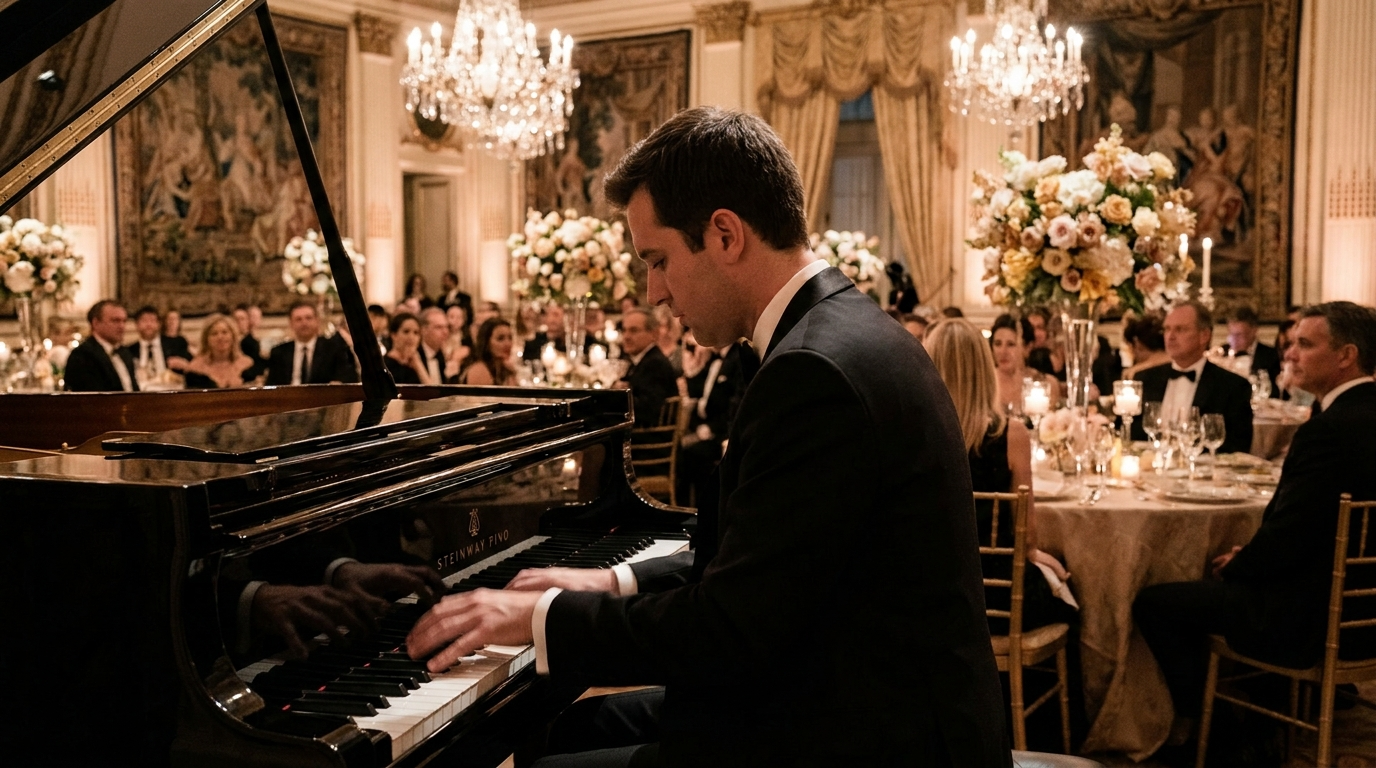
Pianist
Best for: indoor venues that already have a quality grand piano on site. Stunning when the instrument is there, and a non-starter when it is not. Not viable outdoors, unless you have a team of people willing to move it. It can look beautiful in photos, so consider where you put this for the ceremony as well if you're going to have it outside.
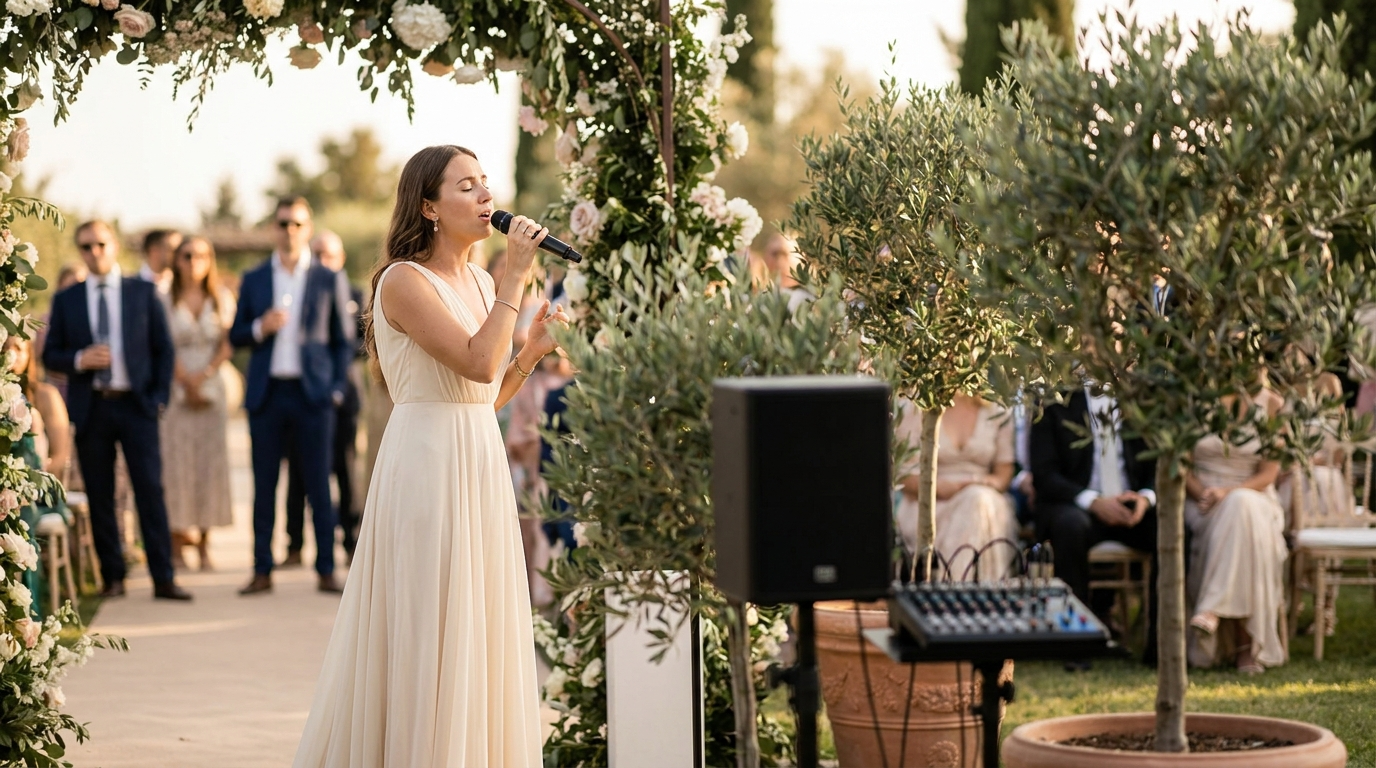
Singer with a backing track
Best for: couples set on one specific song with a strong vocal. The catch is that the backing track is recorded, so only the voice is live, and real-time flexibility drops sharply compared with a guitarist-vocalist who performs the whole thing live. This has the potential to be the most distracting and pull away attention from the bride and the bridal party and everyone else during the ceremony. So keep this in mind. I usually don't recommend this, but some people totally are dead set on having this, and if that's the case, then go for it. But just know your guest will probably be having their focus split between you and the singer.
The Three Ways Couples Build Their Ceremony Repertoire
There's no rulebook or "canon" dictating which songs belong at a ceremony, only common trends people tend to follow out of habit, and couples are free to deviate from every one of them. A dedicated repertoire page lets couples browse a full catalog before deciding anything, and how much a given couple uses it varies more than most guides admit.
Three patterns show up again and again, and all three work out fine. Some couples script the entire ceremony in advance: every song they want, every song they explicitly don't. Others hand over a few favorite examples or genres and let the musician build the set from that starting point. A third group says some version of "just do your thing" and hands the whole decision over. None of the three is the "right" way to plan a ceremony, and a professional should be equally comfortable working from any of them.
The real numbers are smaller than most people assume. Under 5% of couples go fully exhaustive, working through an entire repertoire to build a 30-plus must-play list alongside a 20-plus do-not-play list. Roughly 20% ask for something newly learned specifically for the wedding, whether that's a processional piece, a cocktail-hour request, or a song for later on the dance floor. A musician willing to learn a genuinely new arrangement for one wedding is a real point of difference, and not every performer offers it.
Custom acoustic fingerstyle arrangements of a couple's specific request are part of that same willingness to build something new. One couple asked for a song performed entirely in Italian, a language the musician didn't speak going in. Learning it well enough to sound natural took real preparation, and it's the kind of request that separates a musician who'll stretch for a couple from one who'll steer them toward something safer and easier to play.
What Couples Get Wrong Picking Ceremony Songs
The standard advice is to "pick songs that represent your relationship" or "select three to five ceremony songs," as if the songs need to satisfy someone else's evaluation. A ceremony is a private vow exchanged between two people, and the music only has to mean something to them. Guests are there to witness the moment and hold the couple accountable to their vows to each other, not to be entertained. This is the one part of a wedding you really can throw out what your guests think out the window. You are making a pledge to each other for the rest of your lives - the ceremony is about that. It doesn't matter what Aunt Margaret thinks. Or your mother. Pick the songs you want.
That changes what counts as a good choice. An obscure, deeply personal song, maybe an obscure track from an album nobody else in the room could name, is a completely valid pick if it means something to the couple, regardless of whether a single guest recognizes it. No one has ever needed to identify a wedding song to feel its weight.
What matters more than the specific song is how it's delivered. A slow-to-mid-tempo instrumental arrangement generally serves a ceremony better than a sung version or a fast tempo, whatever the source track sounds like on the original recording. Vocals pull attention onto the performer, and a tempo that's even slightly too fast rushes the walk down the aisle and makes it feel hurried. The arrangement and the performance is doing more work than the title of the song.
The Eight-Song Exercise
A simple, concrete way for a couple to build their own list from what matters to them:
- Each partner independently picks eight songs that tell the story of their lives together, without discussing the list with each other first.
- Compare lists. Songs that show up on both (three or more overlaps) become the natural pick.
- Fewer than three overlaps just means a different next step: share why each song mattered to the person who picked it. That conversation alone tends to deepen how a couple understands each other, and it often surfaces a song neither partner expected to become "theirs."
The exercise works because it removes the guest, the photographer, and the algorithm from the decision entirely. It's just two people and eight songs each.
What Does a Wedding Ceremony Musician Cost in 2026?
Start with a warning about averages. National-average figures blend students, hobbyists, and short marketplace bookings, so they read far lower than what a professional ceremony at a real venue costs. WeddingWire (2026) puts the average U.S. ceremony-music cost near $500, with most couples spending roughly $330 to $700, and Paperlust's 2026 cost guide puts single-musician ceremony-only coverage between $300 and $1,000. Those numbers describe one player booked for a short slot through a directory, frequently a student, not a full professional engagement at a luxury venue.
For a professional solo guitarist or guitarist-vocalist covering a wedding ceremony in the DMV luxury market, pricing scales with the scope of the booking: a ceremony-only engagement costs less than one that extends into cocktail hour or reception coverage, and bundling the ceremony with cocktail hour is almost always more cost-effective than booking two separate performers. A professional string quartet runs higher still because four musicians are involved. Paperlust's 2026 cost guide puts ceremony-only quartet pricing between $1,000 and $3,000, with premium ensembles in major metro markets running above that.
For full-evening entertainment context, The Knot's 2026 Real Weddings Study (10,474 U.S. couples married in 2025) reports an average live band cost of $4,500 against $1,800 for a DJ, with only 12 percent of couples booking a live band for their reception against 71 percent booking a DJ.
For how those band-and-DJ averages split out further by format and by DMV sub-market specifically, what DMV couples are actually paying for wedding music breaks those quotes down in more depth.
2026 Ceremony Music Trends
Two patterns stand out this year, one from the data and one from the aisle.
First, modern acoustic arrangements have taken over. The strongest 2026 trend is instrumental and sung versions of contemporary songs, pop, R and B, and film scores, played on guitar or strings rather than strictly classical repertoire. Couples want the ceremony to feel personal and cinematic. Second, live music requests keep rising even as AI-generated playlists get easier to make, because couples are not choosing live music for lack of an alternative. They are choosing it because they understand the difference the research above describes. Hybrid formats are also growing, with a live guitarist for the emotional weight of the ceremony and a DJ for the flexibility of the dance floor. Across DMV bookings, the ceremony is the moment couples plan in the most obsessive detail, more than the first dance, down to which recording of a song the arrangement should reference.
What to Look For, and the Questions to Ask Before You Book
The difference between a professional and a risk shows up in a short list of specifics. Look for verified reviews that mention the ceremony itself, the processional, the cue-reading, the officiant's microphone, specifics a general five-star rating doesn't capture. Confirm whether or not the quote includes a professional PA and a wireless mic for the officiant as a standard part of the booking. There are many venues, particularly wedding venues, that require general liability insurance for all of your wedding vendors, ideally with the venue named as an additional insured, and some high-end DMV venues demand this. Ask about ceremony-specific experience, because restaurant background sets and wedding ceremonies are completely different skills. For a deeper breakdown of what to check before you book anyone, the full vetting guide covers insurance, backup equipment, and what a quote should include.
Pacing is one part of officiant coordination, covered by the cue-handling question below and the timeline further down. The other part is content: a musician needs the ceremony's rundown from the officiant, the order of readings, any unity ritual, and a heads-up on anything outside the typical structure that will need its own cue. A general sense of the ceremony's shape is what helps here. A ceremony musician listens for the moment itself, and an officiant who can describe how the day flows gives the musician exactly what's useful.
Cultural or family traditions rarely require an explicitly coded genre to feel represented. Every song a couple chooses is already a reflection of who they are, and most requests land somewhere in classic hits, easy listening, or pop. The real exceptions do come up. An Indian wedding request, for instance, has shown up more often in the evening reception, electric guitar layered over Bollywood tracks, than in the ceremony itself. Naming a specific tradition directly to the musician in advance is what gets it reflected in the set.
Then ask these before any deposit:
- Can you play my exact processional song, and can you arrange an instrumental version of it?
- What does your sound setup include, and is the officiant's wireless mic part of it?
- Do you carry general liability insurance, and can you name my venue as additional insured?
- Have you performed at my venue before? (This is not a deal breaker, it just helps if the musician has to know that they're familiar with logistics and setup)
- How do you handle pacing if the processional runs long or short?
- What is your cancellation and rescheduling policy, in writing?
- Who is my point of contact between booking and the wedding day?
- Is there a song, style, or request you would turn down, regardless of the booking?
That last question is worth asking directly, because the answer reveals something the first seven can't. A vendor willing to say no to a request outside their genuine range is a vendor less likely to disappoint on the day. Most vendor disappointment traces back to a bad yes: a booking accepted because it was too good to turn down, or a couple's requests that kept expanding after the contract was signed until nobody felt able to push back.
How to Plan Your Ceremony Music Timeline
- 30 to 45 minutes before: musician arrives, sets up the PA, runs a sound check, tests the officiant mic.
- 20 to 30 minutes before: prelude begins as guests are seated.
- Ceremony start: wedding party processional on the coordinator's cue.
- The entrance: begins the instant the couple appears at the aisle, not on a countdown.
- During: silence or interlude music at the officiant's direction.
- Recessional and postlude: a celebratory exit, then transitional music toward cocktail hour.
WeddingWire recommends booking at least six months out, and earlier for peak season, which in this region runs May into June and again September into October.
Hiring a Wedding Ceremony Musician in Washington DC, Maryland, and Virginia
The DMV has ceremony musicians at every price point, and the quality gap is wide. The region also hosts some of the most demanding venues in the country. The Willard InterContinental in the District, the Inn at Perry Cabin in St Michaels, Salamander in Middleburg, Airlie and Goodstone out in the Virginia hunt country, and the Smithsonian venues all carry strict vendor requirements and acoustically complex rooms, from marble ballrooms that ring to open lawns that swallow sound. A ceremony musician who has worked these spaces plans for the room. A wireless rig matters here: a performer who can move freely through a large space fills the room more evenly and keeps the sound close to guests. For a lawn or terrace with no house system, the live music sound, power and AV questions to settle with your venue cover the power and amplification details to confirm before the day.
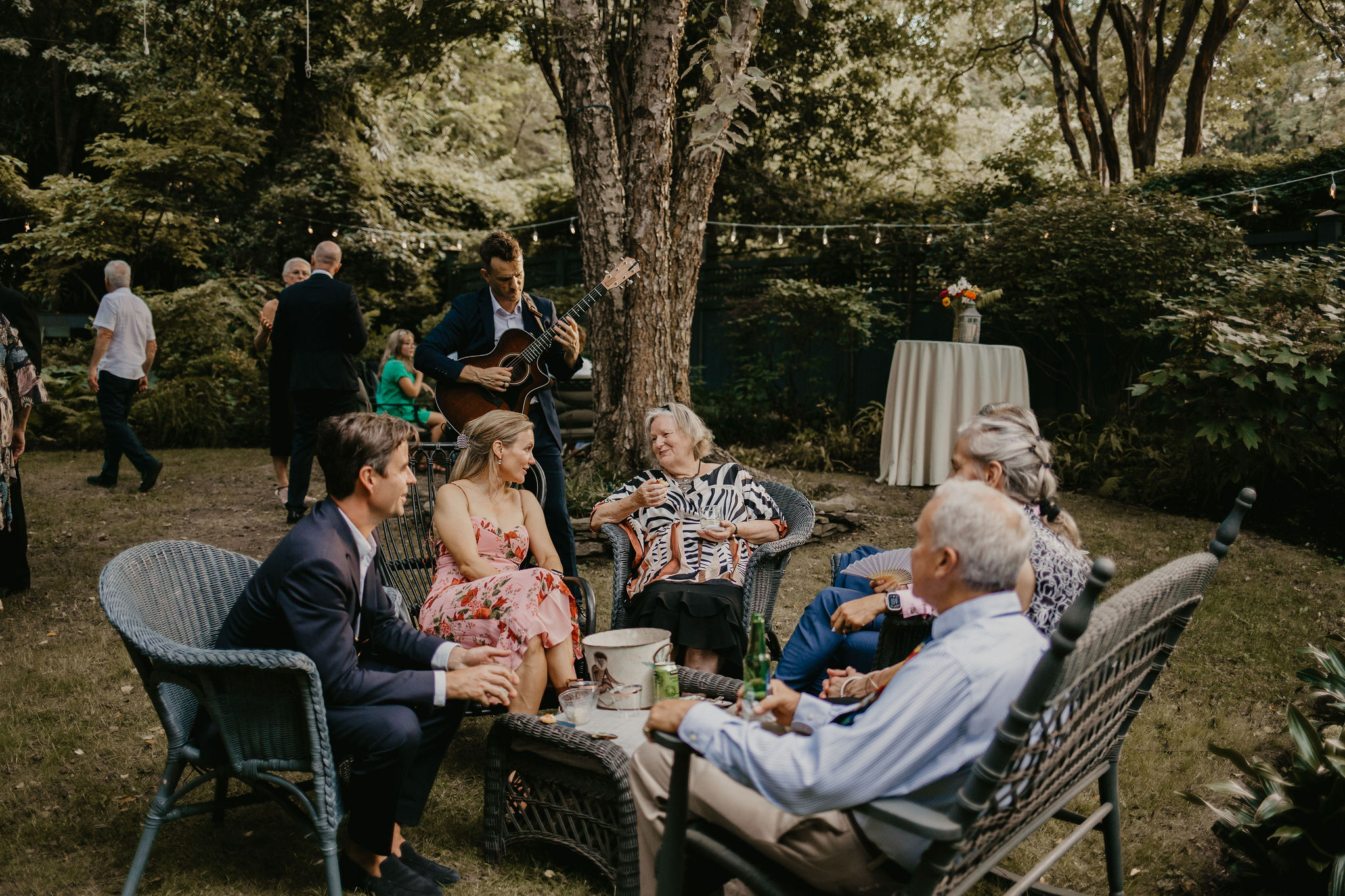
If you want to go deeper on the region, these are useful next reads: what it means to hire a wireless roaming performer, the musicians who play the DMV's luxury venues, and a guide to wedding musicians across Northern Virginia. For an overview of live ceremony and reception options in the region, see live wedding music across DC, Maryland, and Virginia.
Frequently Asked Questions
How much does a wedding ceremony musician cost in 2026?
A professional solo guitarist or guitarist-vocalist for a DMV wedding ceremony costs well above the national average, and the price rises further with cocktail-hour or reception coverage. National averages near $500 (WeddingWire, 2026) reflect students and short marketplace bookings, not a full professional engagement at a luxury venue. Expect to pay $2k - $4k for a highly skilled professional, with some luxury event entertainers costing over $7k or more.
What does a wedding ceremony musician do?
A wedding ceremony musician performs live across the prelude, processional, any interludes, the recessional, and the postlude. The core skill is reading cues in real time, especially starting the processional the instant the couple appears at the aisle.
Is live ceremony music really better than a recorded playlist?
Not only does it have a greater emotional impact, the wow factor and pulls in your family and friends to the ceremony, but research supports that it's the more engaging option. A 2024 University of Zurich study in PNAS found live performance drove stronger, more consistent emotional brain activity than recordings and synchronized listeners' feelings in real time, something a fixed track cannot do because it is not responding to the room.
Can I hear or see your song catalog before I book?
Most professional ceremony musicians can show a couple their song catalog before any commitment is made. A dedicated repertoire page lets couples browse in as much or as little detail as they want, whether that means scripting an exhaustive list or picking a few favorites and leaving the rest to the musician. Ask directly if a catalog isn't offered upfront.
What if we want a song that doesn't naturally work as ceremony music?
In practice, almost any song can work for a ceremony, because there's no fixed rulebook dictating what counts as appropriate. The arrangement is what determines whether a song works. A slow-to-mid-tempo instrumental version of nearly anything, including a song that sounds nothing like traditional ceremony music on the original recording, generally plays better live than a faster or vocal-heavy version would.
Can our ceremony reflect a specific cultural or family tradition in the music?
Yes, and most ceremony music already reflects a couple's identity without needing an explicitly coded genre. Naming a specific tradition directly to the musician, early in the planning process, is what gets it built into the set correctly. Requests do vary: some traditions, like Indian wedding music, show up more often in the evening reception than the ceremony itself, so it's worth being specific about which part of the day matters most.
Do professional ceremony musicians include a microphone for the officiant?
What a musician brings varies by act. Some include a full PA and a wireless microphone for the officiant in the quote, others bring only an instrument or a small amplifier, so ask exactly what is included. Always confirm this in writing, because a ceremony where guests cannot hear the vows is the most common avoidable failure.
What to ask about ceremony sound, setup by setup.
The Only Audience Your Ceremony Music Has to Answer To
Choosing a wedding ceremony musician comes down to one question: who do you trust to hold the emotional weight of your processional in real time? The research is clear that live performance moves a room in ways a recording cannot, and the practical differences between musician types, and between a hobbyist and a seasoned professional, are large enough to shape how the day feels. But the song list underneath all of that only has to satisfy two people. Guests are there to witness the ceremony, and the two of you are the only audience the song list ever has to satisfy, long after the photos and posts are gone. Decide the room first, the repertoire second based on what means something to the two of you, and the person who'll deliver it third, then ask the questions above before any deposit. Get those right and the twenty minutes your guests remember longest will take care of themselves.
Questions about music for your own event? The contact page is here.
Blog Categories
Latest Blogs