Wedding & Event Entertainment Pricing in 2026: What You're Actually Paying For
Dylan Galvin is a Berklee College of Music graduate, mentored by music legends John Mayer, Paul Simon and Livingston Taylor. Performing across the United States since 2009, now based in the DMV (Washington DC, Maryland, and Virginia), more than 1,500 events, including work for Coca-Cola, Wells Fargo, Lincoln, and CBRE. He has performed at weddings for CEOs and at some of the most prominent venues in the United States, playing ceremonies, cocktail hours and receptions.
If you're pricing out live music for your wedding, you've probably noticed that most of what's online is either outdated or made up. This post sticks to current industry data: where the market has been, where it is now, and how far apart a hobbyist and a luxury performer sit, which is further than most couples expect.
How wedding spending has moved since 2001
Before we get to entertainment, it helps to see the backdrop your budget sits in. The average U.S. wedding budget has swung a lot over the past 25 years, with recession dips, a pandemic collapse, and a sharp climb since:

The U.S. average wedding budget dropped 24% during the 2008 to 2009 recession, then fell again during the 2020 pandemic. It has since climbed back to roughly $34,000 in 2024 to 2025, the highest sustained level on record. (Sources: The Wedding Report, The Knot Real Weddings Study, SenticMoney 2026 wedding cost breakdown)
Entertainment has moved with it. Corporate events show the same pattern from a different angle: planners are increasingly prioritizing entertainment and production in their budgets, often putting more toward this line item than they did in past years. Entertainment has become the thing people remember an event by.
What you're paying for, by tier
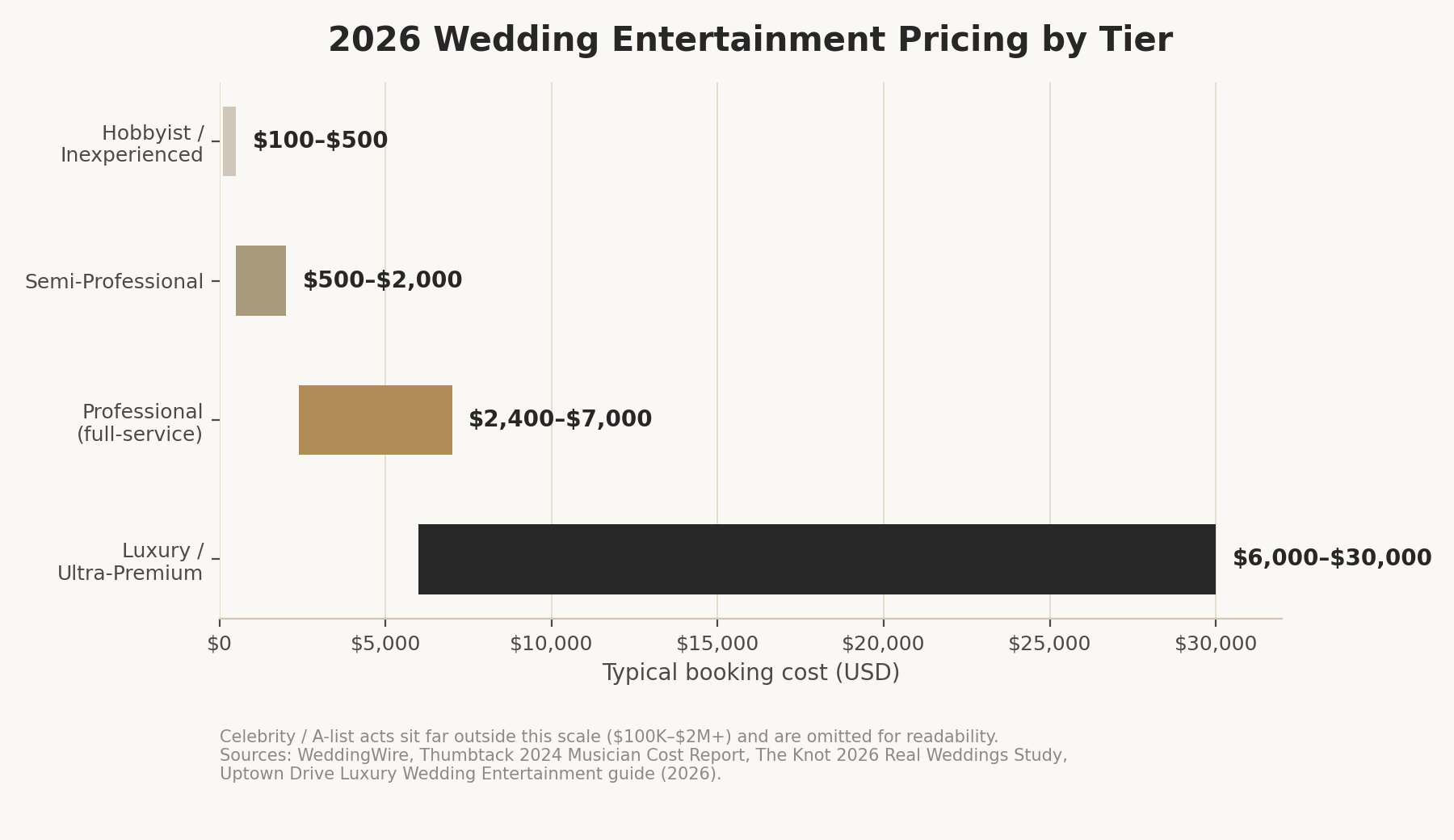
"How much does a wedding musician cost?" doesn't have one answer, because the market isn't one market. Based on current pricing data across WeddingWire, Thumbtack, The Knot, and luxury-market sources, entertainment splits into four tiers you'll run into:
Hobbyist / Inexperienced: $100 to $500. You'll usually be hiring a part-time player with minimal or no production equipment and a limited or no formal contract. They can be genuinely talented. They can also no-show, show up unrehearsed, or have no backup plan if something goes wrong, because there's no business behind the booking, just a person with an instrument. (Source: WeddingWire, Thumbtack 2024 Musician Cost Report)
Semi-Professional: $500 to $2,000. You get more experience, a proper sound setup, and sometimes a contract. This is where most "budget" ceremony and cocktail-hour bookings land: cocktail-hour solo sets typically run $150 to $300 per hour. Reliability is inconsistent, because it's often still a side income rather than the performer's full-time business. (Source: WeddingWire, Thumbtack)
Professional (full-service): $2,500 to $6,000. You're hiring a full-time performer running a business: contract, insurance, backup equipment, a defined repertoire, and, most important, an incentive structure where your event is their reputation. The Knot's 2026 Real Weddings Study puts the national average live wedding band at $4,500. A professional solo entertainer offering the same production value (sound system, wireless mics, full-day coverage, DJ transition) sits in the same range. (Source: The Knot)
If you want to see how that same national number breaks down by band, DJ, and solo format across the DMV's sub-markets, the DMV wedding music cost breakdown walks you through the regional ranges and the three hours most quotes leave out.
Luxury / Ultra-Premium: $6,000 to $30,000+. Expect full-scale production, top-tier musicianship, and often a larger ensemble or extended coverage across every phase of the event. Luxury-market data from destination and high-end wedding markets consistently lands here for a full live band booking. (Celebrity/A-list acts are a separate category entirely, six and seven figures, and sit outside this comparison.) (Source: luxury wedding entertainment market data, 2026)
Why a higher price mostly buys you less risk
Between a $500 performer and a $5,000 one, talent is rarely what separates them. Plenty of $500 performers can play beautifully. What you're paying for is what happens when something goes wrong, because on a wedding day, something always tests the plan a little.
A professional-tier or luxury performer brings a contract that guarantees they show up, backup gear if something fails, and the experience to read a room and adjust in real time instead of freezing. They also coordinate directly with your planner, photographer, and caterer so your day's timeline holds together. None of that shows up in a price comparison. It shows up on the day, when it separates a hiccup nobody notices from a problem your guests can see.
The extra price tag buys you protection from the version of your day where something breaks and nobody experienced enough is in the room to fix it quietly.
What to ask before booking
- What genres do you play, and can I see a real set list?
- Can you learn new songs for our event?
- Do you bring your own sound system and lighting?
- What's your overtime rate if we run long?
- Do you have video or audio from real events, not just a studio reel?
- How do you handle breaks during a multi-hour booking?
- What's included versus billed separately (travel, extra hours, equipment)?
Feeding your entertainer, and how tipping works
Feed them. A performer working a 6 to 8 hour event without a meal plan is running on empty by the final hour of your reception. Most professionals build a meal break into their contract for exactly this reason.
Tipping is where a lot of couples overthink it. At the professional and luxury tiers, the fee already covers the full value of the booking, the same reason you wouldn't tip a photographer or a wedding planner. A tip isn't expected at this level, and nobody will assume one if it doesn't happen. It's more common, and more meaningful, as a bonus on top of a lower-tier or budget performer's modest rate. Either way, a detailed online review after the night does more for a professional's business than a tip ever could. It's the easiest way to show you were happy, and it helps other couples and planners find someone they can trust.
More on Dylan Galvin's wedding music services: dylangalvin.com/wedding-music
Sources cited in this piece:
- The Wedding Report: historical U.S. wedding cost data
- The Knot Worldwide, 2026 Real Weddings Study (10,474 U.S. couples married in 2025)
- SenticMoney, "How Much Does a Wedding Cost in 2026?"
- WeddingWire, Wedding Ceremony Music Cost Guide
- Thumbtack, 2024 Average Solo Musician Cost report
- Uptown Drive, Luxury Wedding Entertainment Austin guide (2026)
Latest Blogs