Activities for Guests at Your Wedding: What Actually Works
Watch a wedding from the corner of the room, the way a musician does, and you learn to spot the exact minute the energy drops. It is almost never during the ceremony or the first dance. It is the forty-five minutes after the couple slips away for photos, when two hundred people are holding a drink, scanning for someone they know, and quietly deciding whether this is going to be a great night or a long one.
That gap is where most guest-activity planning goes wrong. Couples pour thought into the moments they will be present for and leave the moments they will miss to chance. After fifteen years and more than 1,500 events across the country, I can tell you the guest experience is won or lost in those in-between stretches, not on the dance floor.
Here is how to plan activities that actually reach your guests, based on what works in real rooms rather than what photographs well on a planning blog.
Where Weddings Actually Lose Their Guests
Every wedding has three predictable dead zones, and every one of them is fixable.
The first is cocktail hour. It runs about sixty to ninety minutes at most weddings, and it starts the moment the ceremony ends, which is also the moment you disappear for portraits (Zola). Your guests are at their most awkward here. They have just been seated in silence, they do not all know each other, and the two people they came to celebrate are gone.
The second is the transition from cocktail hour into the reception, when the room flips, seating gets sorted, and the crowd stalls in a doorway waiting to be told where to go.
The third is dinner. Not the meal itself, but the long tail of it, when the fast eaters are done, the toasts are over, and the dance floor has not opened yet.
Notice what these three have in common. They are the moments a DJ playlist or a static background act cannot rescue, because a speaker in the corner does not reach the guest stuck at table nine with no one to talk to. Activities that fix dead zones have to travel to the guest. That single idea should shape every choice below.
What the Data Says Couples Get Wrong About Guest Entertainment
Couples already know the guest experience matters. In The Knot 2023 Real Weddings Study, a survey of nearly 10,000 U.S. newlyweds, 75 percent of couples called the guest experience the most crucial part of the entire planning process, rising to 80 percent among couples who hosted a larger celebration (The Knot Worldwide).
The gap is not intention. It is reach. When those same couples added guest entertainment, their top picks were photo booths at 61 percent and games at 20 percent (The Knot Worldwide, 2023 study). Both are good. Both share the same flaw: they are opt-in. A photo booth entertains the twelve people willing to line up for it and no one else. Lawn games reach the guests who wander outside and skip the ones who do not.
Now put that next to what couples say they fear. In The Knot Worldwide 2025 Global Wedding Report, drawn from more than 33,000 newlyweds plus a follow-up poll of over 1,000 followers, nearly half of couples named their single biggest worry as their guests not having fun, and 68 percent said they wanted guests to feel they had never been to a wedding like theirs (The Knot Worldwide). In that same poll, guests ranked entertainment as one of the most memorable parts of a wedding at 21 percent, behind personalized touches at 36 percent and food and drink at 23 percent.
Read those numbers together and the lesson is blunt. The activities most couples reach for first are the ones that touch the fewest guests, while the outcome they fear most is a room where too many people are not engaged. The fix is to lead with an activity that reaches everyone, then layer the opt-in extras on top.
The Activity That Reaches Every Guest, Not Just the Ones Who Opt In
Live music is the only guest activity that comes to the guest instead of waiting for the guest to come to it. That is not a sales line, it is a logistics fact, and it is the reason a roaming musician outperforms a stationary one at exactly the moments described above.
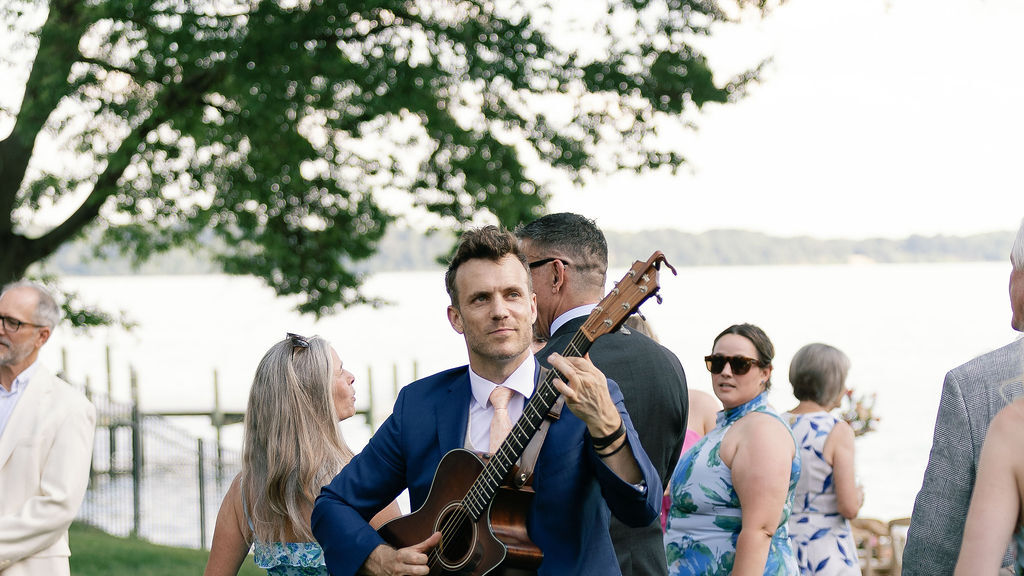
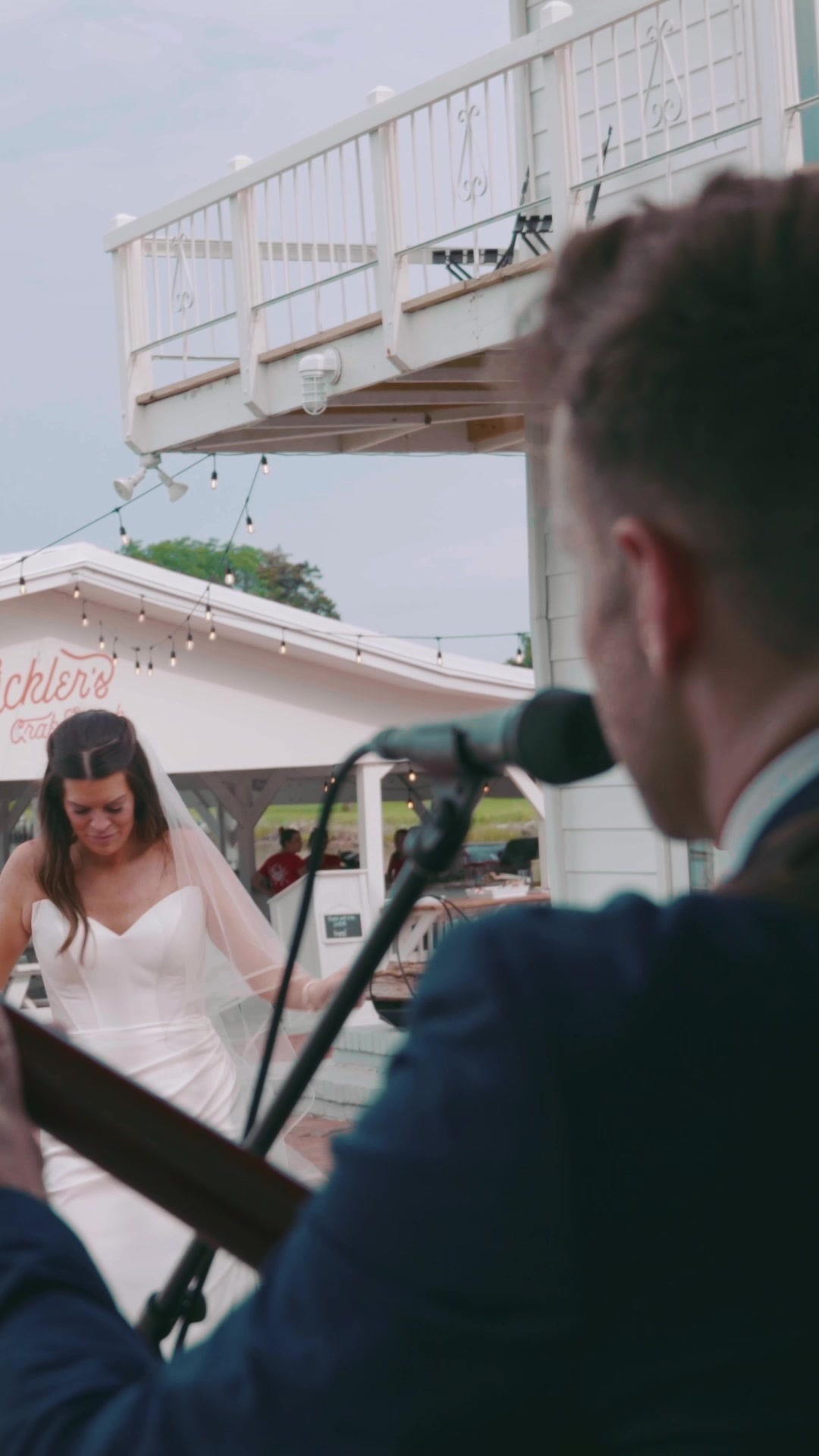
A wireless setup is what makes this possible. Playing guitar and singing on a wireless rig, with a full sound system anchoring the room, I can start a song by the bar, finish it at the far tables, and take a request from a grandmother who would never have walked up to a stage. That mobility is the whole point. A guest who feels invisible at a big wedding feels seen the moment the music arrives at their table. During cocktail hour it fills the silence you left when you went for photos. In the transition gap it gives a stalled crowd something to move toward. During the dinner lull it keeps the room warm without forcing anyone onto a dance floor before they are ready.
There is a technical piece behind the versatility. With live looping, one guitarist can layer a rhythm part, a bass line, and a melody in real time, so a solo act can carry a full room without a five-piece band's footprint or budget. It is the difference between background sound and something guests actually stop to watch. If you want the deeper mechanics of that format, I wrote a full explainer on what a roaming musician actually does.
The point is not that live music is the only thing you should do. It is that it should be the spine of your guest-activity plan, because it is the one element that reaches the whole guest list, and everything else you add is a bonus on top of that foundation.
A Real Menu of Guest Activities, Ranked by How Many Guests They Touch
Most guest-activity lists read like a shopping catalog with no priorities. Here is the same menu, ordered by the one thing that matters, which is how much of your guest list each option actually reaches.
Roaming or live music sits at the top because it travels to every guest and fills dead zones by design. A jazz trio parked in one corner is pleasant but stationary, so a mobile solo or duo act reaches more of the room for less money.
Interactive food and drink stations come next. A build-your-own cocktail bar, a raw bar, a late-night taco cart, or a coffee and dessert station gives guests a reason to move and a conversation starter when they get there. Signature cocktails were part of 45 percent of the weddings in The Knot 2023 study, and local food part of 24 percent, which tells you couples already trust this lever.
Live experiential moments like a wedding painter capturing the scene, a caricature artist, or a fragrance-blending station are strong for guests who engage, and they double as a keepsake. They reach a subset of the room, so treat them as accents, not anchors.
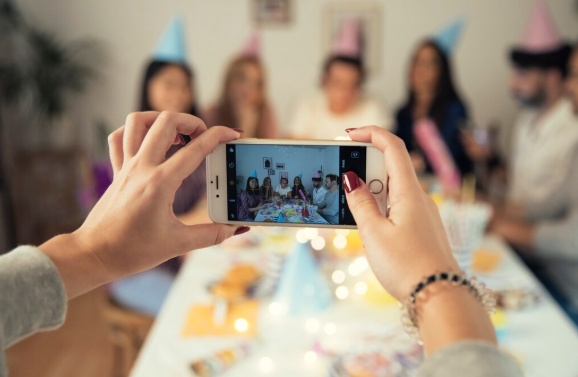
Photo experiences, the modern photo booth or a live portrait station, are proven crowd-pleasers and the single most popular add-on couples choose, but they are opt-in. Place them where foot traffic already flows, near the bar or the entrance, so they catch guests who would not seek them out.
Lawn games like cornhole, giant Jenga, and bocce are perfect for outdoor DMV venues with a terrace or garden and dead weight indoors. Match them to your space, not to a trend.
Structured group moments, an anniversary dance, a shoe game, a well-run set of toasts, cost nothing and pull the whole room's attention for a few minutes. They are the cheapest reach on the list and the most often forgotten.
Matching Activities to the Three Dead Zones
The plan comes together when you assign activities to the gaps instead of scattering them at random.
For cocktail hour, lead with music that moves and one station that gives guests a task. A roaming guitarist plus a signature cocktail bar covers the awkward opening minutes better than any single big-ticket item, because one fills the silence and the other gives hands something to do. Save the loud, static entertainment for later.
For the transition into the reception, use motion. Music that carries guests from one room to the next, a clear announcement, and a visible focal point stop the doorway pileup. This is the cheapest fix of the three and the one couples skip most.
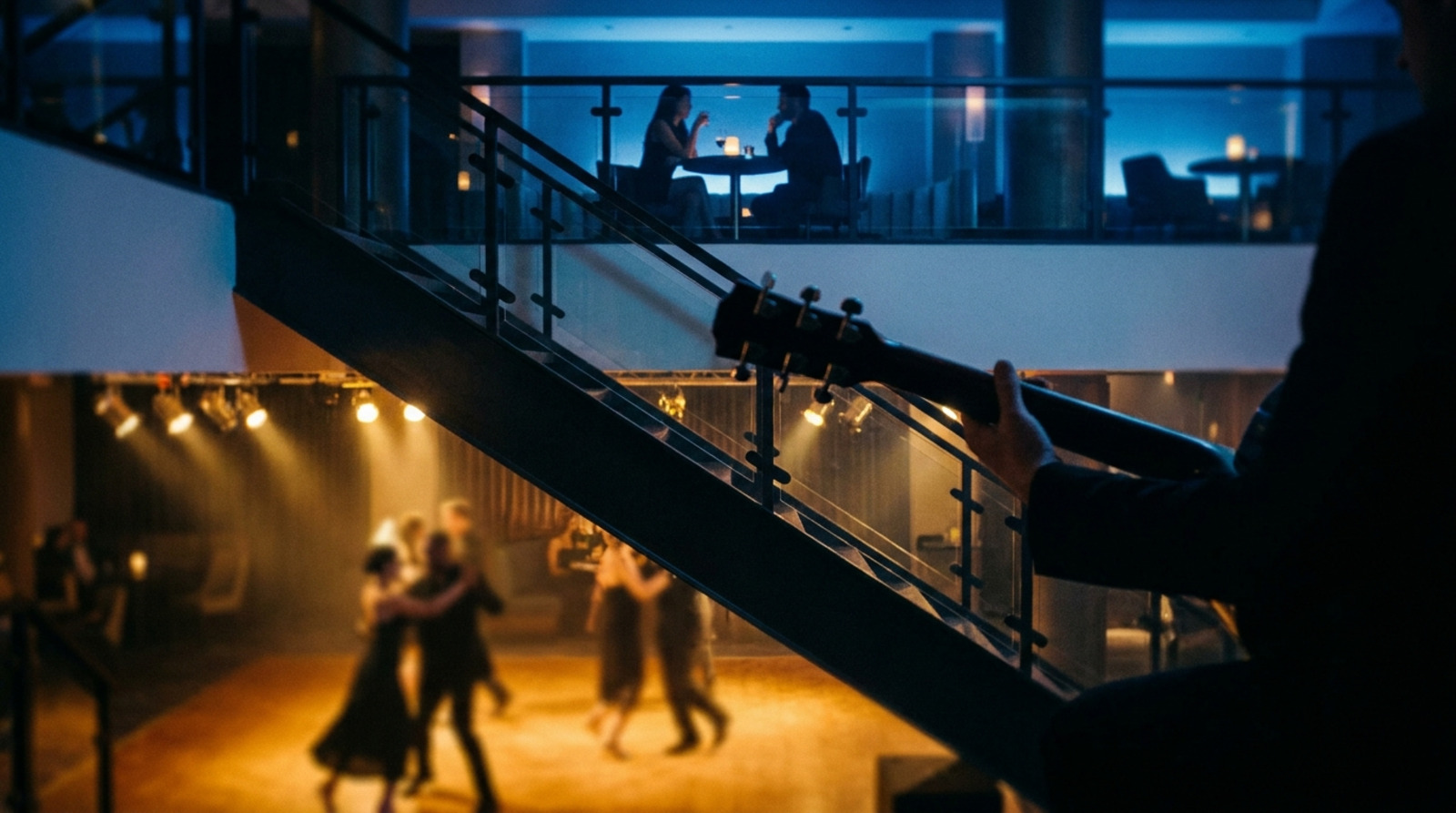
For the dinner lull, keep the temperature up without pushing the party. This is where a solo act earns its keep, playing through the tables at conversation volume, reading which side of the room is ready for more and which is still eating. At a Salamander Resort or a Whitehall Estate wedding I have watched a full dance floor start twenty minutes early simply because the room never went cold between courses. That timing is a judgment call you can only make from inside the room, which is exactly why a live performer beats a fixed playlist here.
If you are still deciding between a live act, a DJ, or a combination of both for the reception itself, that is a separate and worthwhile question, and I broke it down in detail in the best wedding day entertainment idea. For a DC-specific look at scoring the cocktail hour in particular, see the guide to cocktail hour music in Washington DC.
Frequently Asked Questions
What are the best activities for guests at a wedding?
The best activities are the ones that reach the most guests, which means leading with live or roaming music and interactive food and drink stations, then adding opt-in extras like a photo booth or lawn games. Live music is the only option that travels to every guest instead of waiting for guests to come to it, so it covers the awkward gaps a stationary attraction leaves open. Build the plan around one high-reach anchor and layer accents on top.
How do you keep wedding guests entertained during cocktail hour?
Give guests something to hear and something to do. A roaming musician fills the silence left when the couple leaves for photos, and an interactive station like a signature cocktail bar or raw bar gives guests a reason to move and a conversation starter. Cocktail hour runs about sixty to ninety minutes and lands right when guests are most unsure of themselves, so the goal is warmth and motion, not a single big spectacle.
What activities keep guests engaged during the transition and dinner?
Motion during the transition and steady warmth during dinner. When the room flips from cocktail hour to reception, music that carries guests between spaces plus a clear focal point prevents the doorway stall. During the long tail of dinner, a live act playing through the tables at conversation volume keeps energy up without forcing anyone onto the dance floor early. These two gaps are where guest energy quietly drains, and they are the cheapest to fix.
Are photo booths and lawn games worth it?
Yes, as accents rather than anchors. Photo booths were the top guest-entertainment add-on in The Knot 2023 Real Weddings Study at 61 percent, and games followed at 20 percent, so guests clearly enjoy both. The catch is that both are opt-in and only reach guests who choose to participate. Place them where foot traffic already flows and pair them with a high-reach anchor like live music so no one is left out.
How much of the wedding should be built around guest activities?
Enough to cover the three dead zones, and no more. Nearly half of couples in The Knot Worldwide 2025 Global Wedding Report named their biggest worry as guests not having fun, yet over-scheduling a wedding with back-to-back attractions can feel forced. Aim for one high-reach anchor that runs across cocktail hour and dinner, one or two interactive stations, and one or two accents. Coverage of the slow moments matters more than the sheer number of activities.
Do outdoor DMV venues change the activity plan?
They expand it. Outdoor and estate venues around Washington DC, Northern Virginia, and Maryland open the door to lawn games, garden cocktail stations, and roaming music across multiple spaces, which a single indoor ballroom cannot support. The tradeoff is sound and weather. Wireless live music travels across a terrace and lawn where a fixed speaker cannot, and it adapts if the schedule shifts for a passing storm, so mobility becomes even more valuable outdoors.
The Bottom Line
Guest activities are not a checklist of attractions to buy. They are a plan for the specific minutes when a room goes quiet, and the couples who get it right are the ones who cover cocktail hour, the transition, and the dinner lull rather than stacking the dance floor with extras. Lead with an activity that reaches every guest, add interactive stations for motion, and treat the opt-in pieces as accents. Do that and you answer the worry nearly half of couples share, which is simply that everyone they invited has a genuinely good time.
About the Author
Dylan Galvin is a graduate of Berklee College of Music, magna cum laude, mentored by music legends John Mayer, Paul Simon and Livingston Taylor. Performing across the United States since 2009, now based in the DMV (Washington DC, Maryland, and Virginia), more than 1,500 events. Learn more about live wedding music with Dylan Galvin.
Sources
- The Knot Worldwide, "Wedding Guests Take Center Stage: The Knot 2023 Real Weddings Study Reveals 75% of Couples Prioritize The Guest Experience," Feb 14, 2024 (survey of nearly 10,000 U.S. newlyweds). theknotww.com
- The Knot Worldwide, "2025 Global Wedding Report," Aug 13, 2025 (33,174 newlyweds across 8 countries plus a poll of 1,000+ followers). theknotww.com
- Zola, "How Long Is Cocktail Hour? The Power of Happy Hour," 2025 (cocktail hour timing). zola.com
- The Knot, "22 Wedding Cocktail Hour Ideas to Keep Guests Entertained," 2026 (guest-activity idea reference). theknot.com
Blog Categories
Latest Blogs