.png)
What I've Learned Playing Corporate Events for Fortune 500 Brands
If you're a corporate event planner deciding what live entertainment to book, the short answer is this: the biggest risk isn't picking the wrong genre of music, it's booking a performer who can't read a room full of executives, adapt in real time, and disappear into the background exactly when the agenda demands it. After 17 years and more than 1,500 performances for companies like Coca-Cola, Wells Fargo, Delta Air Lines, SAP, and CBRE, that single skill (adaptability under pressure) separates the entertainment planners rebook from the entertainment they quietly cross off the vendor list.
I'm Dylan Galvin, a Berklee-trained guitarist and vocalist who has spent nearly two decades performing corporate events, from CEO dinners to CES activations to five-star hotel galas. This article breaks down what I've actually learned working Fortune 500 rooms, the mistakes I see planners make, the questions I get asked most, and the standards I'd hold any corporate event musician to, myself included.
Key Takeaways for Corporate Event Planners
- Fortune 500 events reward restraint, not spectacle. The best corporate entertainment supports the agenda; it never competes with it.
- Versatility beats a great cover band. A single performer who can shift from soft instrumental to high-energy dance music removes coordination risk and cost.
- Reliability is a credibility signal. Backup gear, insurance, and on-time setup matter more to procurement teams than repertoire size.
- Brand history is verifiable trust. Ask any prospective performer for named clients, venues, and references, not just a highlight reel.
- The booking process should mirror the event's professionalism. A messy quote process is a preview of a messy event.
Why Does Fortune 500 Client History Matter When Booking Entertainment?
Direct answer: 500 client history matters because it's proof a performer can operate inside corporate constraints (brand guidelines, tight run-of-show timing, executive audiences, and zero tolerance for technical surprises), not just proof they can play well. Fortune
Corporate events are fundamentally different from private parties. A wedding guest list forgives a technical hiccup. A room full of Fortune 500 executives, journalists, or investors does not. Companies I've performed for (including Coca-Cola, Wells Fargo, the LA Rams, Delta Air Lines, the Consumer Electronic Show, Tetrapak, Lincoln, CBRE, SAP, and YPO) don't just hire a musician. They're hiring someone who has already proven they can deliver exceptional corporate event live music in Washington, D.C. while consistently meeting professional expectations. That includes the ability to:
- Follow strict timing cues from an event producer or AV team
- Read an unfamiliar corporate culture in minutes and calibrate energy accordingly
- Stay unobtrusive during speeches and seamlessly ramp up for networking
- Work cleanly alongside caterers, AV crews, and other vendors without disrupting flow
When you're evaluating a corporate event musician, ask for a client list and be specific: "Which of these were internal company events versus public performances?" That distinction reveals whether someone has actually operated inside the pressure of a Fortune 500 environment.
What Makes Corporate Event Entertainment Different from Weddings or Private Parties?
Direct answer: Corporate event entertainment has to serve a business objective first and an atmosphere second, every song choice, volume level, and break in the set needs to support the agenda, not just the mood.
At a wedding, the music is the story. At a corporate event, the music is the backdrop to a bigger story, brand messaging, networking, leadership visibility, or client retention. That changes everything about how a performer should operate:
- The Agenda Comes First
A corporate event musician needs to build a set around a run-of-show, not a wedding timeline. That means being ready to stop mid-song for a surprise executive announcement, or stretch a set an extra 20 minutes when cocktail hour runs long.
- Brand Sensitivity Is Non-Negotiable
Song selection, appearance, and volume all need to reflect the client's brand. What works for a tech launch at CES doesn't work for a bank's annual gala. I keep an extensive, adaptable repertoire (classics, easy listening, 80s and 90s favorites, and modern hits), specifically so I can match tone to brand, not the other way around.
- Discretion Matters as Much as Talent
Executives and clients are often having business conversations near the performance area. Great corporate entertainment enhances the room without forcing itself into every conversation.
If you're planning a company event, my Private & Corporate Events page walks through how this plays out in practice, from cocktail hour ambiance to full dance-floor energy.
What Corporate Entertainment Ideas Actually Work at High-Profile Events?
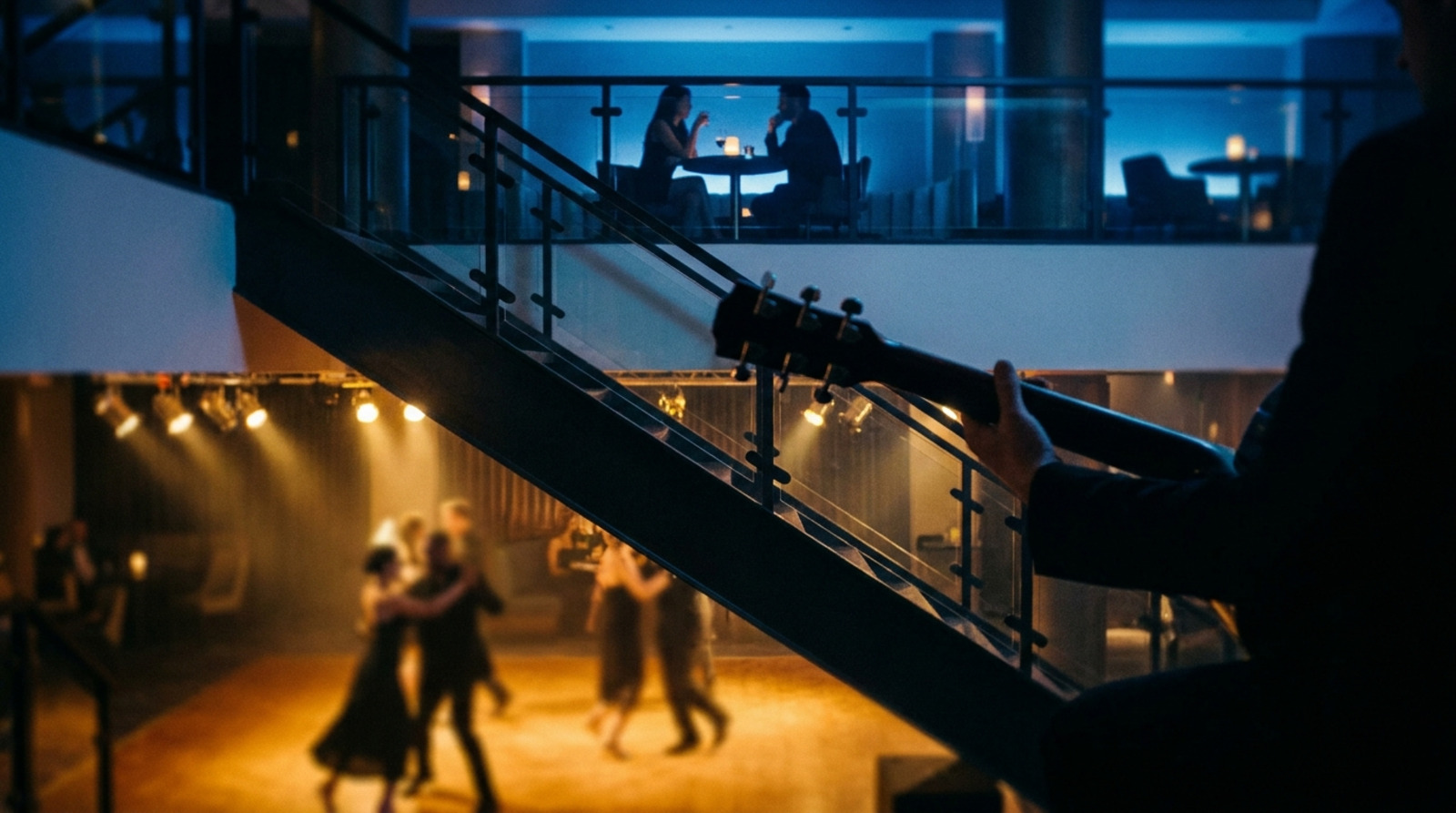
Direct answer: The corporate entertainment ideas that consistently work are the ones that scale in energy across a single event: soft instrumental music for arrivals and dinner, transitioning into upbeat, vocal-driven performance once the formal program ends.
Here's what I've seen work again and again across hundreds of Fortune 500 and luxury hotel events:
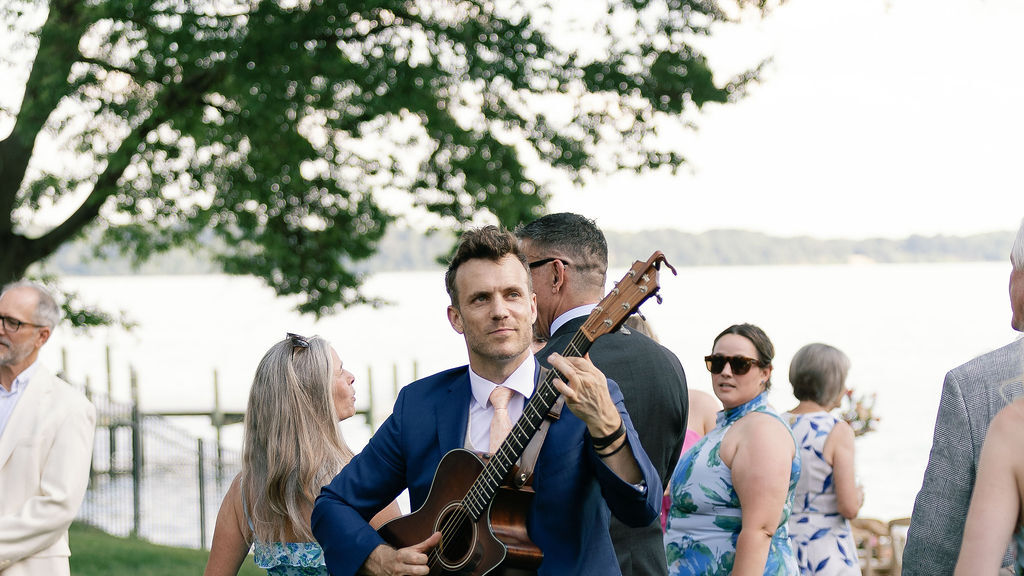
- Roaming acoustic guitar for guest arrivals: sets a sophisticated first impression without requiring a stage or heavy AV
- Instrumental-only music during dinner or speeches: keeps the room's attention on the agenda, not the performer
- A single "3-in-1" performer: instrumental guitar, guitar with vocals, and even DJ-style transitions from one musician instead of coordinating multiple vendors
- Live looping: creates a full-band sound from one performer, useful when budget or space doesn't allow a full band
- A planned energy arc: soft and elegant early, building to upbeat top-40 and dance-floor energy once the business portion of the night ends
Common mistake to avoid: Booking a full band or DJ for an event that's really a networking dinner. It's often more cost-effective, and better received, to book one versatile performer who can shift styles throughout the night than to hire multiple acts for different segments. This is exactly why I built my corporate event offering around a single-performer, multi-mode format.
How Do I Vet a Corporate Event Musician for a High-Stakes Event?
Direct answer: Vet a corporate event musician the way you'd vet any vendor with reputational risk attached: verify their client history, confirm their technical redundancy, and check reviews specifically from event planners, not just individual hosts.
Here's the checklist I'd recommend to any planner booking entertainment for a brand-sensitive event:
- Ask for named, verifiable clients. Vague claims like "performed for Fortune 500 companies" should come with specifics you can sanity-check.
- Confirm backup equipment. A professional performer travels with backup gear specifically to prevent interruptions, ask this directly.
- Check for liability insurance. Most corporate venues require it. A performer who already carries it is one less logistics problem for you.
- Read planner-specific testimonials. A review from another event planner tells you more about professionalism and coordination than a review from a wedding guest.
- Ask how they handle real-time changes. Executive schedules shift. Ask how they'd handle a 20-minute delay or an unplanned speech mid-set.
One planner I worked with on a recurring five-week event put it this way in her review: I showed up early every week to allow plenty of setup time, stayed professional throughout, and engaged directly with the audience, consistency across repeat bookings is exactly what corporate planners are vetting for. You can read that review and others on my homepage.
What Should Corporate Event Planners Expect from the Booking Process?
Direct answer: If you're booking live music for corporate events in Alexandria VA, expect a straightforward process that starts with an initial inquiry, followed by a custom quote tailored to your event rather than a one-size-fits-all package. From there, you'll collaborate on the performance timeline, song selection, and event flow, while the musician handles all setup, sound, and technical details on the day of the event, allowing you to focus on hosting a successful corporate gathering.
A disorganized booking process is often a preview of what the event day will look like. Here's the standard I hold myself to, and what I'd recommend any planner expect:
- Step 1: Share event details. Vision, venue, timeline, and any brand guidelines.
- Step 2: Receive a custom quote. Not a templated package: pricing and recommendations built around your specific event.
- Step 3: Collaborate on the music plan. Finalize style, energy arc, and any must-play or do-not-play songs.
- Step 4: Hand it off entirely on event day. Setup, sound, and troubleshooting should be invisible to you and your client.
If you're scoping an event and want to see this process directly, my contact page is the fastest way to get a custom quote.
Common Mistakes Corporate Planners Make When Booking Entertainment
- Booking on price alone. The cheapest quote often means the least experience with corporate-specific constraints like AV coordination and brand sensitivity.
- Not asking about repertoire flexibility. A performer who can only do one style forces you to build the whole event's energy around their limitations.
- Skipping the reference check. Always ask for at least one reference from a corporate or planner client, not just a private event host.
- Underestimating setup and sound needs for the venue. Confirm the performer has equipment suited for your audience size, my setup, for example, is built for audiences of 300+.
- Locking in music without a contingency plan. Ask what happens if the agenda runs long, short, or changes entirely mid-event.
Expert Tips for Choosing Corporate Event Entertainment
- Match the performer to the arc of your event, not just the venue. A gala's energy curve looks different from a product launch's.
- Build in a short pre-event call. Even 15 minutes with the performer to walk through the run-of-show prevents most day-of surprises.
- Ask for video of comparable corporate events, not just weddings. The skill sets overlap, but corporate rooms have different demands.
- Confirm brand-appropriate presentation. Attire, volume, and interaction style should all be adjustable to fit your client's brand.
- Treat the entertainment vendor like any other reputational vendor. The same diligence you'd apply to a keynote speaker or AV company applies here.
Conclusion
The lesson from 17 years and 1,500+ performances across Fortune 500 companies, luxury hotels, and high-profile venues is simple: corporate entertainment succeeds when it's built around the event's objective, not the performer's ego. Planners who vet for adaptability, professionalism, and verifiable client history (rather than just talent alone) are the ones who get a performer they can rebook with confidence, year after year.
Ready to plan entertainment for your next corporate event? Get a custom quote or explore more about corporate and private event entertainment options tailored to your event's energy and brand.
Frequently Asked Questions
Do corporate event musicians need to be insured?
Yes, most corporate venues require vendor liability insurance before allowing setup. A performer who already carries it removes one step from your logistics checklist.
Can one musician replace a full band or DJ at a corporate event?
Often, yes. A versatile solo performer who can move between instrumental guitar, guitar with vocals, and DJ-style transitions can cover an entire event's energy arc (arrivals, dinner, and dancing) without the coordination cost of multiple acts.
How far in advance should we book entertainment for a corporate event?
As early as possible once your date and venue are confirmed, especially for peak seasons or high-profile venues, since experienced corporate performers' calendars fill quickly.
What if our event schedule changes at the last minute?
An experienced corporate event musician builds flexibility into the plan from the start and can adjust timing, energy, or song selection in real time to match schedule changes.
Do you work directly with event planners and other vendors?
Yes, coordinating directly with planners, coordinators, and AV or catering teams to stay on schedule is a standard part of the process, not an add-on.
Blog Categories
Latest Blogs