Wedding Events
Live Music at Your Annapolis Wedding: A Practical Guide
There's a moment during cocktail hour at Historic London Town and Gardens when the light off the South River turns gold and guests spill out onto the lawn, drinks in hand, looking out toward the water. A DJ in that moment feels like a missed opportunity. Not because DJs are wrong for Annapolis weddings — they're right for plenty of them — but because that specific scene has an acoustic quality to it. The air is warm, the river is right there, and the space wants something human.
That observation doesn't mean every Annapolis couple needs live music. It means Annapolis has more of those moments than most wedding markets, and it's worth thinking carefully about how you want to fill them before you book.
This guide covers what couples and planners should understand before hiring any live musician for an Annapolis-area wedding — from the specific acoustic challenges of waterfront ceremonies to the questions that actually tell you whether a performer has done this before.
What makes Annapolis different from a music-booking standpoint?
Annapolis is a working maritime city that also happens to have a serious concentration of luxury wedding venues along the Chesapeake Bay, the South River, and the historic district downtown. That geography shapes everything about how entertainment works here.
Most of the signature venues — Historic London Town and Gardens, the Annapolis Waterfront Hotel, Watermark's Catherine Marie yacht, Celebrations at the Bay — have outdoor ceremony lawns or waterfront terraces exposed to open air. Even the Historic Inns of Annapolis, with its more sheltered courtyard settings, has outdoor options where amplified sound behaves unpredictably.
The market reflects the area's affluence. Anne Arundel County reported a median household income of $124,911 in 2024, with an average of $156,835 (Neilsberg, 2024). Maryland's statewide average wedding spend hit $45,693 in 2025, with nearly 31,000 weddings performed (The Wedding Report, 2025). Entertainment is a meaningful budget category, and the expectations match.
The catch: the local supply of acoustic performers specifically suited to Annapolis's venue conditions is genuinely thin. WeddingWire lists four wedding ceremony music vendors in Annapolis. GigSalad lists 47 guitarists, but a significant portion are regional generalists without specific waterfront venue experience. Finding a strong performer here often means looking across the broader DMV region rather than just local Annapolis listings.
Which part of the day actually benefits from live music?
Live music doesn't have to cover the entire event — and in most Annapolis weddings, it works better when it doesn't. The day breaks into three distinct entertainment windows, and they call for different things.
Does live music work for an outdoor Annapolis ceremony?
Yes, with the right setup. Outdoor waterfront ceremonies have real acoustic challenges (covered in the next section), but a solo musician with their own sound system — or a small acoustic ensemble familiar with maritime venues — can handle a ceremony beautifully.
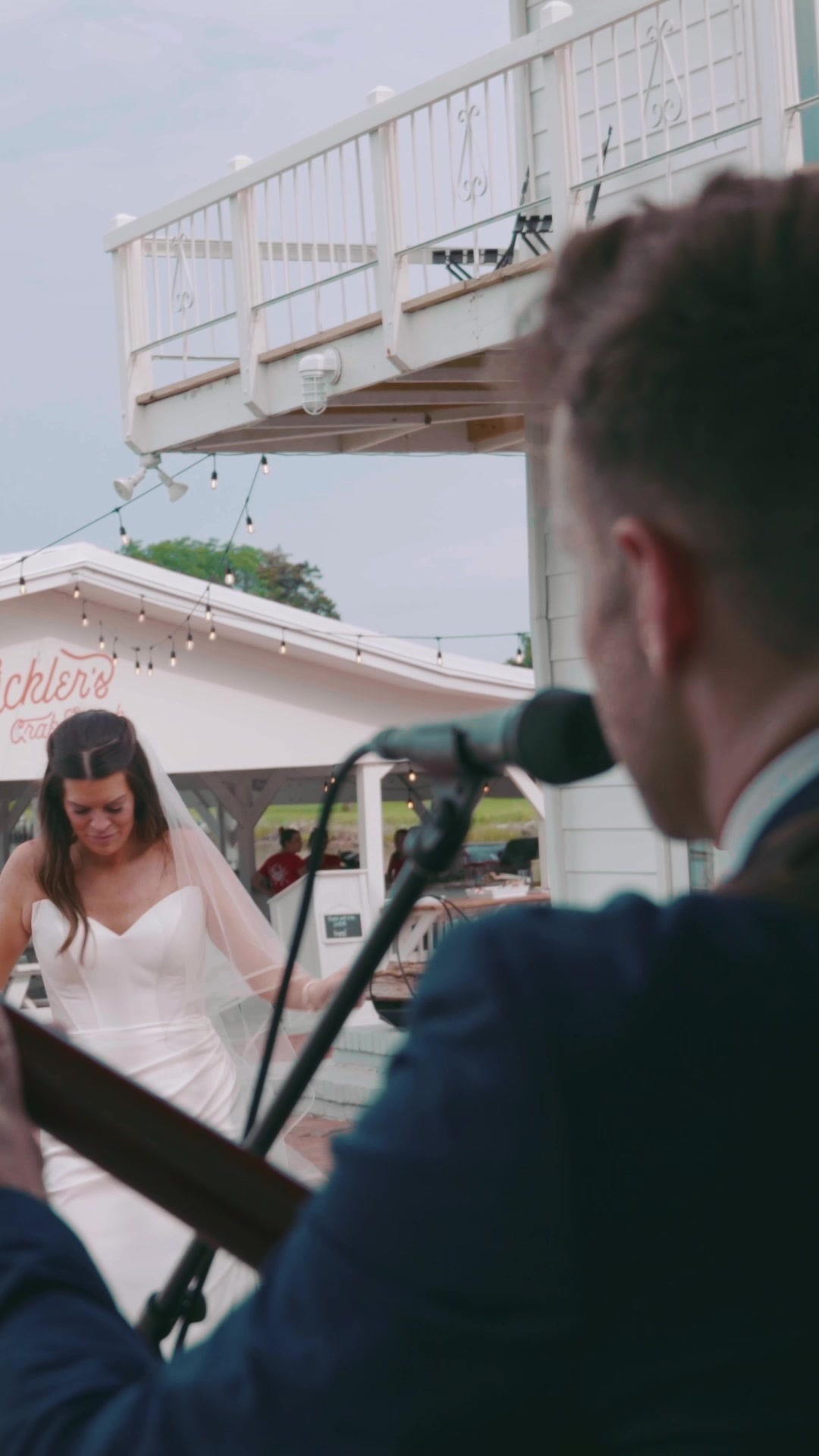
The musical moments in a ceremony are the processional, a possible interlude during the ring exchange or signing, and the recessional. That's roughly 15–20 minutes of active music across a 30-minute ceremony. A solo guitarist or duo can cover all of it while adjusting pacing to what's actually happening on the aisle — which is something no recording can do.
One thing venue coordinators consistently mention: performers who travel with a self-contained, appropriately scaled sound system fit Annapolis venue logistics far better than those who need a full stage backline. It's less about budget and more about the physical reality of waterfront spaces with stone paths, delicate lawns, and strict vendor load-in windows.
Is cocktail hour the highest-return use of live music at an Annapolis wedding?
For most couples planning a waterfront wedding here, yes.
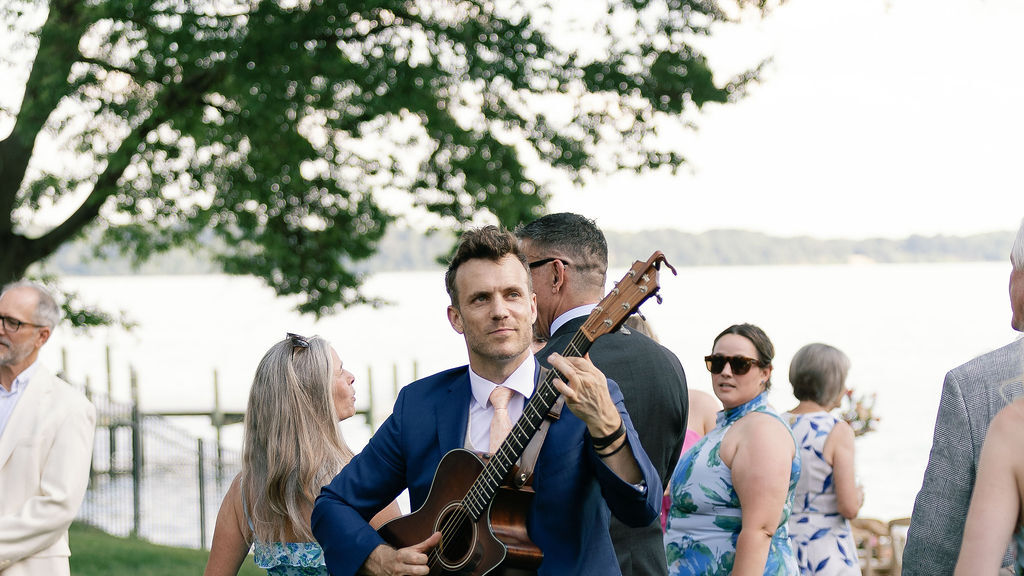
Cocktail hour is the transition from ceremony to reception — a 60-minute window when guests are moving, mingling, and decompressing before dinner. Live acoustic music during this window creates atmosphere without competing with conversation. It signals that this is not a standard ballroom event.
Unlike the ceremony, cocktail hour doesn't require the performer to hit precise musical cues. There's no wrong moment to change keys or segue into something different. This flexibility gives a skilled live musician room to do their best work: reading the room, adjusting to the vibe, responding to what's actually happening. That responsiveness is what separates live performance from a playlist.
Should the reception entertainment be live, DJ, or both?
This depends on the venue, the guest count, and how you want the evening to feel.
A solo acoustic performer — even a strong one — has natural limits on the energy they can sustain for a 100+ person dancing reception. Some performers use live looping technology to layer sounds and build fuller arrangements, which extends what a solo act can do considerably. But for receptions where guests are expected to dance for three or more hours, a DJ typically has more consistent control over the energy arc.
A hybrid approach works well at many Annapolis venues: live music for the ceremony and cocktail hour, DJ for dinner and dancing. This gives you the acoustic intimacy of live performance during the relational parts of the evening and the DJ's programming flexibility during the party. Similar hybrid structures work well in Northern Virginia wedding entertainment for the same reasons — the venue conditions and guest expectations rhyme across the DC metro region.
What are the real sound challenges at Chesapeake Bay waterfront venues?
These are worth understanding before signing any entertainment contract, because they affect what performers and setups will actually work.
Wind off the water. Annapolis sits at the confluence of the Severn River and the Chesapeake Bay. The prevailing breeze shifts in the late afternoon — often right around ceremony time, typically picking up around 5:00–5:30 PM and sometimes bringing a salt marsh smell with it. Sound is directional; wind blowing toward the water carries a performer's voice or instrument away from guests standing a few rows back.
A musician who knows how to position themselves and their speakers relative to the prevailing wind direction will sound completely different from one who doesn't.
Sound over open water. Water doesn't help sound project — it scatters it. At ceremonies where the Chesapeake or South River sits directly behind or beside the guests, the acoustic environment is meaningfully different from a ballroom or a garden enclosed by hedges. A performer with only indoor and traditional lawn venue experience may not immediately recognize or know how to compensate for this.
Outdoor curfews. Anne Arundel County and many venues in the surrounding area have noise ordinances or contractual curfews for outdoor amplified music — commonly 10:00 PM or 11:00 PM. This doesn't change what entertainment you choose, but it does affect how you structure the evening timeline. Confirm the outdoor music cutoff with your venue coordinator before booking a performer with a specific end time in mind.
Seasonal conditions. Annapolis weddings peak in May, September, and October. May can bring quick-moving afternoon thunderstorms; September brings the best weather alongside hurricane-season humidity; October offers comfortable temperatures but earlier sunsets that affect outdoor timing. Performers with genuine Chesapeake Bay experience know which venues have covered backup positions and which ones do not.
Venue-specific notes for live music in Annapolis
Historic London Town and Gardens
On the South River in Edgewater (roughly 10 minutes from downtown Annapolis), London Town offers a waterfront pavilion and multiple ceremony lawns. The pavilion provides shelter and better sound reflection than the fully open lawns. Ceremonies on the waterfront lawn are visually stunning and acoustically challenging — directional speaker arrays and deliberate setup relative to the prevailing breeze matter here. The venue has strict vendor parking and load-in protocols; confirm these early.
Annapolis Waterfront Hotel
Located on City Dock, the Annapolis Waterfront Hotel offers the Chesapeake Ballroom (indoor, for larger counts), the Harborview Room, and an outdoor harbor patio. The outdoor patio setting gets ambient harbor noise — boats, the occasional foghorn, marina sounds. A musician who can work with that ambient noise, rather than fight it, performs better here than one who needs a controlled acoustic environment.
Historic Inns of Annapolis
The Governor's Hall and Governor's Garden Terrace are among the most classically beautiful wedding spaces in the city. The courtyard at the Inns has better natural acoustics than fully open waterfront venues — walls on multiple sides help contain and reflect sound. Both string ensembles and solo acoustic performers work well here. The scale of these spaces rewards intimate performance over high-volume amplification.
Watermark / Catherine Marie (yacht weddings)
Watermark's yacht weddings on the Chesapeake are genuinely different from venue-based weddings. Space is limited, guest counts are smaller, and the acoustic environment shifts with the vessel's movement and position. Most yacht weddings in this market are better served by a DJ or a single acoustic performer with a compact, self-contained setup. Full bands or large ensembles present logistical challenges the space wasn't built for.
What separates a musician who can handle these venues from one who can't?
Five things worth specifically asking about before you book:
Waterfront venue experience. General event experience doesn't transfer automatically. Someone with 500 indoor corporate dinner performances hasn't necessarily solved the wind and water sound problems specific to Chesapeake Bay venues. Ask about venues they've worked by name.
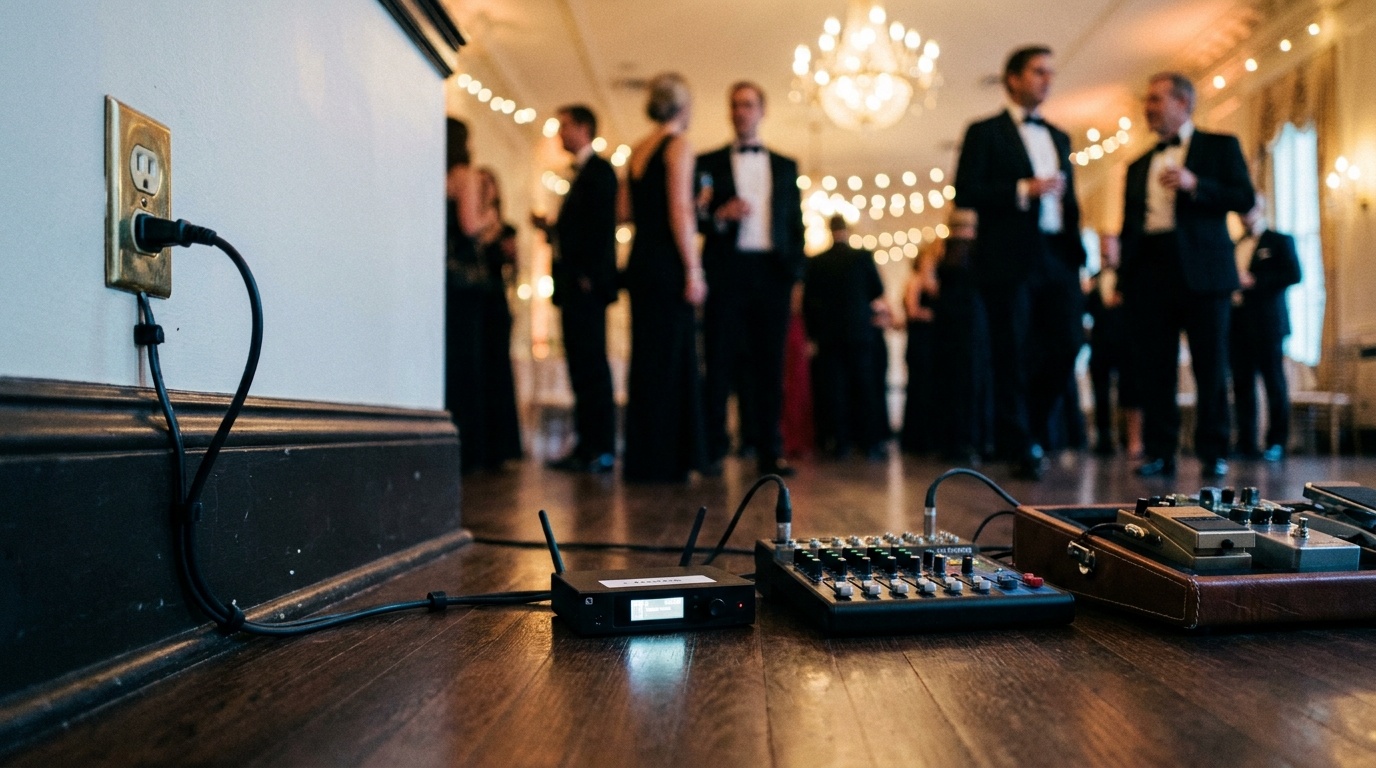
Self-contained sound system. A performer who travels with a complete, self-sufficient sound system — including wireless microphone capability for the officiant if needed — gives you more flexibility and fewer day-of logistics than one who relies on venue-provided equipment.
Ceremony cue handling. Processional music requires live timing judgment. The performer needs to be able to extend or shorten a piece based on what's actually happening on the aisle, not a recording that cuts out at a fixed point. Ask how they handle this specifically.
Experience across multiple segments. A musician who can cover ceremony and cocktail hour (and potentially transition into dinner background) rather than one who only does ceremony work reduces coordination complexity significantly on the wedding day.
How they handle what goes wrong. A performer with real outdoor event experience has a direct answer to this question — they've had power cut mid-set, managed equipment failure at an outdoor venue, played through a brief downpour. Their answer tells you something real about how they operate when conditions are not ideal.
Frequently Asked Questions About Live Music at Annapolis Weddings
How far in advance should I book live music for an Annapolis wedding?
The Annapolis wedding market moves fast. Visit Annapolis notes that top vendors book well ahead of schedule — for peak dates like May and October Saturdays, 12 to 18 months is not unrealistic for experienced performers. Midweek and Sunday dates have more availability, as do November and the January through March off-peak window.
What types of live music work best for outdoor Annapolis ceremonies?
Solo acoustic guitar, vocals and guitar combinations, small acoustic ensembles (guitar and violin, guitar and flute), and classical string quartets all suit the acoustic character of Annapolis waterfront ceremonies well. High-volume amplified acts tend to conflict with both the outdoor environment and venue noise ordinances. The most effective performers in these settings can adapt their volume and feel to the moment rather than delivering a fixed performance at a fixed level.
Is it worth having live music at cocktail hour if the reception will be DJ-only?
Most couples who've done this combination say yes, emphatically. Cocktail hour is when guests are most naturally social and most attentive to ambient music — they're talking, not dancing, and the background texture of the space matters more during this window than at any other point in the evening. The transition from ceremony to live acoustic cocktail hour also bridges the emotional arc of the wedding day more smoothly than moving directly from ceremony to DJ setup.
How does live music for a wedding in Annapolis differ from other DC-area markets?
The primary difference is the predominance of outdoor and waterfront venues. Most DC-area weddings happen in hotel ballrooms, historic mansions, or suburban country clubs — controlled indoor environments where the main acoustic variables are room size and ceiling height. Annapolis adds wind, water, and outdoor noise ordinances to that calculation. Performers with experience specifically at Chesapeake Bay venues carry that environmental knowledge with them; those without it may struggle despite being excellent musicians in other contexts.
What instruments work well for an Annapolis waterfront wedding ceremony?
Acoustic guitar (amplified appropriately for the space) carries well in outdoor settings and adapts to both intimate processionals and more upbeat recessionals. Violin or fiddle pairs naturally with guitar and can project over wind better than many other instruments. String quartets work beautifully in more sheltered settings like the Historic Inns courtyard.
Piano is typically not practical outdoors without a dedicated digital piano setup, though some performers travel with portable solutions. When in doubt, instruments that project naturally with modest amplification outperform those that require significant sound reinforcement in open waterfront settings.
For information on live music for weddings and private events in the broader DMV region, including the considerations that differ by market, see the Dylan Galvin Entertainment wedding music page.
Blog Categories
Latest Blogs