Wedding & Event Entertainment Pricing in 2026: What You're Actually Paying For
Dylan Galvin is a Berklee College of Music graduate, mentored by music legends John Mayer, Paul Simon and Livingston Taylor. Performing across the United States since 2009, now based in the DMV (Washington DC, Maryland, and Virginia), more than 1,500 events, including work for Coca-Cola, Wells Fargo, Lincoln, and CBRE.
Wedding and event entertainment pricing gets asked about constantly, and most of what's online is either outdated or made up. Here's what current industry data actually shows: where the market has been, where it is now, and why the price gap between a hobbyist and a luxury performer is bigger than most people expect.
How wedding spending has moved since 2001
Before getting into entertainment specifically, it helps to see the backdrop. The average U.S. wedding budget has swung significantly over the past 25 years. Recession dips, a pandemic collapse, and a sharp climb since:

The U.S. average wedding budget dropped 24% during the 2008 to 2009 recession, then fell again during the 2020 pandemic, but has climbed back to roughly $34,000 in 2024 to 2025, the highest sustained level on record. (Sources: The Wedding Report, The Knot Real Weddings Study, SenticMoney 2026 wedding cost breakdown)
Entertainment has moved with it. Corporate events show the same pattern from a different angle: planners are increasingly prioritizing entertainment and production in their budgets, often putting more toward this line item than they did in past years. That's the clearest signal yet that entertainment isn't a line item anymore, it's the thing people remember an event by.
What you're actually paying for, by tier
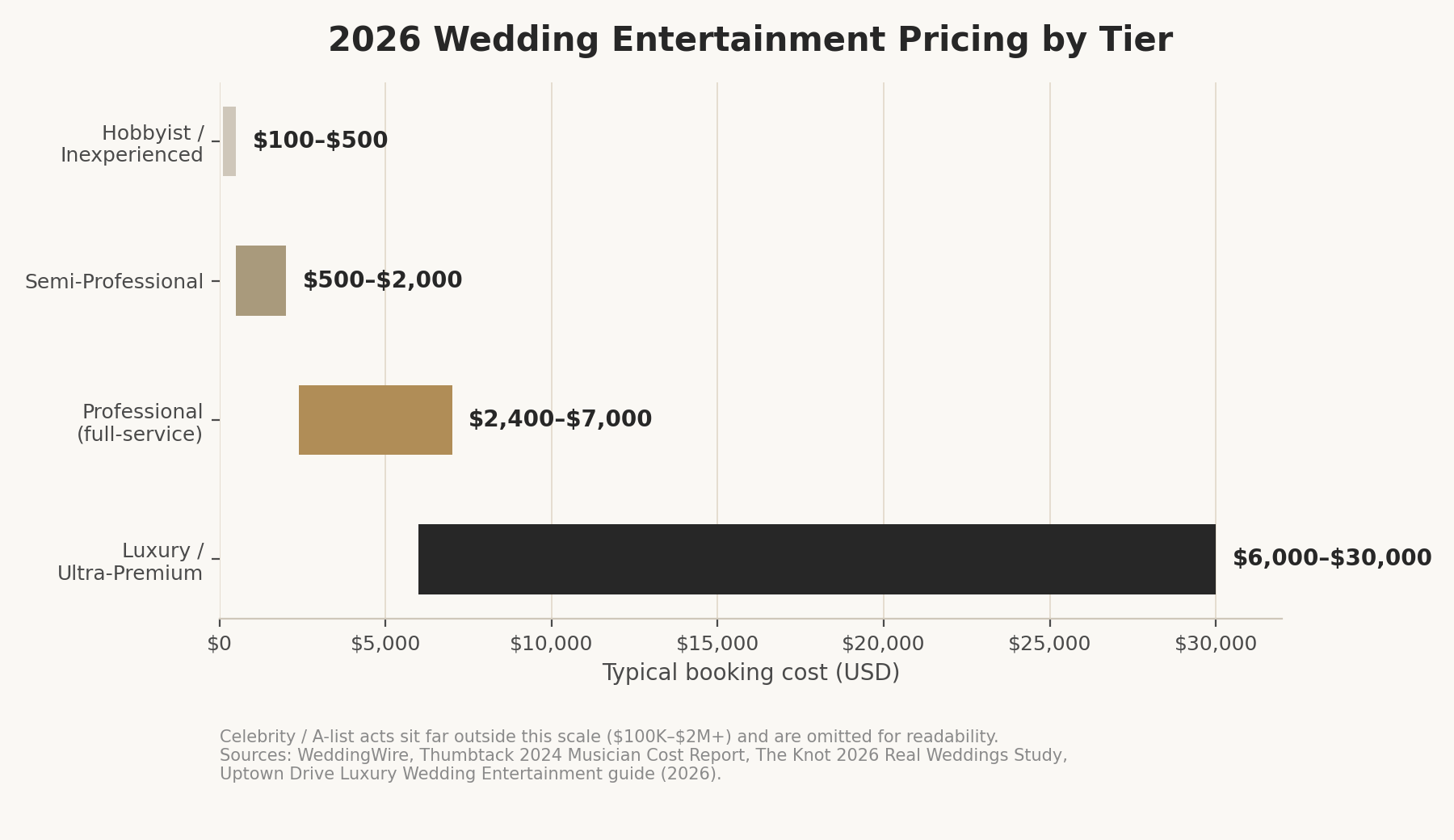
"How much does a wedding musician cost?" doesn't have one answer, because the market isn't one market. Based on current pricing data across WeddingWire, Thumbtack, The Knot, and luxury-market sources, entertainment splits into four real tiers:
Hobbyist / Inexperienced: $100 to $500. Usually a part-time player, minimal or no production equipment, limited or no formal contract. Can be genuinely talented. Can also no-show, show up unrehearsed, or have zero backup plan if something goes wrong, because there's no business behind the booking, just a person with an instrument. (Source: WeddingWire, Thumbtack 2024 Musician Cost Report)
Semi-Professional: $500 to $2,000. More experience, a real sound setup, sometimes a contract. This is where most "budget" ceremony and cocktail-hour bookings land: cocktail-hour solo sets typically run $150 to $300 per hour. Reliability is inconsistent because it's still often a side income, not the performer's full-time business. (Source: WeddingWire, Thumbtack)
Professional (full-service): $2,500 to $6,000. A full-time performer running an actual business: contract, insurance, backup equipment, a defined repertoire, and critically, an incentive structure where your event is their reputation. The Knot's 2026 Real Weddings Study puts the national average live wedding band at $4,500. A professional solo entertainer offering the same production value (sound system, wireless mics, full-day coverage, DJ transition) sits in the same range. (Source: The Knot)
For how that same national number breaks down specifically by band, DJ, and solo format across the DMV's sub-markets, the DMV wedding music cost breakdown walks through the actual regional ranges and the three hours most quotes leave out.
Luxury / Ultra-Premium: $6,000 to $30,000+. Full-scale production, top-tier musicianship, often a larger ensemble or extended coverage across every phase of the event. Luxury-market data from destination and high-end wedding markets consistently lands here for a full live band booking. (Celebrity/A-list acts are a separate category entirely, six and seven figures, and sit outside this comparison.) (Source: luxury wedding entertainment market data, 2026)
Why the price gap is really a risk gap
The difference between $500 and $5,000 isn't really about talent. Plenty of $500 performers can play beautifully. The difference is what happens when something goes wrong, because on a wedding day, something always tests the plan a little.
A professional-tier or luxury performer brings a contract that guarantees they show up. Backup gear if something fails. The experience to read a room and adjust in real time instead of freezing. Direct coordination with your planner, photographer, and caterer so the day's timeline actually holds together. None of that shows up in a price comparison. It only shows up on the day, when it's the difference between a hiccup nobody notices and a visible gap in the event.
That's what the extra price tag buys: not a better song, but the elimination of the version of the day where something breaks and there's no one experienced enough in the room to fix it quietly.
What to actually ask before booking
- What genres do you play, and can I see a real set list?
- Can you learn new songs for our event?
- Do you bring your own sound system and lighting?
- What's your overtime rate if we run long?
- Do you have video or audio from real events, not just a studio reel?
- How do you handle breaks during a multi-hour booking?
- What's included versus billed separately (travel, extra hours, equipment)?
Feeding your entertainer, and the truth about tipping
Feed them. A performer working a 6 to 8 hour event without a meal plan is running on empty by the reception's final hour. Most professionals build a meal break into their contract for exactly this reason.
Tipping is where a lot of couples overthink it. At the professional and luxury tiers, the fee already reflects the full value of the booking, the same reason you wouldn't tip a photographer or a wedding planner. A tip isn't expected at this level and won't be assumed if it doesn't happen. It's more common, and more meaningful, as a bonus on top of a lower-tier or budget performer's modest rate. Either way, a detailed online review at the end of the night does more for a professional's business than a tip ever could. It's the easiest way to signal you were genuinely happy, and it directly helps other couples and planners find someone they can trust.
More on Dylan Galvin's wedding music services: dylangalvin.com/wedding-music
Sources cited in this piece:
- The Wedding Report: historical U.S. wedding cost data
- The Knot Worldwide, 2026 Real Weddings Study (10,474 U.S. couples married in 2025)
- SenticMoney, "How Much Does a Wedding Cost in 2026?"
- WeddingWire, Wedding Ceremony Music Cost Guide
- Thumbtack, 2024 Average Solo Musician Cost report
- Uptown Drive, Luxury Wedding Entertainment Austin guide (2026)
Blog Categories
Latest Blogs